
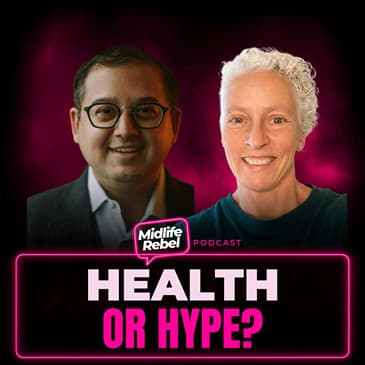
There's no shortage of advice about how to look younger, feel better and live longer. From hormone therapies and aesthetic treatments to peptides, weight-loss medications and the latest longevity trends, the options seem to be growing by the day.
But how do we separate the science from the marketing, and make informed decisions about our health as we age?
In this episode, I'm joined by Dr Furhan Qureshi, an Internal Medicine Physician working at the intersection of hormone health, metabolic wellbeing, longevity and aesthetic medicine.
We explore the growing interest in health optimisation and the relationship between how we look, how we feel and how we function, particularly as we move through midlife.
Our conversation touches on the motivations behind aesthetic treatments, including confidence, identity and relationships, alongside discussions about testosterone therapy, libido, metabolic health and the changing expectations around ageing.
We also explore the influence of social media on health information, the growing popularity of treatments such as peptides and GLP-1 medications, and the importance of understanding the quality of scientific evidence before embracing the latest health trend.
Dr Qureshi shares his perspective on the commercialisation of longevity medicine, the limitations of some emerging research and the challenges of maintaining healthy habits in a world that often makes them difficult to sustain.
Ultimately, this conversation raises some important questions about the choices we make when it comes to our health, the information we trust and what it really means to age well.
Because there's a little bit of rebel in all of us.
Visit our website to find out more about this week's guest.
All of our guests, including this one, are included in our Guest Directory so that you can find out more about them and the work that they do.
https://midliferebelpodcast.com/guest-directory
If you'd like to support the show you can buy me a coffee!
Longevity Hype And Snake Oil
SPEAKER_03On the on the opposite end, you know, longevity medicine, there's a lot of um marketing involved in it. There's a rise of a lot of these, you know, uh unscrupulous kind of telemarketers who are trying to sell dreams versus what's really possible. Um, there's a lot of kind of snake oil out there as well. So I kind of find myself on the one hand advocating for the field in the ethical medical way, but then on the other hand, I I have to kind of protect the consumer from some of the stuff that's not true.
Midlife, Menopause And Optimisation
SPEAKER_00Well, thank you for joining me today. I'm really looking forward to this conversation. There look, I've had lots of guests who talk about all of the things that happen to women in midlife. I've had um professionals like myself who are doctors, probably more women doctors. So it's kind of going to be interesting to hear your perspective on this whole perimenopause-menopause situation. Um but yeah, uh look, there's there are a lot of things that that are happening in midlife when it comes to our health, um, the way that we look, the way that we feel about ourselves. And I feel that you've like you're the person to talk to about the intersection of all of these things that are happening, whether they're connected, whether they're not. Um, I read that you are you you're passionate about helping people, women and men, I believe, understand the connection between vitality, identity, confidence, and aging, all things that are kind of paramount at this time of life. So welcome. I'm really looking forward to hearing all about what you have to say on these topics.
SPEAKER_03Awesome. Thank you for having me, Sam. I'm pleased to be with you.
SPEAKER_00Have you got a particular? So I've mentioned a couple of things. I've mentioned the perimenopause-menopause situation that we uh find ourselves in as women. Um and I'm really uh I really love uh longevity. How do you say that? Like uh I don't know what that like what does that mean? I love longevity. I have longevity practices, which hopefully will support me as I get older. Um so I'm really interested in that um area and would love to hear your thoughts on that. And also like you're you work in aesthetic medicine as well, don't you? So, like how does that fit into all of that? All of it. Where would you like to start?
Why Appearance Became Performance
SPEAKER_03Yeah, so so that's a great question. So I guess how do they all tie into each other? They tie into each other because there's a desire for optimization. That they're all the common theme among all these different areas of uh longevity and aesthetics is optimization. I don't think people anymore with this much science and this much uh technology are willing to just you know retire out in the pasture. Uh, not at all. Um we're in a world now where people are pushing the boundaries of what we can do, but we we we can traditionally do. Um and and the world needs it. You know, um a lot of employers here in the US, they they want this unicorn, they want a unicorn of an employee that you know has the wisdom and experience of an older person, but the youth vigor and vitality and appearance of a younger person. Really? They don't want the young guy with oh yeah. If you look, it's like a joke that we have. I'm I I'm in I live in the DC area, so a lot of my my friends, you know, a lot of our our government contractors, so they always joke, uh, they always joke about this uh this unicorn uh that that all these employers are looking for. They write down things like, we want 10 plus years experience, 15 years experience, we want these certifications. And you know, these are all qualifications, someone who's been in a job for a long time, but then when they go for the interview, they notice if they appear overweighted, you know, they appear, you know, fatigued or are don't are not visually appealing, but tend not to get the job. Wow. Uh so who gets the job? This this this perfect candidate who you know has this experience and wisdom that's on the resume, but then they they just look good. I mean, they're fit, they've had both talks done, they look relaxed, they're visually appealing because guess what? A lot of these jobs involve sales, they'll involve customer service and sales. So what companies, of course, the companies won't openly say that, but uh you know, there's a lot of data out there that shows um when it comes to pay raises and getting a job, it's kind of the same thing that kind of goes with what they're getting for a file. In fact, if you look at online dating, what what is LinkedIn? LinkedIn is basically online dating. You know, you're applying for jobs online, and even you know, and of course LinkedIn will tell you about how important the resume is, but I I think that's only part of the story when it comes to job, job optimization and and uh business. Um we are in the we are in the social media era. Your picture is the most valuable part of what you do, your appearance. Um if you ever, I don't know if you ever did online dating, but if you ever did things like, you know, all these different online dating websites, they're all gonna tell you that, yeah, it's important that you put down funny things about yourself, but your picture is the most important. It's 70% of everything. So um we've been through the a world where there's where we have a hyper, hyper competitive economy. And um if you want a job, you have to not only be the best in terms of your qualification, but you also have to be the best in your appearance and in your demeanor. On the flip side, the opposite is also true. Uh, you have to be careful because now that you're experienced and you're a senior of some of some company, you don't want some young kids to poetry. You don't want some young, handsome, you know, pretty girl or you know, handsome young guy to come in poetry dumb. So now, you know, they're both kind of wanting the same thing. So both both all kinds of people, men and women including, are wanting phosphoster and why they have their own reasons.
Testosterone For Vitality And Confidence
SPEAKER_03Now, men traditionally wanted it because uh they wanted to be strong and big and strong. That's why they, you know, most younger guys want it for that reason. But all their men and women now are wanting it because yeah, it is like a there's a lot of truth to it being like a like a youth serum now. Um, I prescribe it in women as well. I used to do palate injections of women, smaller doses of men, of course. Is that testosterone that you're talking about? Right. Right. Yeah. So for both men and women, they get higher sex drives, improved, improved sexual performance, libido, uh, they get they do tend to get more energy. Um they they yeah, just like women are obsessed with the gym now. In the US, there's data out there that more than 50% of the free weight section of the gym are women now in the US. Which is funny because in Allegheet, when I was in high school, it was just a bunch of jocks and crazy ripped guys, and women were not there. It's reverse on. But women are the ones who are really into um, you know, squats and deadlifts and power lifting. And um, I think Michelle Obama made it popular, so no, but girls want to be uh tone and rip too. So um we everybody wants optimization. They want to be optimized from an aesthetic and a functional uh perspective. The idea of longevity medicine, in my opinion, it's it's not about living longer. You know, I guess that's a joke, right? Hey, like I had you know, somebody probably like, aren't you a doctor? Isn't it a job to make everybody live longer? And I'm like, you know, that's a I guess technically that is true. We try not to let them die. So that's just in routine medicine. But longevity, I think, has has a different meaning. From my understanding of what longevity seems to be, seems to be becoming, it's about optimization. It's about people who don't just want to live longer, but they want to run faster, they want to jump higher, uh, they want to lift more, they want to push the boundary beyond what we're supposed to do. And you know, I I give examples of Sylvester Stallone, you know, he's almost 80, he's still benching over 300 pounds, he can still beat us up in a fight. Tom Fruit is almost 70, he's still jumping out of airplanes and doing action movies. So, you know, um people people want want their their um they want their health and they want their vitality and they want the freedom to live life the way the the boys want to live live it.
SPEAKER_00Wow. And and so uh would you say that your role is to that you your role is to show them what is possible and to support them through that? Or are you here to sort of say, yeah, this is what you want, but we do have some limitations. What what what's your perspective on it?
Peptides, Influencers And Sales Tactics
SPEAKER_03You know, I I I feel like I'm kind of in between both worlds. Okay. Um the traditional the traditional doctor doesn't accept any of this unless you show a medical journal and some recommendation from a society, they don't even believe it's real. So they're not really into it. Um on the opposite end, you know, longevity medicine, there's a lot of um marketing involved in it. There's a rise of a lot of these, you know, uh unscrupulous kind of telemarketers who are trying to sell dreams versus what's really possible. Um, there's a lot of pet kind of snake oil out there as well. So I kind of find myself on the one hand advocating for the field in an ethical medical way, but then on the other hand, I I have to kind of protect the consumer from, you know, like for example, we have this huge phrase with with peptides.
SPEAKER_00And um, I was gonna ask you about that.
SPEAKER_03You know, everybody, everybody thinks that every peptide works. And there's a lot of a lot of people out there, especially on social media, they're preying on the insecurities of the prospective clients. You see, to me, they're patients, but to them, they're sales targets, they're clients.
SPEAKER_04Yeah.
SPEAKER_03And um what a lot of people don't realize is when they're watching these YouTube videos and these social media videos, promoting how these peptides change their life. Number one, you have no guarantee that they actually use the peptides that they're claiming. What if they all just use testosterone? That's how they you know got their body. That's number one. And and number and number two, what a lot of people don't realize is those guys are basically salespeople. They have an inappropriate relationship with those uh uh compound pharmacies. And when they're giving their education or their opinion on these subjects, they're getting commissioned. So when they give you the discount code, okay, you're getting you know 10% off from coach, you know, Jeff's uh paid. But actually, the discount code isn't really a discount, it's just the price they wanted to tag all together. That discount code is actually tracking software. That's actually a that's actually a tracker on the part of the pharmacy to see how good is this coach at selling our product. Um, should we keep working with him? Should we keep paying him? Should we renegotiate? So, you know, there's a lot of consumerism that has that has interceded uh in this in this world. And the consumers have to be protected. And unfortunately, I think a lot of doctors, they're not engaging in this. They're just they think it's all fake and they won't engage, uh, which which I think is wrong. I think there's tremendous consumer interest globally in first up. So we ought to research it, we ought to learn about it, research it, and we ought to, you know, speak up about it and and and try to help guide people in the right way.
SPEAKER_00Wow. Several things came up for me then. I was it when you were as you were talking, I was just thinking, you know, when you were talking
Evidence, Biostatistics And DIY Research
SPEAKER_00about people that are influencers on um social media and the availability of, you know, uh, what did you say, longevity medicine peptides um as that one example. There's also so much information available to us now, isn't there? Like we can we can make decisions for ourselves and our health by researching it ourselves because there is so much information. So it's a very fine line, isn't it, between you know what's ethical, what's safe, do we need the doctor? No offense. I'm just these are all just things that are coming up and free and also free will because we are, you know, we're if you're a smart human being and you've done your research and you want to try something. You're allowed to try it, but it's like, are you being coerced into something, you know? There's so many things up in the air, so many questions.
SPEAKER_03So you're you're you're I'm I'm glad you said what you said, but this is exactly what the thoughts of the average consumer is. They have tremendous information with the rise of AI, it has made people uh better guessers. And you know, when it comes to research, this is this is a tough area because a lot of these different um different salespeople, the research they're pointing at is mostly in animal studies, which is not the same as the human, or the few human studies they're pointing at, they're all underpowered. There's a lot of concepts of biostatistics that the average consumer doesn't know about. They don't know about concepts in biostatistics, including power. Like you'll hear sometimes physicians will dismiss a drug, oh, that study is no good. It was underpowered. Like, what does that even mean? Um, there's a lot of principles that the consumer doesn't know. Um this is not a new problem. This has been going on for decades, actually. When I was finishing medical school back in 2012, just a year before, the um the the American um the AMA, the American Medical Special, they completely revamped our board exam. And one of the biggest changes they made was they placed a much higher emphasis on biostatistics. Why? Well, because in the 90s, uh the US drug, I don't know if Australia does the same thing, but in the US, the uh drug, the big pharma was allowed to market directly to the consumer their drugs. Okay. So it it it the old school used to be you have a complaint, you have a concern, you go to your doctor, and he prescribed the solution that he thinks worked, the rule it flipped the 90s and it continued. Hey doc, I was having vaccine, but I saw this drug on the while watching football and I saw this drug. Do you think I can benefit from that drug? And the doctor was like, oh, I've never heard of that. So then they would go on the website and you know, the drug, they showed us these statistics about how great the drug is, but you know, those doctors may or may not know much about biosidistic. So the American Medical Association, you know, cracked down, you know, the whole medical education system, they decided, you know what, we're gonna teach these kids as much as we can about biosphysics. This is this is gonna be an issue. Because whenever these doctors are either seeing their patients or they're in their personal life, they're meeting, you know, uh people from all walks of life and asking a question, they're gonna be asked, hey, is this a drug or test I saw on TV, is this right for me? And you better know how to answer that question. You better know uh how to read those studies, understand what they mean, understand what a trial is, what the different trial types are, what the biases are. You better understand that because whether it's your patient or it's your or your buddy, Steve at the gym, you better be prepared to have a nuanced conversation with them. And this was you know, back in my day, this is like what, 15 years ago. It's more important than ever now to for the physician, especially young physician, to learn this stuff because now with the right of social media, there's no regulation whatsoever. Um, a lot of these, you know, health coaches are hiding behind um, you know, free speech laws. A lot of them are putting on the disclaimers on their YouTube content. This is just my opinion, or this is just entertainment. Or, you know, uh this is not I'm not a physician, it doesn't cost me a medical visit. They're putting these two disclaimers in their coaching programs because they want it both ways. They want to sell you something to sell you a dream. They don't they don't want to be responsible if it doesn't work. And if you get injured, they don't want that responsibility there, but they want all the profit in between. So they're kind of preying on people's insecurities when they're promoting these things. Um, I'm not gonna make a declare for a statement that all the peptides are bad or they're all work. I'm not gonna make those things like those guys do. Um, the data is kind of we we don't have a lot of good data on it. Um and and I'm not gonna you know go off of you know how BPC1% didn't dog. We're not dogs. Um we're not cats. We we're not we're not those things. Um I think there needs to be more research in those fields before we reach those conclusions, but you know uh on the whole, we have a decentralized system now where anybody can read whatever supports their their beliefs. Chat GPT is famous for doing that. I've seen plenty of parody videos where where where they've got where they they joke, you know, hey, I want to I want to steal these cookies, should I do it? And ChatGPT V agrees, yeah. You should steal the cookie. It's not stealing, it's tasting. And you have a right to taste, you know, to make jokes about the AI, you know, manipulating you with them.
SPEAKER_04Yeah, yeah.
SPEAKER_03Correct. It manipulates you into thinking whatever your belief was. You're right. And uh, you know, it helps with these guys' sales. So, you know, that that's what the public ought to know. Um, one of the problems, one of the complaints that I have recently in the US medical system is um we're too slow to innovate. I think the FDA's the regulation are way too burdensome. Um they hyper focus on safety, which is totally good, but then by hyper-focusing on that, they have slowed down the amount of new new drugs that could come out and help people. So, you know, I I I think from that standpoint, um that that has led to this kind of vacuum of okay, there's a lack of innovation. I'm suffering from back pain. What are my choices? Oh, I saw on the internet this guy you know in New Zealand injected himself with this captime, and now he's who's bigger and stronger, and he's getting older girls. I want to be like him. And you know, there's no you know, international association of health virtuals. These are basically people who are masquerading between a position that they're not and an expert that they're not either. What they're really good at are sales and marketing, they're superior at it, way better than than I ever will be. And um, the public ought to, you know, be aware, you know, not they're not all bad, I don't want to pay it in a broad brush. There are some who really stay in their lane and advocate healthy eating habits that are currently validated at the nurses, and especially in certain parts of the peptide world that are promoting things that are not embedded and could potentially be dangerous.
SPEAKER_00So I guess when we're talking about drugs, when you talk about um I'm looking at my notes, longevity medicine compared to some conventional drugs that might be used um when someone's sick. Like, would you say that longevity medicine would be uh um more along the sides of optimization,
Prevention Thinking And Creatine Basics
SPEAKER_00like not uh so potentially prevention or improvement of your health rather than waiting until you're sick and then being prescribed a medication to try and make you better?
SPEAKER_03That's a good question. Yeah, it's it's a great question. It it it it kind of is in more is more in that direction. Now that's not to say that you know uh doctors won't recommend vitamin D because we're not outside. Yeah, certain things don't recommend. Um, but yeah, I I think the longevity, you do tend to take, you do tend to uh, I guess, take more risks, not in a negative way, but you're more likely to prescribe, you know, or to recommend things that are outside of the normal. Example creatine, we're all big into creatinine. Uh uh uh creatine, excuse me. Yep, creatine, we we have found significant improvement in cognitive studies as well as muscle building, and we're all about it. Conventional doctors don't talk about it that much. That's not really their thing. They're more into disease management. Um, who is better for prevention? That's a good question. They both ought to be good with prevention, but longevity, not an optimization. It's it's a more niche field. Um the studies are are evolving uh in it, but um they are more likely to try more novel approaches to optimize the body versus a conventional doctor. Conventional doctor, you're you're right. Most people say, running those, I see my reusable doctor. If I'm preparing from a marathon, I just see one of these, you know, functional medicine doctrine documents. They're most likely to recommend that it's more potentially cut cutting edge than the other doctor, you know?
SPEAKER_00Yeah, and it's like maintaining um maintaining health uh rather than uh rather than waiting until you get sick, I guess. More awareness around um healthy uh practices. Which I guess we're you know, uh a lot of people that I talk to um in this regard, it they they all pretty much say the same thing. You need to have the lifestyle stuff uh dialed in really for any kind of really good benefits of longevity medicine, or let's, you know, I'm even thinking in terms of uh supplementation of different um different things. Like if you're if you're uh um unbalanced uh in your lifestyle, you know, if you're stressed, if you're not sleeping enough, if you're eating badly, cleaning up all of those things will do a lot of uh the work for us. And then that other stuff is the optimization that is but uh that's often the part that people miss.
SPEAKER_03So this is this is a a subject I speak out speak out about a lot, especially in the US. Um I don't
Overwork, Cars And Metabolic Decline
SPEAKER_03know. Have you have you traveled in the US before or no?
SPEAKER_00Well, yeah, a long time ago. A long time ago.
SPEAKER_03Where'd you where'd you go?
SPEAKER_00I went to LA and San Francisco I've been to, yeah.
SPEAKER_03Okay. Well, LA in particular. What did you think of the of the culture, the way the way it worked?
SPEAKER_00Well, if it was it was in the early 2000s, so I don't know if it's changed very much. Um, and we were only there for a few days. I don't know. We were quite near Hollywood. So you probably had a good time. Yeah, we were having a good time. So you probably get different perspectives depending on what uh uh location you're in. Are you trying to sort of I mean in supermarkets there were um uh mobility scooters, which was a big eye opener for us. It's like wow, that that's you know different. We don't get that here. So that obviously indicates that there's some health problems. I um that's only one thing though.
SPEAKER_03Yeah, yeah, yeah. When it comes to lifestyle, I think Americans have one of the worst lifestyles in in the world. Um I I make a joke that I think North Korea does more for citizens lifestyle-wise than even we do, and people are like shocked when I say that. Because you know, if you watch the documentaries, they actually have state the state makes them do stretches and okay, you know, certain things. I'm like them. I mean, of course, uh, so there's some bad things about that, but there's some good things about it. But you know, that even they think in America, the the the thinking is work hard. I mean, we we're working to a point of pathology, we're working to a point of harm. You know, if you rev your engine too hard, the engine breaks, right? When you're driving your car, you rev the engine too hard. We we have a lot of problems in our country. Um it began a long time ago. I kind of think our hyperproductivity culture kind of started with the automobile. Um, that's true. I want to go further back. You know, back in the 1500s, you know, there was farming and you know, they were using uh, you know, slavery to to to um you know improve their output and and reduce their costs. And then the cotton gin happened in the 1800s. With less people, they were able to maximize their work in the cotton field and make more money. Um, then the industrial revolution happened, you have the rise of industrialization, and now we can generate even more output and make more profit. You know, that's the nature of America. America has always been this kind of um work hard, you know, go-getter kind of country. There were never, I don't think lifestyle was really a focus uh in America. It was always like more, more, more, more, more. Uh work hard because so you can buy nice things. You deserve the best. And don't. These were kind of this is kind of the culture here. And um what ended up happening is uh I think we're a victim of our own success. I think what has happened now is in our pursuit of hyperproductivity, we are now violating basic laws of biology that it took thousands of years for our bodies to develop. We have we have tremendous amounts of obesity. And um the medical community doesn't have a real answer for it. Their answer is oh, sedentary lifestyle, work hard more, improve your diet, and everything will be okay. But you know, that's kind of a cop-out answer. Like, how do you specifically do it? Like, you know, if that's the easy answer, why why has this problem worsened with all of our science and our brains? It's been worsening every year. What in three Americans now is obese? I didn't say I didn't say chubby, I said obese. They're actually clinically obese. Um, it's starting to happen in different parts of the world. I think in India, certain of the wealthier cities, uh, they're having this problem. Uh they're having a rise now in certain places like Mumbai with the people trying to get killed and gain a lot of weight. Uh when Novo Nordist invented Rogovi, you know, Vogovi made obviously a lot of money in the US, but they made tremendous sales in the Gulf area. You know, even the Arabs, especially in the Gulf for Islam, especially in Saudi Arabia, they have a huge obesity crisis. Uh it's it's it's causing significant strain on their health system, and it, you know, this has happened. So what a lot of these places have obviously have in common is actually the car. Um we've had several studies that have shown over the years. For example, we had a study in Atlanta, we had an Atlanta study, we had we had the um the Houston study. What we learned was it's it's an observational trial, but the more someone drives a car, the longer they're in the physically in the car, either driving it or what have you, the more interest they have on their waist. On the flip side, there was a study in Japan. Um I can't remember which city it was. I don't think it was Tokyo, I think it was outside Tokyo, but they did their study. What happens if you make someone have a longer commute, but it's more public transit, it's mass transit-based versus a car. And the opposite happened. The more uh, you know, you had to travel through mass transit like longer the day, the more weight you lost, the the more you're you're shredded. And um, in my travels over of abroad, you know, whether it was Europe or or East Asia, especially Singapore and Japanese places, I kind of got it. You know, the the average the average steps you're walking are way more. The degree, the nature of your walking is more. Um you're going up and down hills. You are forced to do more walking. Um you're when you when you're taking a bus or a train, you're not setting, you're not sitting for very long. You're constantly getting up and switching. The activity that you got there, it was more consistent throughout the day. Whereas in the US, what happens is you're you're sitting all day. You're spending one to two hours in traffic in the car overall, so you've lost a good portion of your day. Then these guys in the US, they work a lot. They work crazy hours. They're working, the average worker is working his main his or her main job anywhere from eight to twelve hours, just on average. But then they're not done. They used to be done. In the 80s and 90s, they were done, they're not done anymore. And this uh we have a gig economy, gig. So gig is, you know, it's a cute way of saying extra job. So now what's happened with the average American workers after he or she's done with their main job, spending eight to twelve hours there, they then do either another part-time job in person, or they're doing something online, or they're Uber driving, or they're Uber delivering. They're doing more work, but again, it's kind of sedentary nature. You know, they're not, you know, raking leaves or carrying a bale of hay at the farm. They're not doing those jobs, and that's fine. Uh, but they're not doing anything physical. Um, so they're working again and making more money because that's what a machine culture is. It's this excess consumerism. And then you would imagine that they're done. They're not done. They might may or may not have dinner with a family, and then when they are eating, they're on the phone, either reading something about their business or planning the next business, they're not even communicating at the dinner table, and then right before they sleep, they're doing something online. Either they're working on their blog or their blog or their content or something, some kind of online venture, and then they're sleeping, kind of, with the phone in their hand, they're sleeping with the phone over, and they're just they're passing out, and they're getting more and more obese as a result of this treacherous lifestyle. Now, the American solution is oh, yeah, do CrossFit, do a very aggressive high-intensity workout. Injuries go up, they get injured, they get discouraged, and they stop working. Like, I'm not gonna do it. Or they don't do CrossFit, they don't do something too high intensity, but they do they do some kind of excess. Maybe they do tread leveling for 45 minutes, or they do weightlifting for 45 minutes. But then the outcomes, I mean, you know, they have some health benefits, but guess what? Their belly is still still out there. Because studies have shown, you know, you can't be sedentary and completely sedentary the whole day, and then catch up on those steps in one hour. Your risk of injury goes up and the outcomes aren't better. You have to somehow get it throughout the day. Sadly, my conclusion about the US, and this is you know, this is specific towards the geography. My conclusion for the US is we are kind of in a hopeless uh cycle. Unless you have a strategic, unless you you have a structural change in your society, you're going to have more obesity. Now, the GLP ones have come about, thank God. The GLP ones have have that it's a man-made solution to a man-made problem, but it's not the ultimate solution. Your statement was correct all along, you have to make lifestyle changes, but the problem is who who makes them. In America, the belief is if it's if you're fat, it's your fault. We make it a moral issue, make it an individual issue. And I push back on that. You know, a lot of Americans always, you know, we always attack ourselves, like, oh, Americans are fat because they're lazy. And I push back on it. Like, how can you say America is not a lot of people?
SPEAKER_04Quite the opposite.
SPEAKER_03Yeah. You we have the one of the highest GDPs in the world. They work the most number of jobs and hours, they take the least vacation time. You can't have it both ways. You cannot say that we're lazy and that's how we're fat, but then we make this much money and have this many hours with such little vacation time. You can't have it both ways. So my concern is there's this um tremendous this over-consumerism. Um it it's it's it's insane. And the level of marketing, it's it's gone beyond the TV screen. You see, back
GLP-1s, Wegovy And Moral Blame
SPEAKER_03in the day in the 80s, 90s, before, you know, the TV was where it's like if I turn off the TV, it's it's done. I can, I can, I can walk, I can sleep. Now it's on your phone, it's on these these things now. So now if I was looking at a kayak for a vacation I was going to have in in the summer, but I didn't buy it. The the cookie has my information on on the website. Then I'm getting text messages about this kayak into my sleep. It's like, would you rather be kayaking or would you rather be sleeping? I'm like, I thought of this. I was I was trying to sleep, but I'm thinking about that kayak again, and they keep hitting you with an email. Did you know the kayak is the greatest exercise for your arm? Like, you know, I need more arm strength now. I need these things. And they have kind of violated the boundary between what is appropriate marketing and what is going too far. Um, and I don't I don't know if you really know this, but but you know, in Google's policy, they made a very controversial policy back when I was in college. Um, their policy this is like over 20 years ago, the policy change. The policy was we have the right to look up your data in your emails with us. Yeah. And we have the right to use it for marketing purposes. So, for example, if I emailed you and I said, Hey, Medin, I'd love to you know go hiking with you in South Africa. We're gonna go and and uh you know check out the wineries and and see the great white shark. If I sent you that email and they saw that, guess what happens next morning? All of a sudden you're on Amazon, you start seeing ads about South Africa. Visiting South Africa, what is this about? Oh, they're talking. This is a cool article or a video. The algorithm, YouTube algorithms are recommending sharks, like great white sharks. Oh, I'm getting these ads about wineries. All because of this email, all because of it. So there's a lot of problems. I mean, it's hard to stop it because there is free speech, and we we are we're not communists, yet we are captivists. But you know, this is this is complex, these are complex subjects that are gonna take a lot of time and and a lot of um it's it's gonna take a lot of debate to how how do we rein it back in? In the US at least, our politicians are all like they're all old. I mean, they don't they don't know what TikTok, they think TikTok is that game, TikTok. They don't know that it's an app. I was watching Tom Tillis the other day on TV and and uh Tripless asked him, Mr. Tillis, you know, he's a big-time center up in North Carolina, uh, Mr. Tillis, do your colleagues even know about AI? And you know the joke he made? I was like, oh, most of my colleagues they don't even know how to spell AI.
SPEAKER_00You could argue that like you know, you've you've kind of described this big old mess that that um America's in in terms of people's health because of overworking and that sort of thing. But right at the beginning of our conversation, we talk about optimization and that there's becoming a greater interest in that aspect. I could argue that some of that advertising that comes up on social media and that gets into our feed on TikTok can be of benefit because it starts to show those people that there is potentially another way. And it sounds like the work that you do is also supporting people who do want to make those types of changes to their lifestyle, who are uh aware of the system that they've got caught up in and that they're ready to upgrade, optimize, improve, change. I don't know.
SPEAKER_03Correct. Correct. So you're you're absolutely right. So the same system that created the problem, you know, you there must be there must be solutions out there. For one thing, I absolutely love these podcasts. I I I think this is a good, I wish more of my colleagues would do them to talk about it, but they don't, they're scared. Most doctors in the US are scared, they don't want to say anything, they want to get in trouble. There's this. I'm like, you know what, man? If you're not gonna say something, some non-physician health coach who is trying to sell a product that may not may not be appropriate, they're gonna say something and they're gonna say with confidence and they're gonna mislead a lot of people. Again, not all of them, but just just some of the unscrupulous ones. But there are solutions out there. Um, I don't want people to be to be misled into thinking that I advocate, you know, a complete abandonment of tech of technology and going back to the I'm not a you know, I'm not advocating that let's let's you know, let's just ride horses again and and and manually. I would never do that because that's not realistic. You know, if you found out that that your retirement portfolio invested in some uh agro stock and they decided for this for the sake of of health, we're gonna bend the machines. Everyone has to manually uh farm, you're gonna think, oh my god, I better sell their stock. These guys are gonna get injured, the injury call uh injuries gonna go up, outputs gonna go down, they're not gonna make money and they're gonna cost it rise. You know, this is not gonna work. So what's happening is we have all this tremendous technology. We we ought to we ought to use it in the right way. I'll give you my own example. My my website, thanks to AI, I built this
Always-On Marketing And Data Tracking
SPEAKER_03these amazing websites. Like while I was on my jogs, like I basically, yeah, you can do this now. Like, like I guess one question I get asked a lot, and it's basically the same question you asked like, well, okay, it can't be all gloom and doom. Like, what can we do to optimize uh our health that's realistic? Well, you're always gonna work hard, especially here in the West. You're always gonna work hard in the US, but you can work smart. You don't have to physically be chained to these chairs anymore. You know, God bless the guys at OpenAI and Anthropic, even though they're developing technology that might eventually wipe out all of our job on humanity. One thing that they're doing is they're they're changing the nature of our work rather than you spending three hours still, you know, working on spreadsheets, make the AI do it. Like, like, like you have to, I want the uh average worker now, what regardless of whether that is to sit back and take a deep, deep sync test and say, okay, here's my job. I work as an analyst, I work, you know, pick a sedentary job that you might have. I'm an accountant, uh I'm uh I'm a physician, I'm an attorney, blah, blah, blah. Why am I in the chair a lot? Can I do my job without being in the chair? If so, how? Think of the task that you have to do. You have to you have to do a self- a very serious self-analysis. Now, guys who have physical jobs like mechanics, you know, they you know, carry on. Construct workers carry on. But the rest of us, most of us have jobs now that involve us being chained into a chair in front of a computer screen, and this is devastating. This is not just bad for long term, you know, it's it's not just bad for long term because of obesity, cancer risk, cardiac risk, bad in the short term. You're you're you're increasing your risk of muscle strains, muscle sprains. Uh, you're increasing muscle cell phone injury as well. We have to find a way to get you to move. So if you can kind of, and you're I'm kind of funny. I'm almost like I'm their spokesman now. If you don't have any ideas, just ask, ask the agent. You know, tell you know Chat GPT or Claude or whatever one you like to use. The AI models now learning context, the learning context. Ask it, you know a lot about me. And you know where I live, you know what I do for work, you know what I was thinking about, you know, my girlfriend or my boyfriend, and you know a lot about me. How can you optimize it? Just ask it, how can you optimize my life so that I can just physically be free? Um we we have to, you know, you're always going to work hard. I'm not saying don't work hard, don't make money. Uh uh, you know, that that's not realistic. Everyone has the right and freedom to do that. But you can change the way you do it. Maybe as an accountant, you don't have to manually, of course, you can, you know, still do that, but let these be. This new technology do the long hard work while you're on your walk at the park. You know, the best medicine isn't even medicine, the best medicine is nature. Uh I mean you know, I when when when you're I I noticed my travels in Europe when whenever I was in France, you know the park, the parks in France are loaded. They be beautiful and be dirty, you know, they're crowded. People are like having picnics and they're going on dates, you know, the guy is taking his girl out on a date walking in the park. I mean, I'm like, not here, man. It's like they're at the bar instead, they're sitting with their Netflix and some chill, and um it's it's harming us. So, you know, you you you you have to modernize your approach to you to your career, your job, your livelihood. Even me when I do my podcast, I don't just sit and read all day. I will listen via an audiobook. If there's an author I'm bringing I'm gonna talk to, or if there or or if there is a YouTube video that I did, maybe I may not watch it, but I listen to it while I'm walking or on my job. I try to physically keep myself moving because this again, this idea of one hour just hardcore running and everything's okay is not okay. Your injuries are gonna go up, your your pleasure is gonna go down. Um so that's not advice. You have to find what to continuously move while being perfect at the same time. And thanks to AI, we're we're achieving that.
SPEAKER_00Yeah, uh that's a really interesting perspective. I've been talking to a good friend of mine about AI in the last 24 hours and just sort of say, and I was saying exactly the same thing, like use it for all that administrative stuff that don't use it to ask if you should have the cookies. Yeah, exactly. What's how how how how how bad is it gonna be to have just one cookie?
SPEAKER_03Um, but but make but make it summarize your emails, make it do your spreadsheets, make make it make it do the cost benefit analysis of just loan or or whatever. And again, it's not always gonna be right. I'll obviously verify, but make it do most of that work so that you have more time to spend on your the the things that you yourself and the things that you love to do.
SPEAKER_00Yeah. Right. How does this how does this um play in like these are all perspectives that you have,
Using AI To Work Smarter
SPEAKER_00but how does this play this stuff play into what you actually do in your clinic? We've talked about um you know, we've talked about peptides a little bit and JLP1, but I'm not sure if you know you're working with people and prescribing those as part of the work you do. Uh we mentioned Botox, so we've got some aesthetic procedure stuff that's going on. How does all of this sort of perspective that you've got um in like come together in in your clinic and the work that you do? Like, are you doing a bit of coaching as well? Like, are you getting people to reevaluate how they do life?
SPEAKER_03Correct. Yeah. So that's it. So what one of the things I personally do is during my consultations, I don't just ask them like just medical questions, like, what are your allergies? What type of conditions do you have? I yeah, I I go beyond that. Like, you know, they'll tell me the concern. Like, I don't like these forehead wrinkles, or I don't like this other problem. You know, rather than just jumping straight to, well, is this procedure contraindicated? I instead ask, well, what why do you feel that way? Why do you have to do any of this? Like, what's going on? Is it a wedding? If it's a wedding, I get it, you know, everyone's looking the best. But what's really going on? A lot of people who are getting this stuff done, they actually have a reason. Um, for example, the middle-aged male, why is he coming in? Well, he's divorced or his wife or his widowed. He wants to go back in the dating world, and you know, he's done well for himself, but he wants to look good. So he's going out there for that. Um women, obviously, they they also want to look good, and that's that's a large part of a woman's identity, is their appearance. Um they want to to look glamorous and and uh they want to look away either for personal reasons, you know, maybe their husband did not take notice of them, or they're dating again. Same thing as the older guy. Or on the flip side, that they're just you know, they want to get better employment opportunities. There's tremendous data out there that shows people who are like visually appealing feel better about themselves psychologically, they're more likely to get to get the job or the promotion or or the sale, whatever that they're selling. Um, that's why we have a joke, you know, when it comes to like big pharma that's in these reps. I have not one single son an outers fake rep. They're all men and women, they're all perfect, like great figure, well dressed. I mean, it's just it's because they want you to buy to sell to to you know prescribe their their the drug. So so so you know, there there's a serious risk risk of body dysmorphia, there's serious risk of people kind of um kind of overdoing these procedures and getting hurt. Um I tell people just be careful, you know, too much uh too much paint can ruin a painting and stuff like that.
SPEAKER_00And do they do you pair your treatments like um that are like the aesthetic treatments? Do you pair that with lifestyle, um, you know, the psychology stuff as well? Do you kind of say, look, you're gonna get better benefit from this if you're doing these other things? Or is it you know, yeah, let's get let's fix your wrinkles and get you out of here?
SPEAKER_03Yeah, yeah, yeah. Yeah, no, so I I I usually try try to do that. I try to try to understand them on a more more holistic level because like you know, the wrinkles don't always tell the story, right? The wrinkles don't tell the story. Like, like what made them come today specifically?
SPEAKER_04Yeah.
SPEAKER_03What are they trying to achieve? Again, if it's just for a wedding or they're just you know, they've always felt this way. And now that they've got that promotion, they got to do the best possible income. Yeah, they're the right to do it. That's totally fine. What I always kind of watch out for are the ones who have extremely low self-esteem and are, you know, these you can kind of identify them. They're the ones who have had too much work, it's not very good, they overproced, they've had they've had over procedures. At that point, you have to protect them from themselves if they're jumping back. I don't think you should do any of this. Um it is it is a business, so I guess doing the procedure that there's a financial incentive. But the thing is, I'm a position. I'm not I'm not a uh I'm not a you know capital entity firm that ends in place, you know. For those guys, it's all about numbers. Push push the procedure, just push it, get it done. With me, it's like no, they're still technically. They're still technically um, you know, patients after all. With every procedure, there there's responsibility, there's risk. I would hate to risk an infection or some negative outcome if they didn't even need it. You know, I I I I care about that stuff, you know. I took an oath, do no harm. Uh so I it means a lot to me. Um, I still work at the hospital, so if I gotta go there, I can go there. Um but um a lot of these places that are non-physician, they're very profit-driven and they're very depressured by by numbers. So they will do the procedures that I I wouldn't have done just to kind of um stay profitable.
SPEAKER_00So, what has led you to this work? Like, why what do you find like what is it that um
Aesthetic Consults Beyond Wrinkles
SPEAKER_00you like about it? What lights you up?
SPEAKER_03You know, for what it was, it was the transformational nature of the work. I was obsessed with that. You know, most of my career was spent, and I still work in the hospital. I I I I treat you know critically ill patients, I bring them back from the dead. I have a lot of blood and guts in my work. So this is kind of not a nice change of pace. But uh I kind of learned a lot about it, and um I I I kind of sarcastically will say to people, there's nothing uglier than the beauty business. I think it can get pretty ugly sometimes, you know. So it's just some of the the sad stories, the boss procedures that other people had, the old there's just the over-procedure proceduralization, the the low self-esteem, and you know, these people a lot of them a lot of these people honestly are are beautiful, in my opinion. They're not they're not what I would call not visually good. A lot of them actually are very beautiful, men and women. But one thing they all have in common is they don't they don't understand their own value. Um they they're just they're lonely and they perceive themselves by their visual aesthetic and by social media. A lot of people make the mistake that high follower accounts and impressions online equals impressions within. They don't know what's called if they don't know what's called like I I've seen countless, you know, models, singers, influencers who have tremendous social media followings, but when you actually get to meet them and know them, it's kind of sad. You know, the relationships that didn't work out, brand deals where they were hustled and cheated, and um it's just it's just that the the darkness of these kids have that the public doesn't really know about. They there's this assumption that whatever's I'm seeing in front of me must be real. Because, you know, with AI filters and people, you know, you can you can take a priceline.com cheap vacation to uh island and you know spend a few hundred dollars and have a great vacation, but honestly, with all the filters and technology, you can make yourself look like your your you know Jay Z's like daughter living the lavish life. And it it it puts it puts people under tremendous pressure to guess work harder and to show that. You know what Instagram what guys at Meta did was very fascinating with what those guys did. You know, whenever we used to watch TV, we watched it for the TV shows with the sports match matches you wanted to watch. And when the commercials came on, we got up and left because we didn't really care for the commercials. They they they built this platform on the opposite, they made us watch it just for the commercials. So the reels, yeah, they inter they interspersed funny reels that you know you and I would make, and then three or four commercials in a row about something we may have liked. I may have liked this video about safaris because I'm thinking of going to safari next summer. Because I like the videos, I'm not getting ads from different safaris from Africa. Come with our safari, come here. I'm getting you know videos about when you go to a safari, you want to have the right clothes. Buy these clothes and these apparel. And it's made into like this marking powerhouse, and um that's how these things get tied together. Like, we all want to be this perfect avatar of everlasting youth, perfect body success, great health.
SPEAKER_00So you helping people do that.
SPEAKER_03You know, I I I encourage people a lot that you know they they they gotta take take back control of their
Social Media Pressure And Loneliness
SPEAKER_03lives. Um, they they gotta find hobbies. You know, one of the things I'm a huge fan of personally to kind of fight back is um take a class, like learn something. Yeah, like whenever I feel coming in, they're like, oh, you know, I don't have much friends, it's ironic, it's all the social media be more source or not.
SPEAKER_04Yes, yes.
SPEAKER_03I tell them, you know what, go on Groupon or one of those websites and take up a cooking or take a painting class. What's nice about these things are A, you're learning a skill, but then it's fun and and you're meeting people. I mean, I've done that before, some especially when I was a medical student. Whenever I would have a new city that I would live in, and and I was bored, I was outside of the hospital. Okay. I'm in, you know, Georgia, what's big here? Golf? Okay, let's take this in a golf lesson. Oh, golf lessons, okay. Then I would go and learn how to how to swing, and I would become friends with the trainer, or I'd meet people at the at the country club. Or, you know, uh photography class. Like I'm in a photography class, I'm not really into photograph with people, I'll just learn about it, and you end up making friends. We we we have to re reconnect uh as a society. And one of the things I I think we ought to do here in the US to do that is we we gotta move away from from cars. Cars are the problem, besides the inactivity. What are you doing in your climate? You're you're stuck in a silo by yourself. If we can move towards an aggressive mass transit system, like you know, like London, you know, those guys have a tremendous mass transit system. I think that we can improve, improve the experience. Like, you know, people are forced to see other people, they can interact if they want to. Americans are people, you know, whenever you're flying, if you ever take a flight in the US, you know, nine times out of ten, the guy next to us are talking, oh, I like your purse. I got one for my daughter. Oh, me too. And then you're chatting. The American are very chatty. They are chatty people, they're very folks significant on the location. You know, we we like to talk. I mean, we we we need more of that. And I think by switching towards a mass transit model, we can achieve a number of goals. We we can finally tackle obesity and and this chronic metabolic disease um on a on a societal level, which is which is awesome for me as a physician, you know. Um, we can also improve you know this epidemic reconnection, yeah.
SPEAKER_00And ditch the social media.
SPEAKER_03You're not gonna ditch social media. It's you just say, no, I'm sorry, it's here to stay.
SPEAKER_00It's too powerful, but it is powerful, but one of the things that you're kind of saying is that the that we're you know, we we're disconnected because of it. Part of the reason is because of it.
SPEAKER_03So, you know, if we let me tell you, let me tell you how let me tell you how powerful that this thing is, just for perspective. If you remember in 2020, right? The Arab Spring, you had brutal dictators in Egypt and these places, they survived everything, they survived war, they survived protests, they always suppressed their people and won. But what what was one thing that took all those guys out? Facebook, Instagram. It's what they didn't have an answer. I mean, even Gaddafi, the the the crazy Gaddafi who who had the women's soldiers and all the shenanigans. I mean, this guy, it was social media that took him out. And it wasn't just that, it wasn't like a fluke. It happened again and again. You know, the entire Rohingya crisis that happened in in uh Burma, that was all social media driven. It was a campaign that began on Facebook. False story, they were not true, but there were false stories about these people, the Rohingya who insulted their country and their beliefs, and it led to a genocide. Um it it uh it has led to war, conflict, governments falling, Bangladesh's entire government collapsed two years ago, the lady ran off India because of a social media campaign. Um it's that's how powerful it is. Like it's not just being used in such a way uh in in marketing, but it's also very powerful politically, creating to change to changes in uh revolutions in governments across the world. So unfortunately, you know, it's not gonna go away. It's gonna be here. We need to raise awareness of this issue. And then, of course, people will then say, okay, I hear the problem. What are your solutions? This is gonna be it. The solution is going to have to be towards forcing the public to just like when you were a kid, when we're kids, our mom and used to always make us play with the kid. We don't want to play with it at the break on you know that we shovel the sandbox. I'm a 90s kid, so that's what happened to me. My mom, there was some kid I want to play with, but my mama would make me play, like sit next to this guy in the sandbox. Like, well, I have no choice now, so here's our shovel, you can build your sandcastle. You force people to talk. I mean, it is possible.
SPEAKER_00We've um come to the end of our conversation. Um, thank you. It's gone on a wild ride,
Who Can You Trust Now?
SPEAKER_00really, hasn't it?
SPEAKER_03It has been, yeah. I mean, all these things are connected to each other. They're all connected, and you know, people have to be aware of it and uh just make smart smart decisions. But but you know, the the final question is who who can you trust in this world? Who can you trust in this world? I don't I only have I think 600 followers, so I'm I'm not the expert. But these health coaches, they have tremendous social media game. I mean 50,000 followers and I can never I can never dance my way to that many, that many numbers.
SPEAKER_00I think part of the you know, one of the reasons I have these conversations is because I can talk to people who have, you know, professional credentials that can give us you know their realistic perspectives on different things so that we can make informed choices about what we want to do with our health, um, you know, how we want to approach um whatever it is, you know, the way that we look or whether we take hormone replacement therapy or you know, knowing what it's all about and hearing that from people who are experts is you know one of the reasons that I do this podcast. So I appreciate your time.
SPEAKER_02Um by the way, I was welcome. Everyone's gonna do a good job.
SPEAKER_00Oh, thanks. I appreciate that. That's a really nice way to close. Thank you so much for joining me. It's been great to meet you. Hey there, Rebel. Thank you for listening to this episode of the Midlife Rebel Podcast.
Support The Podcast
SPEAKER_00If you'd like to support the show, you can buy me a coffee by going to buy me a coffee forward slash midlife rebel podcast. Thanks for listening.