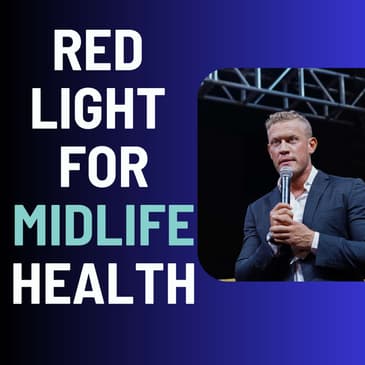

Why does red light therapy still sound like a fringe wellness trend when the science behind it is so substantial?
In this episode of The Midlife Rebel Podcast, I’m joined by John Graham Harper, founder of Lumiflex, for a grounded conversation about healing, recovery, and what’s possible when we stop accepting pain and fatigue as just part of getting older.
John shares his journey through rugby, CrossFit, and amateur boxing — along with the injuries, wear and tear, and “just push through it” mentality so many of us have been conditioned to normalise. After a major health wake-up call, he began exploring red light therapy with healthy scepticism, only to discover results that changed the direction of his life and work.
We unpack how red and near-infrared light support the body at a cellular level, why mitochondria matter so much for energy, inflammation, and recovery, and why consistency often matters more than quick fixes.
We also explore the deeper conversation around modern health: our disconnection from natural light, circadian rhythms, poor sleep, stress physiology, and the small daily shifts that can create meaningful change in midlife.
From pain relief and recovery to brain health and gut health, this episode invites a bigger question:
What if the body isn’t failing us in midlife… but asking for a new relationship?
If you’re ready to challenge outdated narratives around ageing, vitality, and what’s possible now, this conversation is for you.
If it resonates, subscribe, share it with someone who needs to hear it, and leave a review so more women can find The Midlife Rebel Podcast.
Visit our website to find out more about this week's guest.
All of our guests, including this one, are included in our Guest Directory so that you can find out more about them and the work that they do.
https://midliferebelpodcast.com/guest-directory
If you'd like to support the show you can buy me a coffee!
https://buymeacoffee.com/midliferebelpodcast
Why Red Light Is Ignored
SPEAKER_04Why aren't doctors talking about this more? Why isn't this mainstream? Why isn't you know red light therapy being heavily uh prescribed, at least as a treatment to try before engaging into something that's more evasive?
SPEAKER_00Welcome to Life, Health, and the Universe. Bringing you stories that connect us, preventative and holistic health practices to empower us, and esoteric wisdom to enlighten us. We invite you to visit our website where you can access the podcast, watch on YouTube, and find all of our guests in the guest directory. Visit lifehealth the universe.podcastpage. Now let's get stuck into this week's episode. Before I started this podcast, I spent quite a few years competing in CrossFit, so I understand the rigours of training and the toll it can take on the body, especially in midlife. There comes a point where recovery matters just as much as performance, and where you start paying closer attention to what your body actually needs to keep going. My guest today, John Graham Harper, knows that path well. After years in the fitness industry and navigating his own injuries, he went searching for better ways to support recovery, which led him to red light therapy. Today, John is the founder of Lumiflex, and today we're going to talk to him about what it actually looks like to support recovery performance and long-term health in a more intentional way. Welcome to the podcast. Thank you so much for joining me. I love talking about this stuff. So I'm excited to get stuck in.
SPEAKER_03Fantastic. Thank you so much. Yeah, I'm excited for it. I love your microphone too. That's real professional. Yeah.
SPEAKER_00It picks up all of the it picks up all of the um external noise. So, you know, when there's the kids are running down the hallway and stuff. So it's good, but it it also is too good sometimes.
SPEAKER_04Nice. But it does look the part.
SPEAKER_00Yeah, you can you hear them? Can you hear birds and stuff? Yeah, yeah, cool.
SPEAKER_03Good. I like that.
Rugby And CrossFit Injury Lessons
SPEAKER_00So do you so yeah, I've got a background in CrossFit. I didn't tell you that before we um hit record, but um, I know that you've got a little bit of experience in CrossFit as well, and um, yeah, and other sports. And it it pay it like it you've got to pay attention to what's going on with your body. You can't just like go for it with that intensity all the time without making sure you're taking care of yourself. So, do you want to sort of leave us off with a little bit about your own experience and and we'll go from there?
Boxing Scare And Tumour Surgery
First Red Light Results And Doubts
Research Proof And Building Lumiflex
SPEAKER_04Yeah, I started I started out as playing rugby, very passionate about rugby. I remember my my coach Mark, big, big burly Aussie boy. He was like, mate, you got potential. You could be a real good rugby player. Um but uh that was yeah, I had I had two dislocated shoulders. The first dislocation was was kind of like a there was a bit of a micro tear. It was a very severe one, the the the left uh left shoulder. Um so that I I continued to play rugby, but I was I just wasn't performing very well because I was I was very worried about getting injured again. And um, that's when I went into CrossFit and CrossFit, you know, these cleans and jerks and everything. And I think, you know, I I'm not gonna knock CrossFit at all. I I think um CrossFit when it became famous and sort of the origins of it with this military background, you know, like the you know, let's go hard kind of thing. I it it's um and it's very community-driven sport. But back then there wasn't as much emphasis on recovery as there is now. Like you know, the this this guy Wim Hof, who's a breathwork and ice sponge guy. Um, I had the pleasure of meeting his daughter uh a few times. And actually, just last weekend, I did um, I was part of a breath, uh Wim Hof breathwork uh workshop with a with a with a master instructor. And um, it was something we were talking about before, like in those early days of CrossFit, there wasn't a lot of this cold immersion, heat immersion, compression was compression, uh even the compression boots was still quite new. So people were really just hammering the you know, the crossfit. And I was definitely one of those. I was thinking in a very sort of like, I want to be the best at this, and I have to push the limits. I have to sort of dance with the devil with injuries, you know, I have to expect it, you know, that um I'm gonna get injured and just deal with it and keep going. Um, and I think that's now so it's it's not as bad. I even now with there's we're into the the in the in the high rocks evolution now, you know, the big rocks race and everything. And still that they like when you go to those high rocks events, wherever they are in the world, they have a recovery partner and everyone is well informed of you know, heat, cold, red light, compression, and even oxygen, which I I consider those as like the five pillars, your base pillars of recovery as if you're a competitive athlete, or you or you see yourself as a competitive athlete, right? You're you're chasing a podium. Um, but yeah, uh back in the day with with CrossFit, I remember doing um some very heavy clean and jerks and thinking in this mentality of like, I'll just I'll just push through this, right? I'll I'll just um I'm not gonna I'm gonna try to get hit a PR, maybe at a time when you're not like you're supposed to go through a program and hit a PR much later, build up strength. But I'm like, no, watch me do this, hold my beer. And I remember doing like a uh a snatch and then the clean, and then my knee kind of felt funny, and then it started to get worse and worse and worse. And actually, the worst injury that I I ever had was that left knee, which was was caused just by not you know paying attention to it and just um letting the you know trying to muscle through the pain. I have a very high pain tolerance, actually. That's and maybe that's a good thing now, but it isn't a good thing if you're um if you're thinking long term, you know, I it's something that you should be aware of. But I I left CrossFit, went into um amateur boxing, and after four years of competing in amateurs, I started to get really severe headaches. And my girlfriend at the time, who was who's now my wife, she was the one pushing me to go get a to go get a check. I checked the full scan and they found a tumor that was in my head. And they told me that it was just from just impacts to the brain. They were like, did you have you have a you have a car accident when you were young? You know, did you fall down as a baby? You know, did you like all these? And I was like, no, but I'm I'm now fighting amateurs. And they were like, Yeah, you can't do that now. Like your body's not conditioned for immediately stop doing anything high impact. And I had 11 months to plan the surgery, or it, or it was gonna be too difficult to use microsurgery, and it would have like had probably a big nasty scar on my head. And um, they said the tumor was growing into my brain and it could be fatal. 11 months, plan the surgery, plan the surgery. Let's get this done, let's get this finished. And at that was sort of a time when I um uh, you know, after that surgery, I sort of shifted my my mental state. You could say, you know, I I felt like I was very physically healthy, very physically capable, you know. But then there's other other forms of health, right? Physical, mental, spiritual, and emotional, right? I I sort of wanted to focus more on those areas. You know, maybe my mental state wasn't so healthy. And this was also, you know, making me less uh healthy emotionally, and then of course spiritually as well. I felt like I was, you know, I wasn't balancing all my health markers, you know, all my all my data points weren't right. Um, but um, yeah, then my I was I started using red light therapy again from my wife, and she, you know, dealing with these injuries, she was telling me to use this red light therapy. And I thought it was like this, you know, pseudoscience, feng shui medicine, hocus pocus nonsense. You know, this is what you ladies do. This isn't something that is, this isn't gonna work for me. And she bought this lamp. Um and it was a lamp that is to this day, I I still see it in a lot of clinics. There's it's still still widely used. It's an ugly thing, you know, that's something that um it belongs in a medical setting, not really, you know, you don't see it in houses. It's quite it does, it looks a bit, it looks a bit gross. But it worked. And um I remember where I got that aha moment was with my left knee, where aiming the lamp on my my knee for 20 minutes every night, which is what uh my wife was telling me to do, um, the pain disappeared after a week. And then I did it for one more week just to sort of like, you know, see is this really, you know, I want to guarantee that this is a this is a real thing. And then I stopped using it for my knee. And to this day, my knee's always been fine. And I run, I run high rocks, and um, at least I'm trying to. I'm I'm getting doing my best to, you know, stay fit and you know, engage in a challenge and be part of that community. Um, but I'm always on my knee, I'm always squatting and everything, and I've never had any issue with my knee whatsoever. And um, but that triggered a real interest into light therapy because uh, you know, the the device, it was using evervescent light. So it's very, very wide spectrum of light that was available in this lamp. And the bulb would get very hot. It was very hot. Very and so I'd play this sort of dancing game with my knee where I'd put the knee close to the bulb to get the treatment, and then I'd have to move it away because I was like, oh, it's getting hot. So I'd have to, uh, uh, you know, I'd do this. That that's how I did these the 20 minutes. And then I, you know, realizing that it was not the heat, it was more the light that was healing me. That was what triggered the interest into what is light therapy? What does this all mean? Where, you know, where'd this come from? And why hasn't this been talked about before? Because, and if I'm 100% honest, I wanted to get into light therapy as a little hack, you know, as a competitive athlete. I'll have this over all the other, you know, the other. Um, so that was it was it was it was more of an interest of like, oh, I want to be, I want to be the guy with the um the secrets, you know, like some guys are doing these, you know, special protein drinks and you know, different supplements. I'm doing the the this light thing, right? Um, but uh light therapy, the clinical research back then was still was still developing, what's but still something very undeniable that you couldn't just you know brush to the side. I mean, we're in a we're in a place now where I have access to a link on the internet that was built that was built by um a guy I met in Finland. It was at a medical conference. He gave me the link and he said, What I'm gonna do, I'm so impassionate about photobimodulation. I'm gonna get all the research and I'm gonna put it all into one link so anybody can access it. And I'll send you this link and everyone listening, check out this link. It's it's this link alone is like gives all the encouragement and you know credibility to light therapy. It's every single piece of you know clinical research, every paper all in one place. So you can go to the link, type, you know, press control F and type um chronic pain or arthritis or you know, uh Alzheimer's or Parkinson's, and you will just see hundreds of papers, you know. And and I've seen mainstream media do, you know, exposes on oh, this new and you know unknown thing called light therapy. Do we trust it? Hmm, still unknown. And it's like you obviously don't have access to this link. You know, you obviously are not in the line. Yeah, it's it's like it's the the you uh as a as a journalist, if you if you're publishing an article that is sort of giving people like, oh, we can't really say undeniably, you it's it's I I think I think once this link is fully out there, it uh a journalist will feel funny writing a you know a piece with that sort of you know tone. It should be like, check out this amazing amount of research. Why aren't doctors talking about this more? Why isn't this mainstream? Why isn't you know red light therapy being heavily uh prescribed at least as a treatment to try before engaging into something that's more evasive? That's something, you know, something you put in your mouth or surgery. It should at least be made, you should at least be made aware of light therapy. At least I feel like I I'm not the doctor's not doing me, you know, a good service to at least not make me aware of it. Um, but I'll send that link over. Yeah, cool. That that to this day, that's my favorite link on the internet. I got wildly inspired about it. And also I got very inspired by being in the fellowship of these scientists, you know, that devoted their lives to red light therapy. And for years, you know, 40 plus years, people were like, no, no, no, you can't, you don't get a speaking slot. You can't come to this. No, no, no, no. This is still fringe. No, no, no. You're you're a hippie. And they were shunned, you know, from the from these big medical conferences and you know, all the guys in the fancy white coats, like, no, no, no, no, no, this isn't science, you know. And now they're given like red carpet treatment. Like, please, can you come and give a talk? Like, oh, like, and they're getting famous on social media as you know, as leaders in in health and and you know, uh in um non-evasive treatments. Um, so that I've watched that shift like take over, you know, like and now the internet is exploding with light therapy, and it's wonderful. Um, but all of that got me inspired to build a device. And my device, I wanted it to be something highly portable, something highly versatile, and something like it's not going to take away from larger devices. It won't take away from that lamp, but it can be that lamp in your pocket, in your gym bag, in your in your bag to use on the go. Like that, that was the inspiration of Lumiflex was a highly portable, versatile, durable, flexible device, and all in one that can be put on your shoulder, your neck, you know, your head, your gut, you know, your knee, your ankle, anywhere. And you can use it anytime. You know, you're you're with the kids, you know, at soccer practice, you know, if you're at the office and you're doing you know, a late night, you know, or you're you're you've just um you know, you're in transit, you know, flying and you, you know, your your circadian rhythm is out of whack and you need to sleep, you know, it can help with any of these situations. That was that was the idea with with Lumiflex. And um, yeah, here we are now. We're we're this we're three years launched, but there was also three years of development. So it's like a six-year project. And um, we're distributing in around 20, it's around 21 countries outside of the US. We have a wonderful partner in Australia, okay, Kelly O'Brien. She's a distribution partner for Australia. She does loads of podcasts, she's wonderful. I gotta introduce you to her. She has an incredible wellness story as well. And though you know, those distributions outside the US, they're all like very, very close friends of mine. And we all try to we try to talk and make sure, you know, on a weekly basis, we're supporting each other and helping to grow the awareness. And um, yeah, we're GSA approved. So that means I can sell to the military in the US. Um, I have 11 design and innovation awards from around the world. So that's more awards for design and innovation on Lumiflex than any other red light therapy company since ever. And um probably my biggest, biggest um claim to fame is our education. We're uh we're we we realized that we had this award-winning product, you know, it's awesome, you can use it anywhere, you can take it into the battlefield, you can take it into an ice bath because one of the devices is fully waterproof. Um you can use it for you know brain health and everything, but it wasn't really a full solution. People would see the device and they'd be like, what do I do with it? How do I treat it? Well, you know, what's the recommendations? So we're like, all right, let's, I, you know, I teamed up with one of my one of the scientists who's one of the smartest, most amazing people like in my life right now. And um I said, let's build a course, make it easy to digest, make it like a five-year-old should be able to understand this, and then go talk about it to his parents, you know, or to his granddad or grandma, right? And then, and then once we launched that education, that that almost became a sales manual for our distribution, for our retail and everything. I was like, we're not gonna teach you how to sell, we're gonna teach you about light therapy, we're gonna get you inspired, and then let the product, you know, follow afterwards. And um, now we are ACE and NASAM accredited. So now the education is an actual accredited course where you get credits. So it's yeah, it's exciting. We're in a bit of a growth phase now. We're kind of exploding. So it's it's in a what been a wonderful journey. And if any, if anyone, you know, listening to this, you know, um the the key takeaway is just just dip your toes into red light therapy. If you've never heard of it, go to YouTube, type red light therapy, what is it? And it's it'll just blow your mind, you know, what what it's doing for the human condition. And and for me, what excites but also frustrates me is like, why has this been hidden from our, you know, from from us. Is it because it's so is it because it's so overwhelming, like the the these teams of you know, the scientists and doctors that have been fighting to get this these clinical papers out, and now it's just like, you know, the the powers, big pharma, whoever you want to call them, they've been like, okay, we can't let it go. And they're like, let's shift focus somewhere else. Like that's another fun conversation.
SPEAKER_00Yes, it is. I've actually had a conversation with um another guest who is in the US. I can't remember where. I'd have to look it up, but I can send you his information. But he does like full red light beds. And so it's like you lay in there for seven minutes and it's got like the uh I mean, some of the the claims that he made that that patients were experiencing like really significant um benefits to like quite serious ailments, you know, heart disease and and so forth. Um, and he had links and and studies and papers and all of that as well. But he he actually said that one of his biggest challenges was like distribution or and getting it out there. It was almost like there was a bit that he was experiencing some kind of pushback, you know, when it was uh when he was trying to get uh contacts overseas and that sort of thing. And you kind of go, well, why? Why is that? And I feel like it can sound a bit, you know, if people haven't read the research and they hear you and I talking about red light and they might go, Oh, yeah, whatever. I know that my dad, you know, I kind of said to him he had sore feet, and I was like, You need to get you ought to get in front of the red light. He was almost afraid to do it. And you know, like it might be dangerous, it's like it's light, but um, to me, it's like a no-brainer. If you it doesn't hurt, and therefore it doesn't hurt to just try it. And we also know that plus placebo is a thing as well. So if we believe in the red light, then it's gonna have some positive benefit. So yeah, it's just like, why wouldn't you? Why wouldn't you?
SPEAKER_04I always I always approach it from this side then. Well, whenever I speak see those people, I always approach it from this side. So light therapy, just light, what does that mean? So that means the light that's been emitting, it's not you know, with a bunch of modern Einsteins in a laboratory tinkering around like, oh, these, you know, light, wow, magic potions, spells. It's from the sun. Yeah, it's from it's outside, and it's available to us, you know. If we're on if it's sunny, it's just sitting outside that way for you. Think of the the sun as a multivitamin. The amount and and and what that means is that um it the light that's and and then of course there's the light spectrum.
SPEAKER_03Yes.
SPEAKER_04The light spectrum, we have red light and the 600 ranges, then you have, then you jump to 800, 900s, close in then the thousands. That's near infrared. Then you have far infrared, and far infrared reacts on your body's water. And the red in the near infrared reacts on your body's mitochondria. And far infrared is heat. That's the heat that we feel. Right. And um you'll have like an infrared sauna, which is actually a far infrared sauna. And that helps you sweat, helps you detoxify. Right. All of it is good. But where medical licenses come in is in the red and near infrared. That's where all the most of the papers are in. So that's when we when we make a product, we want red and near infrared, because then we can then, you know, use clinical research, use design, use, use the whole process of the product development to then get a medical license. Um, and what what the light does is it passes through the skin barrier and activates your mitochondria. If your car, if you're a car, your brain is the driver, the engine is the mitochondria. What all the light is doing is giving energy to the engine of your car. Now, how you drive that car, what you do, that's that's a different story. But just think your body is made up of, I think it's the it's 30, 30 trillion cells is what your body's made of. Every one of those cells has has an engine. And if you're giving energy to the that engine, that cell is going to do its job. It's going to do better. That's cell, just like the car is going to drive well. And if your body is, if your mitochondria is healthy, if your mitochondria has energy, you're a healthy person by default. Like because you're so if you think on it on a cellular level like that, that's how that's what where the conversation isn't like, you know, can red light help therapy help with this or with this or with this? It's like, yeah, it can that that's again how you're driving the car. Can it do, can it turn or can it U-turn? Can it skid? Can it drift? You know, we all we're focused on is giving energy to your to your cells. And then whatever you want the car to do, or whatever condition you have, you you'll you'll you'll be able to service that. You'll be able to get support, right? We just want to give energy to to your cells. And um, this leads into a much more deeper conversation about our history as a human race and our relationship with the sun and how our relationship with the sun has slow has slowly but surely really decreased. We're now like 80 to 80 to 90 percent deficient in sunlight, which is not what we are designed for. We were designed to wake up with our alarm clock, with the which is the sunrise. That was our red and near-infrared light. This that that red and ear infrared light would actually condition our cells to be protected against the later rays of light, the UV light that comes into play later in the day. And because that's actually another clinical paper, is your your body's SPF levels, you know, raised with exposure to red and infrared light. And then so and then see that sunset. Now, and that's our circadian rhythm. That's that was sort of our happy place, right? We, you know, where where we're breaking our circadian rhythm now is with waking up later, not catching the sunrise, not exposing ourselves to red and infrared light first thing in the morning, and then going to bed very, very late and keeping our body, our brain awake by being on our phone, by you know, being in in front of televisions and everything. So we're we're out of whack, you know, and and it's our job to try to get our circadian rhythm back. And this is self helps with not just inflammation, but with brain health, with mood, with you know, you know, depression and anxiety and whatnot. But um, if you think about it that way, about our ancient history and where we've come from uh in terms of our sun exposure, it's a different kind of conversation when someone says, Oh, is it gonna hurt me or is this good for me? Are there conditions? It's like, well, there's no conditions when you go out in the sun. It's the same, the same thing. And it's far more powerful out in the sun because you're getting a huge different variety of light. And it's and depending on you know the UV rating and how powerful the sun is. So it's just all we're getting is the is the red and near-infrared lights um nanometers, programming them into an LED. That LED then gives those exact healing nanometers to your body, but it's still from the sun. So if if you want to go down a rabbit hole, um you could you just Google um sundex, like early hospitals sun decks, you'll see black and white photos of people where they would get patients and they would put them out in the sun because they knew that like this sun, it's the sun, this has healing benefits and it can help with a lot of conditions. But then um antibiotics hit the market and suddenly all the sun decks disappeared. So, ooh, what happened there? Right. I was I had a conversation with a physio once. We were like going down some very some of these rabbit holes, and um she was saying, like, you know, oh, you know, some of my patients have a bad back, you know, what would you recommend? Uh, you know, a red light therapy device or or or proper sun exposure. And I was like, well, depending on if the sun is good, if the sun is strong, you know the skin, the pigmentation of the, you know, if they're very fair skinned, that you have to take that into calculation with UV. But imagine if you had your your therapy table, like on a on a balcony or on a roof, and you would literally tell your patient to come and lay down and you would position, you would line the sun up, you'd position, you know, where they are in their their hip or their back, and then you would sort of be like, okay, you know, I'll come back in 20 minutes. Like, and I that's the the ultimate red and infrared light is the sun. Like nothing should replace it, you know. But it where where a sun supplement comes in, like like Lumiflex, is when you don't have time, you're on the go, you know, and you can't, you know, oh, the UV rating's so high, I'm I'm fair skinned, so it's you know, it's it's gonna cause more damage to me than it is gonna be good. That's where that comes in. I see Lumaflex as a sun supplement, and I always encourage people to use the sun, to get out in the sun, to not forget our relationship with the sun. But to put those calculations in, check the the UV rating in your phone. You know, the there is optimal times to get you know your sun exposure. UV light is still very important for us. We still need this. Um, and to do this, to sort of encourage this conversation and this understanding of the sun and our relationship with the sun. On on my website, I actually have um I have a silk, a special fabric. And this silk, this is uh this goes out in, you know, this is uh some more research about the silk road and everything. But silk, uh especially red silk at a certain thickness, actually can block all UV light and only let in red and near infrared, a certain kind of silk. Yeah. But it to it like the the optimal like um dose of red and near infrared light with no UV is this certain silk. But pretty much any red fabric does it to a certain degree.
SPEAKER_02Really?
SPEAKER_04And I always encourage people like get the silk on a sunny day, yeah, just put it over, don't put sunblock on because that's a toxin. You don't want to be putting toxins into your body, and then go outside and get your red and infrared light. Go and sit down and aim the the sun directly behind you, and it it creates this conversation, this interest, like, oh, what is what is the sun? What have we forgotten about the sun? Why we always you know have these umbrellas and oh these sunglasses and trying to shield away from the sun. And perhaps in our ancient times, you know, the sun was was actually worshipped because of its healing, right? It kind of these these conversations, I like it when then it starts you start to see the positioning of red light therapy and red light therapy devices. Oh, that's a sun supplement. Just like I have protein supplements, or I have like a vitamin C supplement or whatever, it's a supplement. And that's how I engage with this this this device, and that's how I can incorporate it. It's it's a more I feel like doing it this way, you you create more awareness, you have let people sort of to open up a little bit more and and not not be so swayed by the by the information that comes out by the the medical industry because it's a lot of it is you know, no, stay at home.
SPEAKER_00It's don't go out in the sun for sure, like it's dangerous.
Circadian Rhythm And Night Lighting
SPEAKER_04You need a medical doctor to okay that consult, you know, what are the papers on that? I I feel like the the medical industry, what it's done for so long is it's it's gotten a taken had a flower outside in its natural environment, it's taken it away, put it into a house, the flower starts to wilt, and then it's like, what's wrong with the flower? Give it pills, give it pills, give it pills. All is get the flower, put it back in its natural environment. Like, wow, the the flower works. I know I always think of that, like anytime you hear some ad, or when you hear a doctor's prescription, is they're just trained and they're they're thinking, giving pills to the flower. When you just get the flower, put it in its natural environment. Right.
SPEAKER_00I had never really thought about the red light um as a way of um like using it for circadian rhythm and as a like a sunlight therapy. Like I've always you know thought of it as a way of targeting some kind of healing process, whether that's um joints, skin. Um yeah, I've never really um attributed it to that circadian rhythm as well. How do you here's the device a compared to a so say you were using a night? So say you were using that as a device for a sore back, let's just say. Um how if you wanted to use it for circadian rhythm to improve your circadian rhythm, um how would you use it and how would that be different to like if you were using it on a particular area of your body for healing?
SPEAKER_04So if you think like us in ancient times, right? We you know, we're a bunch of, you know, we're we're out in the fields, you know, we're doing our thing. The sun starts to set, we get that beautiful red and infrared light that tells our brain, like, okay, wind down, time to go to bed. Calm down, calm down. So when the sun sets, our light would have been campfires. We would have had campfires. We wouldn't have had these bright, you know, neon lights like I have in the office.
SPEAKER_01Like I've got right now.
SPEAKER_04And and and artificial light, um, like the ones I've got in my office now, um, clinically proven to create inflammation in your body. Clinically proven. So, what you want to do is when the sun sets, you don't want to expose yourself to this blue light. So I I use this as a night light. Yeah, so I turn that on. Yeah, and then with my phone, I have a setting where I I press three times and I turn it red.
SPEAKER_01Ah, yeah.
SPEAKER_04Yeah. Most phones all have this. Okay. So, and if you're I'm gonna I gotta work or I'm doing a late shift or I'm traveling, what do I do? The next solution is blue light blockers. You have these lights with these these. I I have these these gargles, these sorry, these glasses, but I don't use them anywhere where I can get natural light. And I see people not quite understanding how they work. Like I've seen people outside wearing them. And I'm like, no, that's no, that's not quite the point. Like wear them when you're in an environment where you've got to be. Yes, and it's only when the sun goes down. When the sun goes down, that's when you're when it's very important. Yeah, and there's a few uh brands that you can buy um where you can actually there's like shades, like these clip-on magnetic shades that actually support again, you calming down. So you have like yellow, clip on the shades, it's orange, and then one hour before bed, you clip on the red ones. So you're calming your your body further down. And it's it's not like everyone can do this. Like I'm sure, you know, guys like Brian Johnson, you know, they had it down to a T. They have, you know, the light in their home and everything all automatically like they've invested in it. But if you just, if you just sort of think of it that way and you do your best, you'd be amazed at how better your sleep is. Um, and then and and we we know very, very, very, very um clearly that sleep is like almost like the most important marker of health. Like the the better your sleep is as a practice, it's like the the better your health is. So like optimizing your day for sleep can be a very it's a simple, challenging, you know, to to arrange it all, but it can be a simple one data point that you can do to really reverse a lot of the you know bad health conditions or bad habits. So just optimizing your sleep. So I uh the blue light blockers, definitely the phone filter, and then having a red light device, yeah. Uh as like like if I if I need to go to the bathroom throughout the night, I do not turn the light off. That's a big no-no. That's like a big shock.
SPEAKER_01Your body's like, oh stay tonight, don't give up.
SPEAKER_04Yeah, yeah. And then you're laying in bed and you're like, huh, okay, I'll play on my phone. Uh you just make it worse, worse, worse. So you you wake up, you turn on, use this, go to the bathroom, and then you make sure you go back to sleep. What what I even do with when I'm laying down to fall asleep is I'll I'll do close my eyes and I'll put the lumiflex right there. Okay. And that's if like I've really been like I've been busy, I've been at a trade show. And after the trade show, you know, I've taken some clients out to dinner, and then we've been out and about, and I haven't calmed down. I get back to the hotel and I'm like, whoa, I'm I'm I like to really support sleep, I go put it straight onto my face. But yeah, that's that's a little a little simple protocol, but you can go you can go very complicated. There's devices.
Skin Healing Plus Brain And Gut
SPEAKER_00You can you can basically like yeah, do your entire lifestyle, can't you? Like you said, your phone, you turning the TV off at a certain time, or and your computer, you can do the glasses. The we've got I've got like a red light book light. Well, it's not red light, it's kind of orange light. So it's like a little clip on my book. So I'm reading at night, it just shines a light onto the book, but I don't have to have an overhead light on. We've got light globes, not in all of our rooms, but you know, it's possible to really like do that in your home. Yeah. Um, yeah, yeah. So that's that's almost like yeah, that's the circadian rhythm thing, and using the red light for the benefit of helping you sort of get your circadian rhythms right and blocking out the the the incorrect lights um at certain points of the day. And then there's that because all of the other, yes, yes. Yeah. And then there's all the other benefits, right? So I would love for you to share with us. I mean, you've you've touched on some of them already. I'll tell you a little anecdotal um thing that I did the other day. My my daughter had a she got like a skin infection, and we covered it up, um, and then I put a band-aid on it. And then the sticky from the band-aid actually inflamed her skin as well. If I'd gone to the doctor, I can guarantee you 100% she would have been on antibiotics. The skin, it was pretty bad, like there was a couple of bad patches that looked, you know, not very good. I put her in front of the red light, like we washed it and did all of the things, and then in front of a red light panel twice a day, 10 minutes a day, and healed it naturally within like a week to 10 days. So it took some consistency, and it took some nobody does that so good. I was like, I don't want the drugs, and I'm and I believe that this works. So it's a no-brainer. Um, anyway, it worked. And then there's the I've I've heard you on another interview, and and I'd be really keen to hear um you talk about this as well as the you know, injury management and and that sort of thing and recovery. Um brain health, gut health, yes. I had never heard that before, and I heard you talking about it on another interview. Can you tell us a little bit about that? Because that sounds really exciting.
SPEAKER_04Yeah, because um so with with with Lumiflex, the um the idea behind this device was that we want to maintain a high portability. Yeah, because clinical research shows that if consistent use of red light therapy, your recovery, your your response goes faster. So two people, you know, person A, person B get in the same car accident, the person using red light therapy consistently will heal faster in the same car accident. Okay, so just start and and this again is a no-brainer because it's like, yes, of course, because back in our ancient times, we had a better relationship with the sun. We used to get sun every day. So therefore, consistent red is kind of like the key thing. It's don't think of red light therapy as something that, like, oh, I have a problem, I use it. Yeah, daily, daily exposure is how you is how you want to.
SPEAKER_00And is that specifically visual? Sorry to interrupt, is that specifically visual? Every visual, yeah. Okay. Like get eyes or yeah, yeah.
SPEAKER_04I I always think of myself as like um one of the guys that was helping to build the pyramids and the amount of light exposure I got, like my back, chest, you know, and then I would have taken a break and laid down by the sun, you know. It would have been a very high dose, you know. I probably wouldn't have a lot darker skin. But um, and that's another thing with 30 degrees away from the equator, you know, people with fairer skin, we would we would have that same sun exposure, but we would it would because of our pigmentation, we it was different for us. A high melaton melatin in your in your in your um in your in your skin. That was a key thing. And melatin in this, that's a that's a great conversation, but that's a that's a a very long conversation about that's an that's a molecule that's very key with red light therapy. Um but so I designed the device to be an optimal amount of output to get a pain management outcome without you know overdosing or doing doing any or wasting wasting power. So the the device, the the device of Lumiflex, we require that you touch skin. And the reason for that is because the output is optimized to be directly touching skin. Yeah, so devices that are at a distance, their protocol for for treatment, it's a different approach. My approach is like the exact amount you need for a 10-minute session, you know, based on two sessions or three sessions a day per site for chronic inflammation or for you know for acute pain for for all for all of that. I'm trying to sort of widen the amount of outcomes for mass uh masses. And the way that I calculated all with with the science team was let's touch skin and let's guarantee that output into your body because light does reflect, it reflects, right? If we were in a dark room and I had the device on on my chest, the room would stay dark. The moment I go an inch away, you can see the light, the light starts to bounce. So the the approach of devices that are at a distance is very, very powerful. And usually sometimes I'll ask you to wear the goggles or the there'll be some sort of there'll be other precautions. All good and well, it's just a different approach. I have a more targeted approach, more precise approach. And when when you look at the that database that I'll send you the link later, you'll see that a lot of the clinical research, the devices, the mechanisms that the science teams use in those studies are actually touching skin. So they use like LED strips in the in the study, and they'll have like they'll they'll the nanometers and then they'll place the nanometer on, then they'll run the study. So I was like, oh, that's an interesting interesting fact, is like touching skin. We need to try to match the majority of these studies. So touching skin, um, another thing with the with the with the two, there's two in the in the line of three, uh, there's pulse frequencies, because that's another thing that pulsing light is another thing that has a lot of clinical research on different different conditions, different pulsing lights in different hertz. So 40 hertz. Um, I remember a study uh that caught my mind because I was very big in the military was um was PTSD. Uh-huh. PTSD at pulsing the light at 40 hertz was it was, and there's another one for for women's period pain at 50 hertz.
SPEAKER_01Okay.
SPEAKER_04And aiming to let the go. So we have we had pulse frequency, we have touching skin, and then we go into the nanometers. Then the nanometers, we got the red light, then we got the near infrared, and we always want a variety of both. And each of the nanometers has supporting research. So 630 and 660 are the I'm gonna I'll just give you all the the nanometers that we use in all of the devices. So we have 660 and 630, hundreds of research papers on this, but this is still surface level. Then we go to 810, um, and then 850. 850, these again, an insane amount of re research just on these two nanometers. Then we jump to 904 and 1064. Now, 904 and 1064, there's a substantial amount of research now on these specific nanometers for brain health and how therapy aimed at the brain for again addressing a condition on a cellular level, because what light does is it gives it allows your body to create more energy, more ATP energy just in the mind or. The next thing is it increases blood circulation. And then this gives a reduction in inflammation. So these three mechanisms, when you have inflammation, your body is crying out, give me energy, give me blood, give me energy, give me blood. Like you hurt your shoulder, you get a headache. That's what inflammation is. It's sending the signal. I need energy. And in ancient times, like I'm that guy building the pyramid, I would, oh, I'd be in the sun. I'd be getting energy, right? That the red light would be giving my cells energy and it would be giving my body circulation. So the inflammation would switch off.
SPEAKER_01Okay.
SPEAKER_04So this applies the these this same mechanism applies to everything in the body, including brain health. And the research done for Alzheimer's, Parkinson's, autism, dementia, with these specific nanometers, I, with the original two products that I launched, the Body Pro and the Essential, I was very focused on pain management. The new device that we've launched last year, October, with uh six different wavelengths in one, is where I'm really trying to push into brain health. Without making the claim that this is gonna cure your Alzheimer's or anything, I just say brain health. Here's the research. Look at this wonderful research. Look at this research using the 1064, 904 nanometer for Alzheimer's. Check out this paper, look at the protocol. All of all of that research, the times and everything is all that's how we've we've designed our our product product development. It's all based on this, and our education as well. Um, but then with with the brain, you think, oh, I've got a brain issue. You you naturally think aim it at the brain. Yeah but it's important to aim it at the brain for sure. But actually, research is showing that gut, your second brain, a lot of problems here can be solved in your gut. Like there was a study outside of light therapy where they had autism patients and they changed the microbiome in their gut as patients were able to speak for the first time.
SPEAKER_01Yeah.
SPEAKER_04And right now, my the essential pro, the the brain health one, is being used in Italy for a clinical trial for autism. And that's where out of all the regions, I've um, this is where I'm seeing all of the testimonials and reviews of people with Parkinson's and Alzheimer's. Because my my distributor in Italy, Gianni, he's a very credible medical doctor, very, very credible. He's he's he's well known in Europe. And he has a franchise of clinics, and he's super, he's very he loves the data, he loves the device, and he loves the the ability to position it based on new research coming out. Oh, we can position it here. Oh, we can change the Hertz. They can he can really target and make treatment precise. So always always remember that like your gut, gut health. Like, you know, when you go, you know, you go into a clinic and they're like, oh, you know, let's do a checkup, let's see how, let's see how you're doing. And you do your blood work, there's like lots of different markers that you can check. I me personally, I would say your the microbiome test is is a is a is one of the most secure ways of knowing, like, am I a healthy person? Or or like understanding your biological age is is your gut health. And this is research that I think just within the last 10, 15 years started to come out, the the importance of gut health and your second brain and everything. And it's and and having the div, and this is something that I wasn't like the design of Lumiflex, the reason why it's this big um was because I wanted to aim it on the lower back, yeah, because that's the biggest pain in the right now. But I didn't want the device to be too big to where it loses portability, but I didn't want like a small surface area to to address that pain of lower back. But where where we've come from now is I've seen like, oh, it's actually a perfect gut panel as well. Like we're seeing people from all over the world, like on the gut, on the gut, on the gut. Because as research is coming out about gut health, gut health, it's it relates to everything, not just brain, but like so many, so many things in your life are related to your gut. Yeah. And how and and beyond the gut is that that's what I recommend to anyone who's, you know, if you're feeling a bit dizzy or like you've got a headache, or you're stressed, or you're anxious, you know, you or what whatever sort of condition you have in your head, I always recommend first your gut and then aim it at the back of your neck. Okay. On for your spine. And then finally you do it on the the front, on the on the on the center, like right here. Yeah. But it's an amazing um sort of rabbit hole to go down is just simply gut health. Like gut health is like there are doctors that are like royalty in my eyes that are just gut health specialists, and they're like, I can fix everything, I just need to know what's what's going on there. Yeah, yeah.
Dosing Rules And Daily Protocols
SPEAKER_00Well, I had a guest guest on a few weeks ago, and she was talking about hormonal health for women in perimenopause, and she said the first thing she does is test the gut. And often if they fix the gut, there's no need for like medication to help with symptoms of perimenopause and menopause. So, yeah, that was really insightful, very cool conversation. Right. So if we're using that we yeah, it's just so it's so cool to have so many people knowing all of these things. Um, would you how many times a day would you have to use it? Is it kind of like a once whenever you feel like it, or you'd think that that regular approach is the most important thing about it that yeah, the this this sort of leads to the the question of overdosing on light therapy.
SPEAKER_04And what what what what there is is with light therapies there's sort of there's like this optimal um a dose, the optimal dose, you know, that that you can get and that is enough. You don't need to do more, you don't need less. You you've got the optimal amount. And that's Lumaflex is based on like the output is based on that optimal dose. But when it comes to full, but like light therapy has like a systemic effect. So you know that the the gentleman with the bed, for example. Yes, if you get in that bed and and that's like if you can imagine the amount of cellular energy you you really fill your body's battery with that. That's I love those beds, it's just an issue of cost and yes, you know, convenience. But if you're if you're Floyd Money Mayweather or your Ronaldo, you got your bed. Trust me, these guys all have a bed. Like, I get full book, oh 100%, all of them. Like name, name an athlete, name, name a public figure, they all have it. Like now they're all like talking about their hyperbaric chambers that they have as well. Like it's it's a no-brainer. If you have money, it's like the first thing you buy, like you add to cart. Um, but there's I think there's a study, and I can't quite remember where it is. Um, but it's basically your body's battery, the average human body's battery. If you can imagine it, like your phone, your body is full after about 20 minutes of full body red light therapy. So that bed, it the average person, 20 minutes is roughly this amount. 20 minutes, your body's battery is full. So, so you you're like, I'm that's my sweet spot, I'm done. But what you have to remember about everybody is everyone has different batteries, and everybody has everybody's batteries depletion, it sort of depletes at different rates. So somebody who's like dealing with stress because they just lost their job, you know, they're or they're grumpy because you know, they they've been through divorce, or someone who's been in a car accident, someone who stubbed their toe, or someone who's, you know, dealing with you know symptoms of chemotherapy, all the batteries are depleting at different rates. And you may need that top up again. Someone really with dealing with heavy inflammation, their body is like, I need energy, I need energy, blood circulation. Like we're really we're fine to keep this person alive. They may need like two times full body treatment of 20 minutes, right? So if if you kind of look at that, and then you look at Lumaflex with that's targeted, um, and then you look at that, you know, that that biphasical dose, that optimal dose. What we recommend in our education is we say per site, two times a day is enough.
unknownOkay.
SPEAKER_04One in the morning, one at night. And that's that's per site.
SPEAKER_01Yeah.
SPEAKER_04And you'll have like your well-being protocol, and then you'll have your pain management protocol. So, like a guy with um, there was a guy I met in New York. Uh, I'll never forget this guy's face, his big smile on his face. He he was like, he has like a he had a uh uh an old sports injury from his college days, an older guy, right? Like, oh, you know, I can't move up my arm, I can't sleep on it, it hurts. Like, this has been 20 years, you know. And um, I said, let's do let's do 10 minutes in the front, let's do 10 minutes on the back. And we're all it's like this big medical conference. We're all sort of talking there. And then he finishes and he swings his arm around, he runs out of the conference, he calls his wife, and he's these guys are crazy.
SPEAKER_02This black magic, what's going on with the shoulder? This is nuts.
SPEAKER_04Um, and we filmed the video because um my scientist, he's doing uh a documentary on light therapy. So he wants like this, so he filmed this video. And um, I I look at that that um that sort of that uh subject, right? If we you know, if we were to do an analysis, and we'd say, well, his battery, right? His battery basically it wasn't it just lacked enough, like he was a healthy person. Yeah, he just didn't have enough energy to deal with that lagging inflammation. Whatever it was, his lifestyle, you know, his you know, his food choices, how how well he was hydrated, that's a key factor, is hydration. All of this, he basically was just at a slight energy deficit. And he just needed to top up and then boom, the energy, like then that it could deal with that inflammation, right? Whereas other people, it might, there might be lower, like their batteries might be lower. They might need to work on other areas, like maybe they're smoking or they're drinking or they don't sleep well. They need to sort of look at their body as an overall whole, right? And try to aim to optimize their red light therapy intake by making sure they drink a lot of water, they're exercising and all of that. So it 10 minutes per sight is is good for morning and night, but then a well-being protocol, that's can be a separate thing where you aim it at the gut, you aim it at the chest, you aim it at the the back of the spine, then you aim it on the face, first thing in the morning, and then you do that at night. That is like I I can't like since starting Lumaflex, I can't remember a single day that I haven't done that well-being protocol. And then I do my site. Oh, I've done you know, some leg day, I'm a little bit sore, let's put put it there. Like, oh, I gotta, you know, I knocked my shoulder, I'll do it there. I'll do my I'll do my pain management protocol. But I think for like that, that's that's sort of where Lumaflex fits into that the daily life of someone. You know, is like they're on the go, they're in their hotel, they want to take it on a plane, you know, they do want to have it in the car, and you wake up, put it on your face, keep your eyes closed, and then you do those other areas on your body as you're going throughout your day, as you're getting you know, your breakfast ready or you're doing your morning routine, and then the same at night. That's kind of that that's kind of the the overall ideal protocol for for everyone, for no matter what their what what you what case is. And then outside of that, you know, the depending on your your your condition, click the clinical research, clut type your condition into the thing and actually get a precise protocol. Okay. Time, number of sessions, number of weeks, what's the hearse frequency, and you can be so precise and really like it's touching skin. That output is guaranteed into my body. That's the number of like you can have it, you can match the clinical study. That's very cool.
SPEAKER_00Um, so obviously, your device, you can kind of shove it in your inside your t-shirt or just in the top of your pants or whatever, and wander around with it. So you're not you're not having to sit still and and do your do your 40 minutes in the morning, 40 minutes in the I had I have these straps.
SPEAKER_04Like when you buy the package, there's a long strap and a short strap. Okay. Like I've seen like it's funny, just like you know, as a product of you know, when you do product development, you run these user trials, you get feedback from people, and we're at the place now where the straps, the short strap people use for arms and legs, but I people just use their clothing, they just pull pull their shirt, they shift the device there, they tuck it in their pants, you know. And I was like, ah, I never I never thought of that. I never thought you could use your clothing. Yeah, that's great.
Modern Inflammation And Lifestyle Levers
SPEAKER_00That's good. It's uh it um reduces the barrier to entry, right? When you can just walk around and use it while you're doing doing life. I was actually gonna ask you before we um before you talk a little bit more about I I'm conscious we've come close to the end of our hour, so I won't hold you for too much longer. Um, but I'd love you to talk about your um your online academy. But the I did have one question and you kind of semi-answered it for me. But I I wondered how effective red light is if you're not doing all of the other good things, if you're not eating well, if you are smoking, drinking, you know, stressed, like is it for everyone and is it as effective for everyone, regardless of the those lifestyle factors?
SPEAKER_04Yeah, it's it all comes down to then age, genetics, all like there's genetics is a major thing as well. But if if you're if you're like if you're if you're creating like inflammation is something that we can never escape. Like we're in where we are in the digital age is um we're so far away from nature, it's scary. It's like it's a it is a problem. It's like a it's a serious problem that doctors are now like, wow, this is you know, this is something we is just simply our us as a as a flower, we're in we it's almost impossible for us to go back into our natural environment. So whether it be like microplastics or Wi-Fi, um, we're sitting on car batteries now. Like, who thought of that? Like, oh like let's just watch how the amount of you know is that the placement of a car battery is under the seat of a driver's uh like under a driver's seat.
SPEAKER_00Is that a new thing, is it?
SPEAKER_04Yeah. No, yeah, like yeah, yeah, like every time I'm I'm I'm sitting on the car, I'm like, is like I'm gonna pay for this. In you know, in as I'm when I get older, I'm we're we're all gonna pay for this. Everyone's gonna say, oh yeah. And and even and even like polyester, like Lululemon and our company, there's studies that show like in most of it ends up oh yeah, it ends up in the waterways.
SPEAKER_00Like every time you wash it, kind of part of it goes into Yeah, so therefore we're we're drinking Lululemon.
SPEAKER_04Yeah, yeah. We're we're uh we we're pretty much in a state in our in our in our environment now where we have to accept that every single day we're fighting inflammation. Every day, yeah, always we're gonna be fighting inflammation. Yeah, it we're always compared to our how we were before, it's just we've got no hope of reversing. Unless, of course, you drop everything and you go off, you live, live by yourself, you know, and you you detach from the world. Um, so we need tools. We need tools to fight inflammation, any and all tools. And that's where the whole biohacking culture came from. Yeah. And biohacking is saying, look at what we did before in our in our ancient times. We can't do that now, but we've made devices. We've made like structured water canisters, or we've made groundy mats, or we've made these PMF uh machines, or like there's these, these are all devices that are basically mimicking how things were completely normal for us in our natural environment as humans. And it's just giving you giving you tools. So if some if someone's sort of sitting there saying, like, oh, it doesn't work, it's like it it it in my humble opinion, I think it's like we don't have a choice, like unless you really are connected to nature and you're like, don't worry, I've got my house, I'm exposed to the sun, then it's like, okay, you're one of the very, very few. But if you're in the city and you really are like on the go or you're you're working, you gotta grab whatever tool you can. And if if on top of that you're you're a heavy drinker and you're smoking, I'm always thinking, like, you don't need to smoke anymore, bro. Like, you don't need to. You're we're already all of us are smoky by default, like just air quality alone, at least in some places in the world, is so bad. Like, no one needs to smoke. Like it's it's you you really are not setting yourself up for any kind of success in terms of like your your body like physically if you're in actually doing like something like smoking or drinking or you know, or something of the like that. You're you're it's almost like you're trying to end your life as quickly as possible, you know. Um, but I I can see like the world now, smoking is almost is almost like like most countries in the world I go to now, I rarely see anyone smoke. Like it's it's it's a very yeah yeah. They'll go out on the tree and they'll be a group and you'll be like, wow, that's still, you know, people still do that thing. Um then so so outside of that, like I think I think like the red light therapy can have it can have such an amazing effect, like first and foremost, just on your mood. Just on your mood. You're exposing your body to red and infrared light. That's sort of the first outcome. So your improved sleep is like something you get in the first day of using red light therapy, improved mood, overall like energy just to just to be alive, because your body's like, thank you. This is how we were before, you know. Now now I'm getting back to my you know my normal you know way of living. Um, but then when it comes to like addressing a big pain condition, I've had this pain for 20 years, you know, can it help me? That's when I would really encourage someone to not obviously go to the quick fix to the drug dealer, but you look to see, like, okay, um, let's make a lifestyle change here. I want to use non-invasive, I want to use natural means. You know, what what sort of a list of to-dos I can do? What am I, how am I how am I doing this? And if if if someone if you're smoking and you're drinking, and you know, a drink every now and then is fine, but if you're drinking like consistently, that's kind of the thing you want to hit first. So you're like, okay, I'm gonna do my red light therapy. I don't want to go to the drug dealer, but I want to do my red light therapy and optimize this. Let's cut the drinking out. Like that, just that one, that one metric will you'll see a sudden upsurge. Then you'll say, Okay, I need to start drinking good water. I need to start drinking, not distilled water, real water, like water that's uh mineral water. You know, that that'll have another huge impact on your red light therapy treatment. You know, and you can slowly sort of see, and it it can be a game, you know, that you could you could gamify it, make it fun, start knocking things off, and then watch your treatments get better and better. And your pain ratings go from 10 to 6 to 4 to 2. You know, you can actually I I enjoy that. I I like protocoling and gamifying my life, you know, when I introduce something new, you know, but just don't go to the drug dealer. That's right.
Academy Training And Final Wrap
SPEAKER_00Yeah, it's um it's it's great, it's empowering, isn't it, when you can make a choice that is actually much more favorable for your body and you know you don't get any side effects. Yeah, it's it's a it's a winner. Um, I'm conscious of your time, but I would love for you to uh close by just sharing a little bit about your Lumaflex Academy um and um what that means for you and and what you've been doing in terms of educating people on the the red lights.
SPEAKER_04That's right. Yeah, Lumaflex Academy, all credit goes to my scientist, a photobiomodulation expert by the name of Peter Forhan. He is one of the one of the most important people in my life right now, who's always sharing and and elevating my my understanding and knowledge of of uh of light therapy. He's actually written a book called Light Bodies. So if you go to lightbodiesbook.com, okay, it his book, it's a it's a very heavy read. I'm warning people like it's it's it's uh it's like a science book, you know, and it's it's a book that I read and have to reread because it's very very deep science. And it but it talks about light, talks about health, and it talks about a very, very big picture about us uh uh as as humans out of our natural environment. But light therapy is a key part of that, right? And um, he built my entire education program on the Lumiflex Academy. So we have the foundation's course, we have a course on the wavelengths of light that we use in Lumiflex, we have a course on pulse frequency, um, in introducing frequency into your to red light therapy. We have a practitioner's course, and then we even have a course on pet health because we everyone there's so many people and how to use red light therapy for your pets, and then also for equine care, because in some regions around the world, like the Lumiflex is used for some very high performing. racehorses, especially in Poland. So all of that, all that coursework, and in the courses, he'll talk about clinical research. He'll refer to the clinical research. He'll, you know, he'll deep dive and he'll he'll break it apart and he'll teach people how to always reflect on clinical research to support, you know, being credible in you know your own understanding and then what you're sharing. Like he's Peter's like a guy he can like quote a clinical paper. You know, like that that real like prodigy you know and he'll close like oh at this time and he'll like and I'm like how do you how do you quote papers? Like there's the study the the database I have I think it's um I think we're close to 10,000 studies. 10,000. So and when he's like oh I know a stuck and he'll like pull out these I'm like I'm I'm still like digesting the first five you know I'm still like having to reread them and re-understand. And he's just quoting them. But yeah all of that is in the in the the course and anybody listening if you're interested um just hit me up on let's do Instagram John Graham Fitness just go to John say love the show I need to learn about light therapy here's my email I'll get your email I'll enroll you and I'll give you lifetime access so you can amazing in and out whenever you want and it's all video format too. So it's like a workshop format so you can have it playing and and listen to it.
SPEAKER_00So cool. Yeah cost of pain as well it's something that I'm like that's really generous of you we've also got a guest guest directory for the podcast so we can probably share the link in your um profile. That would be cool. Yeah so that people can access it easily. Yeah amazing thank you so much this has been a really insightful conversation and yeah it's very cool to to hear all about LumaFlex. Thank you so much for joining me I really appreciate your time.
SPEAKER_03Thank you I appreciate it.
SPEAKER_00Hey there Rebel thank you for listening to this episode of the Midlife Rebel Podcast. If you'd like to support the show you can buy me a coffee by going to buy me a coffee forward slash midlife rebel podcast. Thanks for listening