
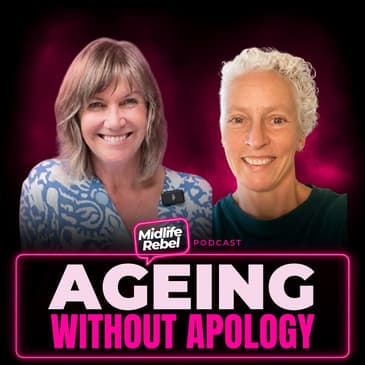

Ageing isn't the problem. The stories we've been told about ageing are.
In this episode of The Midlife Rebel Podcast, I'm joined by Jo Blackwell, host of the Midlife & Beyond podcast and a passionate advocate for positive ageing. I loved this conversation with Jo because we explore something that affects every one of us, yet so rarely gets spoken about honestly: what it really means to grow older in a culture that's obsessed with youth.
From retirement home brochures arriving on your 50th birthday to comments reminding women they're no longer considered "relevant", we unpack the subtle (and not so subtle) ways ageism shows up in everyday life. Jo shares how listening to thousands of women's stories revealed just how deeply many of us have internalised these messages, often without even realising it.
We also talk about the real-world impact of ageism, from medical gaslighting and being dismissed by healthcare professionals, to the importance of advocating for yourself and staying informed about your own health. As someone with a background in the fitness industry, I especially loved our conversation around strength training, movement, muscle, bone health, and why ageing well isn't about trying to look younger, but about maintaining the freedom and independence to keep living life on your own terms.
And, of course, we couldn't talk about midlife without talking about identity. When children leave home, careers change, hormones fluctuate, and long-held roles begin to fall away, many women find themselves asking, Who am I now? Jo offers a refreshing perspective, suggesting that midlife isn't about reinventing yourself so much as reclaiming the parts of yourself that have been waiting patiently beneath the expectations of everyone else.
If you've ever worried about getting older, questioned your place in the world, or felt like society has already decided your best years are behind you, I think you'll really enjoy this conversation.
Visit our website to find out more about this week's guest.
All of our guests, including this one, are included in our Guest Directory so that you can find out more about them and the work that they do.
https://midliferebelpodcast.com/guest-directory
If you'd like to support the show you can buy me a coffee!
https://buymeacoffee.com/midliferebelpodcast
The Good News About Ageing
SPEAKER_00You know, there's a lot of good news about getting older.
SPEAKER_01Yes.
SPEAKER_00And that's what I'm kind of leaning into now. And that's the message that I want to get out there is forget all this cultural sort of um, you know, uh message or all that that we get that goes in all the time, that we're gonna we're going into a decline. I mean, I'm not Pollyanna. Some of it is awful. You know, there are certain things like your body bodily things and what have you that, you know, things start to break down or you what have you. But if you focus on that, then yes, the self-agism, it goes into your head and you start, you know, talking about, you know, your senior moments and I can't do this. And I can't, I'm not saying I'm perfect by any means because I catch myself doing it even now. You know, I I restrict myself, you know, I think, oh, I don't think I can do that anymore, you know, this kind of thing. Um, and there are certain things I actually can't do anymore, like bend my knees, you know, mechanically, I can't really do it very well. But um, but the but the compensation, you know, that of the other things that come in, which I'm sure we'll talk about, is it's just worth it. It's you know, this is the best time of my life.
SPEAKER_01Well,
Building A Midlife Sisterhood
SPEAKER_01I have been looking forward to this conversation since we made contact because um, yeah, when I when I looked at the stuff that you're doing and I listened to some of your podcasts, I was like, oh, this is such a great uh well, what you do just offers a different perspective. A lot of people that I do interview, um, you know, they uh acknowledge that there's stuff going on in midlife, but they're coaches, they're guides, they're mentors, they're specialists in certain health areas. But your your kind of like lived experience. How would you just how would you describe yourself? Because you've built this community, you're writing books about midlife, you've got a podcast. How would you sort of describe who you are and what you do?
SPEAKER_00Well, the one thing I I realized, and I'm going off on a tangent, but the one thing I realized when I became a photographer, because I didn't become a photographer till I was nearly 50.
SPEAKER_02Okay.
SPEAKER_00And I it's quite a young person's game in in many ways, and I tried to be somebody I wasn't. I tried to be that sort of hip person instead of arthritic hip person, you know. And I suddenly realized that actually the people coming to me actually liked liked my sort of um grandmotherly vibe, basically. So I lent into it, and that really taught me a lesson. So I do that as well with my podcast and everything that I do. I just I'm just who I am. Yeah, because it it's exhausting trying to be somebody else. You can't, you just and I wouldn't want to be, there's only one me, and um not everybody's cup of tea, but you know, that's good because you only want people that are really going to, you know, benefit. So let let me let me go back to your question.
SPEAKER_01Yeah, like how would you describe yourself? And I would like to say as a as a little aside there that I kind of went, oh, when you said uh you were in your 50s when you started photography and um people liked your grandmother mother vibe, and I'm 52 and I don't feel like a grandmother yet.
SPEAKER_00Well, no, you'd you'd have to rock your motherly vibe. I'm gonna know what my motherly vibe is. Um a a lot were coming for 40th birthday, 50th birthday, 60th, 70th, 80th, and one lady in a for a 90th birthday playing for portraits. And and I absolutely loved that. And particularly the the one the because this is how I started the midlife movement, was because I was the most of the people who came to me, whether it was for brand photography or for portraiture, were women in midlife, and we would sit and chat for uh ages before you know I started poking a camera in their face, which is how I got the natural sort of portraits and what have you. But um, but I realized that we were all talking about the same things all the time, and there was this need, you know. So it was kind of the reason I started the midlife movement was to be um like a big sister, really, and just hold my hand out and say, I know that this is rubbish, um and I also know that you're gonna get through it, you know. So just hang in there. Here's a few tips, and and you know, here is a few hacks, I suppose, but you are gonna come through it and come through the other side. And actually, what's on the other side is pretty marvelous, and that's what I my my message, I suppose my whole message is that um getting older is not what we thought it was. You know, there's a lot of good news about getting older, yes, and that's what I'm kind of leaning into now, and that's the message that I want to get out there is forget all this cultural sort of um, you know, uh message that we get that goes in all the time that we're getting we're going into a decline. I mean, I'm not Polly Anna, some of it is awful, you know. There are certain things like your body bodily things and what have you, that you know, you things start to break down or you what have you. But if you focus on that, then yes, the self-ageism, it goes into your head and you start, you know, talking about, you know, your senior moments and I can't do this. And I can't, I'm not saying I'm perfect by any means because I catch myself doing it even now. You know, I restrict myself, you know, I think, oh, I don't think I can do that anymore, you know, this kind of thing. Um, and there are certain things I actually can't do anymore, like bend my knees, you know, mechanically, I can't really do it very well. But um, but the but the compensation, you know, that that of the other things that come in, which I'm sure we'll talk about, is it's just worth it. It's you know, this is the best time of my life.
SPEAKER_02Wonderful.
SPEAKER_00That's so good.
SPEAKER_01That's really good to hear, and that's why I've been so excited about um yeah, speaking to you because you've got so much wisdom and experience through your own lived experience, but also talking to so many different women and and seeing that there are those common threads that we're all going through. I think that that's such a reassuring thing that yes, there are some really difficult times, and some for some it might be, you know, hormonal, some it might be emotional. Oh gosh, I'm sure you'll be able to tell us some of some of the other all of the things, um, psychological, um so many questions. Um, but to know that it's like, oh, you're going through this too. These this is part of our journey, and that there is, yeah, there is magic on the other side.
SPEAKER_00And the one thing I didn't want to do, somebody asked me about being a leader, which made me go, you know, it was a real bum clencher because I'm a leader, and I don't want to be a leader, I just want to be someone walking alongside you. You know, it's um it, you know, you use the word wisdom, I you know, and I I've I used to have a real problem with that because it felt it felt a little bit like I was setting myself up as some kind of guru. You know, I've come to learn that actually that's just a word, and I do have a lot of wisdom. We all have a lot of wisdom because you you don't get to 65, which is what I am, without without get get uh you know getting some knowledge. I mean, well, I suppose some people you look at them and you think, do you have any what have you on this life journey? But um, but generally speaking, we've we've all you know been through a lot and we've you don't go get get to the age, you know, you don't get to 50 without experiencing loss or grief or you know, difficulties in in other areas in your life, you know, it's you just don't. So that but that inherently gives you wisdom.
SPEAKER_01So let's talk about these this ageism thing and self-ageism and culture. You mentioned those those things already. Because I've I've I noticed and I've talked about this a few years ago. I took I got into my 40s and I started getting served up ads for people that looked like they were of retirement age, wearing like brown corduroy, you know, walking their dog down the path. I'm like, what the hell? Like that is not me. And I've recently got some about not just about retirement, but about like writing my will,
Spotting Ageism In Everyday Life
SPEAKER_01you know, all of that stuff. So there's this subliminal stuff going on all the time.
SPEAKER_00Can you talk to us about some of those things? On my 50th birthday, I received a flyer for the local retirement home. And I was I I turned to my kids because they were all home for my birthday, and I right, who's signed me up for this? Who's the joker? And then they still deny it. I don't know who it was. I think it was probably just one of those things, but I was convinced they were just pranking me, you know. I it, you know, cutting continence pads, that's one of them that you get. Um, you you have funeral plans, you know, and and you're just coming into a stage in your life, you're quite vulnerable if if you're going through menopause because you've got all those hormonal things going on as well. It really doesn't do much for your self-esteem, does it? Um, but it I mean it's you all you can do is laugh, really, isn't it? And and yes, you must write your will, and yes, you must put your um your lasting powers of attorney in in place, you know. That is a good thing to start stop and think, right, okay, because you don't want to leave a mess for your kids, you know. But once you've done it, you forget about it and it and it's it's done. So that's all sorted. Um but I think that if you look if you look at um fashion brands and things like that, now there's some very good ones like um The Bias Cuts, which is the brand Jacinth Bassett started. I don't know if you're aware of um Jacinth. She's uh oh, Ageism is never in style. It's one of the brands that she did. She does an awful lot of work. Um, she's a young woman, she's in her 30s, does a lot of work around ageism because of course it cuts both ways as well. Um so there's this fashion. There's there are more women on the TV. I mean, um, you know, I I've put it in here, sort of in here. Sorry, I'm pointing at my book. Just subliminally pointing at it. In here, um, I wrote about how you you weren't be we were not represented on the TV and in programmes and what have you. And I think that's getting better because Generation X, I mean, I'm a late boomer, and Generation X is different. It it really is. My sister's a Generation X, and then a Generation X is not going to put up with that. They're not going to put up with being put in the corner. You don't put baby in the corner, you know, whereas I was brought up to be a good girl and and to be a people pleaser, and I think most of us were the people pleasing. But I think things are changing, but slowly. But I'll just I'll just say this. Um, on on the my YouTube channel, I I really hesitated to go onto YouTube because I thought, oh, I'm gonna get a load of trolls, you know, I I don't want the misogyny and so on. I got a message, I've got a video on there um that's called Invisible, why why women over 50 feel invisible and what to do about it, you know, and I appeared on it with no makeup and you know, it was quite raw, it was one of my early ones. Um, about a year ago, I made it, and on my birthday, a couple of weeks ago, when I turned 65, I happened to notice that I got a notification. I clicked on this notification, and it said, I'm 28. Um, we're looking at younger women, not you. Your time in the sun has been and gone.
SPEAKER_02What?
SPEAKER_00And I mean, my son, who's a YouTuber, always says to me, Mum, all you do is block, just block, block, block. You don't want that kind of energy on your and I go, no. This time I thought, I did you reply? And I replied, but then I deleted it. I got up with uh I didn't want the dialogue, and I didn't want the women who have who've commented on that very vulnerably to see that because it it gave me a gut punch because I thought, what makes you think that we want to be visible to you? You entitled little you can swear, I won't be offended. No, I yeah, I'd like to swear too at times, but um honestly, and this was late at night on my birthday as well, and I thought, well, thanks very much, you know. I felt quite good today. And then I thought, why am I bothered by it? Why am I bothered by it? And I think it's just that dismissiveness, isn't it? That feeling that you're being dismissed, the that feeling that I mean, talk about patriarchal BS. It's just um, yeah, no, you see, I can't swear, you know. I don't swear on my. Yeah, but uh no, in real life I do swear quite a lot because there's a lot to swear about the dean, let's face it.
SPEAKER_01So talk about the patriarchal uh thing that you just mentioned.
SPEAKER_00Let's go there. Well, uh as I've got older, I've become more and more angry. And that'll be I'd I'd be interested to know if there are other women sort of uh in midlife and beyond who feel the same way. Because the thing with patriarchy, it's an egregore, isn't it? It's one of those, an egregore is one of those things that we just accept as part of society.
SPEAKER_02Yeah.
SPEAKER_00But we don't really, we just, you know, it this is how it is and how it's always been, and so we live within it. And I never really realized. I I'm angry because I hadn't recognised that
Patriarchy, Anger, And Choice
SPEAKER_00I've lived in that all my life and I've complied with it. Um I I was quietly rebellious as a child, and uh, and well not as a child, but as teen. I joined um, you know, I well, you subscribe to spare rib. And I always remember my dad um saying, Carol, you've not stirred my tea, and she came in and stirred it. Oh my god me telling him off and and and saying, stir your own tea, dad. What's wrong with you? Are you you're handicapped in your hand or something? Why can't you stir your own tea? him saying, Don't you bring this feminine feminist nonsense into this house? Oh my god. Women's lib, not having that in this house. Uh so I was always that way inclined, but I met my husband at 18. I was married by my 20th birthday. Excuse me. Um, I made the contract with him that I would stay at home and look after the children, he would go out to work. Um, I never thought about it. It was just the way it was. Um, and yes, I made those choices, but I made those choices not realizing that there were other choices.
SPEAKER_01Okay, yeah.
SPEAKER_00And I think that is, and as I see it, I mean, particularly what's happening politically at the moment um in the world, and I see the rise of racism and misogyny and uh prejudice in in all its forms, and ageism comes into that as well. It's it makes me more and more angry and agitated to the point where um, you know, I am now doing a little bit of work because I've done quite a bit of research, so I'm I'm trying to collaborate with other other people now to kind of fight against it a little bit because we need to bring that out into the open before the the younger women uh you know who are subsumed into this go through the same thing.
SPEAKER_01Do you it was interesting that you said that you're like at the um tail end of the baby boomers and Gen X seem to have a slightly different attitude?
SPEAKER_00Yes.
SPEAKER_01That's interesting, isn't it? I want and and I've actually heard that there are younger women, there's a there's like a um a resurgence of younger women who are becoming that kind of um stay-at-home mum and really deliberately saying that you know the man's in charge. Have you seen that?
SPEAKER_00I have and you know, I if that's their choice, I'm all for choice for women, however, they're giving away their choice, they're giving away their autonomy. I think there's a bit of a movement, isn't there, in the US um with uh women saying, I don't mind giving up my vote, I will let my husband vote for me.
SPEAKER_02Yes.
SPEAKER_00If that's what you want to do, I wouldn't do it myself. Do what you want to do, however, don't push it on other people. Make it policy, and that's the danger. And that's the danger as well with ageism, is that when we have these cultural ideas about people in decline, we've got this cultural um narrative at the moment about there being an aging population and it being a problem, and we're building retirement villages away from the main part of the town and isolating older people. So younger people, children aren't growing up with grandparents uh necessarily on their doorstep, but they're also not seeing older people, and it's very easy to other somebody that you don't spend time with and you don't get to know, and that worries me. Um, I I was reading the other day, I think it's uh is it 2030? Uh we're moving in in the US, they're moving towards um a c a society where there are more people over 65 than there are under 30. I think it was I'm not very good at remembering figures, but the the general gist was that. Um, and then there's this book that's just come out by is it a Yale professor saying something along the lines of basically framing getting older is a problem for society. Once you start doing that, that goes into policy. So governments start to, as we say, do the planning for the retirement homes. They don't um like roads and pavements and and steps up to things and ramps and things, they don't take it all into account because we're a problem. And I don't if anybody's listening who's the same age as me at 65, you were saying you you started getting those ads with people who didn't look anything like you.
unknownYes.
SPEAKER_00And do you feel do you feel that you can't be part of society? You know, are you ready to be shipped off into God's waiting room? Because I sure as hell ain't. No, I've got so much more to give, and I've got the time to give it now. And actually, as my mob mobility has decreased, um uh I've had two years of of pretty, you know, up and down sort of health and what have you. I've got more time because I'm sitting on my bum more, I've got more time to uh research, think, write, etc. etc.
SPEAKER_01So there are always payoffs to what's happening, you know, and uh yeah, let don't let me just no no well I just find that really fascinating because I just haven't really heard that perspective at all. But it all it it sounds very it sounds very planned, yeah. Like hasn't it? What is that about? Yeah, yeah, because it's so it is so like I said before, that sort of subliminal messaging that we're receiving. But but that when you mentioned that it actually can start to change policy, and no doubt, if you know there's women who are saying that they'll give their vote up for their husband, but things like that become policy, potentially elderly people not being allowed to make decisions for themselves will become policy because they're not of right mind or whatever. And yeah, when does that when does that sort of thing potentially start happening? Like at what age and how can it be determined whether you're too old?
SPEAKER_00I think if there's one one thing that scares me about getting older is losing my autonomy.
SPEAKER_01Yeah.
SPEAKER_00Um, hopefully, you know, one or two of my children would advocate for me. Um, obviously, if you if you go down that dementia route, there will come a point where you can't make those decisions for yourself. And um, you need a trusted person then to to advocate for you. But I don't want that to happen yet. And the problem I as I see it is because we've got all these messages in the either, as it was, were around us, because we have this egregore that you decline as you get older and you become less relevant and you're not part of society, and you know, you're no use to anybody. We believe that. Yes, and if you start to believe that about yourself, then you are on a slippery slope and you're letting the old woman in, as they say, because I've done it myself. I um I went to visit my daughter in New Zealand a couple of years ago. She had a new baby, and I got on a plane and went over there. And obviously, it's a really long journey. I was in economy, it's a very hard seat. BA have very hard seats, just uh just a tip, and my uh not my service. What's it called? Cervix. But believe me, that wasn't in involved in my flight. My coccyx deviated.
SPEAKER_01Oh, right.
SPEAKER_00And that pressed on a nerve, which gave me a pain in my foot, which meant I couldn't walk. Um, and I was on a stick for about six months. Um, and then I went back to
Power Of Suggestion And Decline
SPEAKER_00New Zealand and I saw a really good osteopath there, and she realized what had happened, put it back, but it still took you know another three or four months before I could wait bare properly and and walk properly again. And during that time, walking with a stick and having to go through the airport the second time in a wheelchair, I just thought it it really did something in my psyche. The backstory to that is that when I was about 38, I went to see an orthopedic surgeon because my knees weren't working properly. And um, and I had all the tests and so on, and he just sat back and he said, Well, he said, you know, yes, your knees are fucked basically. Um, and uh he didn't say that. Well you might as well have. Yeah. And he I said, Well, hang on, what what are we doing about it? And um, and he said, Well, there's not much we can do. You're you're you have a like a congenital thing where my bones are sort of slightly off. Okay. I don't quite so that that's why that all the cartilage had gone there. Um and he said, So you're not suitable for knee replacements, which I wouldn't have wanted to consider at 38 anyway. And I said, Well, what's the prognosis? What do I do now? And he said, Come back and see me. He said, You'll probably be in a wheelchair by the time you're 60. He said, Come back and see me when you're 60 and your needs have reduced.
SPEAKER_02Oh my god.
SPEAKER_00Let that sink in. I I my my jaw hit the floor. And I said, Hang on a minute. I said, what do you think I'm going to be doing when I'm 60? You know, am I supposed to be sitting on the sofa watching daytime TV and knitting? Because that's not my plan. My plan is to travel in my 60s, you know, and all the children have gone finally, you know, backwards and forwards things as they do. Um and I, you know, I'm planning to really live my life in my 60s, and he just shrugged. And I I walked out of there feeling 10 years older for a start. And I went home and I said to my husband, Well, I'm fucked. That's it. And in fact, we went to um America. I went on a training course in Los Angeles with a photographer there, and he flew out to meet me. And we we I hiked through Grand uh Bryce Canyon. It was very slow. I had to use walking poles, thought I was gonna die, but I did it, and I made a little Facebook video, just said, This is a message for my consultant. Because I was hot, I was sweaty, but I was absolutely doing it, yeah. But I did it, and it just proved to me, yes, I can, because he said, Don't walk up hills um to preserve your knees. Don't walk up hills, don't squat, don't run, don't lunge. And I thought, um, I did spend six months just sitting, you know, thinking, don't God, you know. So I'm I'm not the I'm I'm a fairly sedentary person anyway, and I do need to do a little bit more than I do, but I I can walk, I feel better now than I did in my 40s. You know, you don't have to take these things. I remember reading, I used to be really I I love um uh Native American culture, you know, the history and what have you. Um I can't remember the correct term, so forgive me if I'm being politically incorrect there. Um, but uh I always remember reading about the medicine man. And if he said you were going to die, you could be perfectly healthy, you would die a few days later because the power of suggestion is so strong. And I've always borne that in mind, and I I always think of that consultant as my medicine man who condemned me to a wheelchair. But the funny thing was, just after my 60th birthday, I broke my ankle and had to be wheeled into um agony in a wheelchair. Oh no.
SPEAKER_01He was right, kind of, kind of, but not really. Kind of, but not really. Yeah, that's so true. And I've I've totally I'm so conscious of that and how that shows up. I was talking to one of my clients. I'm a I've got a personal training business with my husband. So I was talking to one of my clients today about that exact thing, about how there's just all of this, the these stories that we can believe about ourselves and the power of suggestion, the power of those thought processes really can shape whether we are aging well or just following the story and declining.
SPEAKER_00Yeah, exactly.
SPEAKER_01I remember when I was a kid, my parents had a bakery in the UK, and there was a guy who worked there, and he'd worked there for years and years and years. He was the delivery man, and he had a plan that he was physically active, he worked right up until his 65th birthday, but when he turned 65, he stopped driving, he retired, he went, he started going on coach holidays, you know. He basically did all of the things that you're supposed to do when you're old, yeah, and you're retired, and it's just a mindset.
SPEAKER_00Do you know it's funny? My my brother is a head teacher at uh primary school, and um he's 56, 55, maybe, seven years younger than me. 58? No, he's nine years younger than me. Sorry. That's a by the by. Anyway, he's um so yeah, he's yeah, thank you. And he's talking about retiring, but he's he's doing things like he's a Coast Guard and he's he's looking at other because he's not ready to retire, he's just ready to finish left, yeah. Leave school. But he said he was telling me that um the figures for um early death for head teachers most last on an average seven years after they retire.
SPEAKER_01Oh god, why?
SPEAKER_00Um I suppose because uh like the stress is taken away. Maybe it's like when I started eating properly, my gallbladder packed up.
unknownOh right.
SPEAKER_00Yeah, I think that's it. Hang on a minute, you know, where's all my fat? Where's my saturated fat? I'm gonna have to, I'm gonna throw a wobbler here. Um, you know, I I don't know why, but I'm I'm seeing him in a couple of weeks. I'm gonna give him a darn good talking to because it's frightened, it's frightened the life out of him, but in a good way, in insofar as he's sort of looking at other things he's going to do. He wants to set up a podcast actually about men's health and what have you. So, you know, that so that'll be interesting. But um yeah, this this power of suggestion. And you you were just saying about um negative messages, you know, having such an effect on you. So as a personal trainer, you the positive messages that you give, it must go the other way as well, mustn't it? Yes, you know, well, I was and do it.
SPEAKER_01The client I was talking to reminded me of the of the conversation. So she's 65 as well, and she was gonna, she would had been, she's got some neck issues, and she um was told that she needed an MRI and that she would probably need to have a uh neck operation, and she's like, no. And I said, Isn't it interesting how we go we can we can help you get stronger, and you know, we're celebrating every win, and that so there's a positive feedback happening when we're personal training with them, and they can go to a specialist, and it's all like worst-case scenario, worst case scenario, isn't it? Like, oh no, and sometimes you just have to stop and go, hang on a minute, I actually feel all right. So I you just have to go exactly. I don't feel like I'm gonna be in a wheelchair when I'm 60.
SPEAKER_00I just did a um uh a little few weeks ago, I I did a video about medical gaslighting.
SPEAKER_01Okay.
SPEAKER_00Um, because I had an experience even recently where um I was going for a cis cystoscopy, which is where they put a camera in your urethra. Okay. Did you know men get a low clan aesthetic and women don't?
SPEAKER_01Oh.
SPEAKER_00Well, my my nursing daughter-in-law said, well, they have a longer urethra.
SPEAKER_01Okay.
SPEAKER_00But I thought, well, it's still more, it still friggin' hurts, I'm sure. But I was trying to ask him, he did, he was very cross. I was asking him any questions. Um, he said, You need you need to go on statin straight away. Your blood pressure is high, your LDL cholesterol is high, and um, my blood pressure was high because
Medical Gaslighting And Self-Advocacy
SPEAKER_00he was about to put a camera up my uretha. That's the only time my blood pressure's ever been high and it went, it rocketed. I was sitting there in the waiting room getting more and more nervous, took one reading of my blood pressure.
SPEAKER_01Um, and that's a statistic, right? Because you're 65 and so oh high blood pressure, gotta take the drugs.
SPEAKER_00Yeah, I mean, I I'll be honest, um, I've got some coming now because I have panicked because I've got a um an aneurysm in my splenic artery.
SPEAKER_01Okay.
SPEAKER_00And lots of calcification. So if there's calcification in one artery, it's there's probable. So when it was trying to prevent a condition, I was off a diet, my exercise, and and you know, give me six months, I'll get it down again, you know. Um, and uh, and now it's I have a condition, therefore, I think maybe I should take a low dose of statin, you know, and see how did you find out about that? Um by chance, because I had a CT scan on my kidneys. So this last two years, as I say, I've um I've got chronic kidney disease.
SPEAKER_01Okay.
SPEAKER_00Um and then they found that there was a tumour in one of my kidneys, it's a benign, fatty tumour, so that's fine, but they had to do all the investigations. Um, and then through that, they found out that I've got arthritis in my spine, which explains the backache, and in my hip, and which explains why I couldn't sleep and I was taking too much ibuprofen, which was killing my kidneys. But I've actually I went into stage 3A, I've gone back up to stage two, so I've managed to affect my EGF, my friction rate by seven points.
SPEAKER_01Wow.
SPEAKER_00Uh by giving up ibuprofen and not having so much protein. Because as a menopausal woman, a prostmenopausal woman, you're supposed to have more protein. Gazzling down the protein, having an ibuprofen so I could sleep. And you know, it I'd I'd done that to to myself, really. Um, but uh as I say, uh with everything that they they take, because I only went to get my blood taken because I'd lost two stone and um which is 28 pounds to Americans. Um, and I wanted to to boast about my my cholesterol going down to my doctor because they've been after me for statin since I was in my 30s, and uh it took the blood, and they did a full count, didn't they? And then it was we've got to get you to see this specialist, then we've got to say see this specialist. Oh my gosh. But this urologist, um, I tried to ask him a question about um about my bladder, and he only half heard it and prescribed me a drug for something I don't have.
SPEAKER_02Oh my gosh.
SPEAKER_00Now you imagine I went to my GP, she'd always she's he's described um subscribed this. I said, What's that for? She told me, and I said, I don't have that. He wasn't listening. I knew he wasn't listening. But if I'd been more compliant, as I might have been, yeah, um, you know, like my my my dad's generation would have been, I'd been taken a drug for that as well, which I don't need. So, you know, you have to advocate for yourself, you have to educate yourself about how your body works. And my attitude is yes, there are some things I can't I can't physically do, but I'd rather focus on the things I can do.
SPEAKER_01Yeah. And the fact that you've been able to partially reverse a condition through lifestyle changes is testament to the fact that you can do more than sometimes you're told you can do, right?
SPEAKER_00Yeah, exactly. And I was um thinking, um, you know, because I'm a little bit worried about lifting now because of this, it's only small this aneurysm. They're just going to um uh you know, uh monitor it annually, um, which is great. I've got to go to the hospital annually, I'm thrilled. But so I'm I was thinking I'll sit down while I'm doing my upper body. Yeah. I'm not putting too much pressure on my my prolapse, my my uterine prolapse, and my, you know, I don't want to be pushing down and out. I want to make sure that everything's held in place. But you know, if I hadn't, the only reason I know all about it is because I researched it myself, because he just said, everything's fine with your bladder, we can't find a reason for the blood in your urine, so everything's fine. He said, Um, oh, just one small thing. You have a little swelling in your splenic artery, so we're going to and the the proper people have seen it. So speaking to me like a child, not the vascular team have had a look, you know. The proper people have seen it and they're going to monitor it. So you come back next year for a CT scan. And I walked out and I'd taken my husband in with me. And this is how badly I felt about this particular consultant because I knew that I would get more answers if my husband was there. He shook his hand, he's never shaken my hand. Oh my god. Back to the patriarchy. And um going off a little tangent here, and I had to go away and talk to my friend ChatGPT and say, What does this mean? And worked it out with AI, and then went to my doctor and said, Could it be and she said, Yes, that's exactly what it is.
SPEAKER_01Oh my god.
SPEAKER_00Why could he not have explained it to me as if I'm an adult woman, you that can, you know, advocate for herself and can work out what's best for herself. Why do you just say you need to take this tablet, not tell me why, you know, just send me on my merry way. And I think that that again, this is what I I worry about with getting older. I I had to, they thought I'd had a stroke a couple of years ago when it all started, and they did a Doppler scan. I hadn't, uh I don't think. They did a Doppler scan on my neck, and she passed me the notes, said, Take that to elderly care, please. And I said, Why? Why why have I got what? She said, Well, you're over 60, you're under elderly care. You know, I don't I words matter.
SPEAKER_01Totally.
SPEAKER_00I don't mind being an elder. An elder suggests wisdom and you know, respect. Elderly suggests frail, weak, fragile, you know, uh that that's not a good word.
SPEAKER_01I got it from my 40s because I had Louis, my eldest, when I was 40, advanced maternal age. You know, and there's yeah, Jerry, yeah, there's all of this, or you know, well, you're high risk. It's like, well, I'm healthier than half the other people in this hospital waiting room. Like high risk. And then I and then when I was about 45, I took Winnie to the doctor for something or other. And and he was like, How old are you? And I said, 45. And he's like, Oh, you ought to get uh you ought to get your all your um health check done. And he's like, Any family members with high blood pressure? Yeah. Anyone with heart disease? Yeah, my dad, blah, blah, blah. And he's and he's like, Oh, yeah, you're high risk. And I was like, sitting in front of him, clearly extremely physically fit. I was like, I have a completely different lifestyle to my parents. I feel all right, thanks. I don't need a health check.
SPEAKER_00Well, I mean, there is there is something to be said for having a check so that you know that everything because we don't know what's going on in your body. And I wouldn't have known about this aneurysm had I not had that scan. Um, and I'm glad I know about it because I could have started lifting heavy and so on again, the wrong technique or whatever. And you know, um, it is less than two centimetres, so it's not likely to burst, apparently. And actually, the calcification is a good thing because it's like an eggshell around it.
SPEAKER_02Right.
SPEAKER_00So thank you, Arthur Lastrollerosis, or whatever it's um. So I'm I'm all for checks and and because I think that's part of your power. If if you know that your blood pressure is high, if you know that your cholesterol is high, you've got an opportunity to do something about it. Whereas if you don't know it's high and you just carry on carrying on, yeah, then it could be worse.
SPEAKER_01And you know, I think part of that was a more like the messaging and the the tone, you know, like oh, like without any conversation, just like, oh well, yeah, you're old, and therefore you're gonna have all of these things where it's and and that's you know, that's basically what you've been talking about is being gaslit, but also that ageism thing where where there's all of this messaging everywhere you go that tells you that it's all downhill.
SPEAKER_00And there are certain things that you think about. So I I don't drive at night because I have cataracts.
SPEAKER_01Okay.
SPEAKER_00But that's my decision.
SPEAKER_01Yeah.
SPEAKER_00I've I've decided I don't want to be that prat that says I'm fine and then I kill someone. You know? Um, and I felt very sad when I decided I wasn't going to drive at night, but it was okay because it was my decision.
SPEAKER_02Yeah.
SPEAKER_00Um, where somebody had told me I'd got to, I would have been very upset about it. Um, so and the same, I my my grand grand eldest grandchild um is moving their belongings, and I've been asked if I can go down with a car. Um, and my son said they'll do the lifting because they know that I'm not supposed to lift heavy weights. Yeah, and I don't like that. I don't I really don't like, but I know why. So that's okay. I'll I'll adapt.
SPEAKER_01Yeah.
SPEAKER_00Yeah. Or even maybe get a trolley, something like that to take down. Yeah, I'm sure you can hire those things that you push.
SPEAKER_02Yeah.
SPEAKER_00Um, because that would be very difficult if they're on their own, haven't got any mates with them to help them lift all the stuff. That would be very difficult for me not to help lift. You don't just stand us on to one side, do you?
SPEAKER_01No.
SPEAKER_00We'll see. We'll see. We'll see how strong I am by then. I wish I've got you as my trainer.
SPEAKER_01Well, Darren, my husband, he's got some really awesome um older adults. I call them the fogies that he trains. He's got some 75-year-olds in his class, and they are just amazing, doing some amazing things. And one of the women actually has osteoporosis, and she had a bone density scan, and her bone density has increased since she's been training by I can't remember, like 7% or something. Something really like yeah, but that's something we're told can't you can't do it, you know. It's all like, oh no, yeah, no, lose muscle, bones spritty.
SPEAKER_00Like medical community don't seem to,
Strength, Bones, And Getting Fitter
SPEAKER_00it takes them a long time. With our NHS, much as I love it, it's always behind with the research and the protocols that we need. So yeah, I mean, that is such a positive message. Um, I I follow a physiotherapist called uh Will Harlow on YouTube, and he's um he's a physio for over 50s, and he he's brilliant. He makes he's just got a new book out. He's lots of little exercise snack things. This is why you do this exercise over 5060, this is why you do this. But he sends his email out with all the research, um, which is really handy for a writer, then I can look up the source. But um he there's been a research study recently that shows that you can gain muscle mass and muscle strength with only a few minutes a day in your 80s. It's never too late to improve. And if you've I and I know some of my audience um, you know, sometimes will come back at me and say, Well, I've got this, it's all right for you, I've got this, I've got this, you know, there's always something you can do. Yeah, and I'm not trying to shame people who can't move around much or what have you. You do it in your chair, you know, so long as you're doing something, um, you know, you you can affect the way you age. Yeah, and I think if you become strong, I interviewed somebody the other day, and and her um her motto for her fitness thing is uh strong and seen. Okay. You know, you're seen to your it's it's becoming invisible to yourself that's the problem.
SPEAKER_01Anyway, yeah, yeah. Yeah, it's all about trying to inspire women, especially I think your mostly women audience, female audience.
SPEAKER_00Yeah, most mostly female.
SPEAKER_01Yeah. And and like offer possibility and just get get them to a question is this actually true or is it just a story?
SPEAKER_00Are you puffing up this hill because you're old or because you are a little bit unfit?
SPEAKER_02Yeah.
SPEAKER_00You know, if you were 30, you'd think, oh, I'm unfit. Because you're six or five, you're going, oh, it's because I'm getting old. You know, and it it's the same thing, you're just a bit unfit. I puff up hills. I know about it, and I will. Now I've got the medical all clear. I will. Um, you know, it it's it's about taking control and um of your own life and not listening, you know, putting your your virtual headphones on and not listening to all these negative messages that are flying around about getting older and being visible. It's really important that we're visible, living our lives in a vibrant, energetic way to younger people.
SPEAKER_01Yeah.
SPEAKER_00So you know, it's refusing to listen to the to the trolls of this world who tell you your time in the sun has come and gone. I mean, just unpack that for a minute, honestly. But the entitlement, the patriarchal, misogynistic, sexist, ageist. Was it a guy? Was it a guy who wrote it? Oh, yes, it was a young guy. Oh, I thought it was a young woman. No, it was a young guy. No, we're looking at younger women, we're not looking at you. You know, your part of the sun has been and gone. And I honestly, I could have been crushed by that because I've been brought up to look at you know, listen to a man's opinion, yeah, and and make me make it matter. And this is I'm thinking, if I had you in front of me, I'd give you a slap. You're younger than my youngest child. How dare you? How dare you come? When did we become so rude and uncouth?
SPEAKER_01You know, well, you can hide behind a keyboard, can't you? That's part of it. Yeah, yeah. Like, you know, I bet he'd never say something like that to your face.
SPEAKER_00Well, wouldn't dare get the look, wouldn't they?
SPEAKER_01I think they'd get more than the look.
SPEAKER_00Yeah, it's hilarious.
SPEAKER_01I don't know. There's so many things that we could talk about, and we've we've spent the majority of our conversation, which is very cool because I think it's really important about the society and culture and all of those sort of the belief system that we have been guided towards. Um, but I'd love to hear a little bit just about your your insights on identity shifts that happen in midlife because this is a real big thing for us. Um, and well, identity and purpose. You said purpose, um that just keeps coming at you. I feel like I've been going through this midlife journey for the last 10 years or
Menopause, Identity, And Reclamation
SPEAKER_01so. I think it started for me with having children. Like that was I've done it all a little bit back to front, but um yeah. You just double whammy, have you? Yeah, I've got a double whammy.
SPEAKER_00Have you got a daughter?
SPEAKER_01A daughter, yeah, son and a daughter.
SPEAKER_00Yeah, puberty, menopause together.
SPEAKER_01Yeah, pretty much.
SPEAKER_00Yeah, yeah.
SPEAKER_01Well, I've I'm kind of in menopause now. I've done I've done my 12 months of yeah, yeah.
SPEAKER_00You're post-menopause all night.
SPEAKER_01I post menopause.
SPEAKER_00And yay. Um, yes, purpose, identity shifts. I've I always thought that um a midlife crisis is a crisis of identity. Yeah, so you've spent all your life putting other people first, whether it's your parents, your teachers, your boyfriend, your husband, your girlfriend, what what whatever, your your children, particularly your children. And I've been a facilitator all my life, you know, and I've had four children. One of them was long-term sick, she had chronic fatigue syndrome. Um, so I I never got to go to work, I never had a career. Um, so my whole life was around the the children. Um, and I kind of I won't say I didn't notice my eldest leaving home because I thought that's that would be awful. But I was in the middle still of looking after the the second one, and um, and I also still had children at home. Then when the last one left home, I mean, uh to be fair, he kept boomeranging back, so I'd just get used to it and then he'd go away again and then he'd come back again, you know. Um, you just suddenly look around and you you go to put some music on in the car and you think, I don't know what kind of music I like, because you've been listening to their music for years and years and years. Um, why do you want to go on holiday? Oh, I don't know really. What do you think? Yeah. I suddenly realized I didn't have opinions about anything. I'd been so busy in the weeds, making sure everybody was fed, making sure that um they were at school and they had clean clothes and etc. etc. It took up all my mental energy and I didn't have the time for myself. Um, I did write, I did I had a you know a short career as a fiction writer, which you know was great, but um that was done in the night. I didn't see myself that way. It was it was very much this is Dan's mum or or you know Beth's mum or what have you, or Neil's wife. So you take those things, though, um that sudden shock of realizing that you don't know yourself anymore, and you mix it in with losing some estrogen and it going up and down like this, and you wonder why you're driving along in the car and there are tears rolling down your face. That's what happened to me. It was like, why am I crying? I'm crying. Why am I crying? And for me, most of my symptoms, I had the odd hot flush, but it was more um emotional and psychological for me, the the symptoms. I was constantly anxious. I'd wake up in the morning with a stone of anxiety in my stomach, you know, in the pit of my stomach, and um and my confidence, I would stand in the supermarket staring, not knowing what to buy, you know, staring at the at the shelf and thinking, well, what brand of tomatoes shall I buy? Who cares, Joe? Pull yourself together, you know. And and I just felt so feeble. Uh I f you know, and I think that a lot of us, you know, coupled with the you then go to go to the local Costa or what have you, you order your your tea or your coffee. Um, but but the barista looks over your head and and serves the person behind you. Am I invisible? What being shoulder barged in the street. I mean, you literally start to feel as if you must be invisible. Am I dead? Am I a ghost? Do I not know? I watch too many films, but it's it's a whole um it's a whole upheaval in your psyche. So the first thing with midlife is to start to get to know yourself again.
SPEAKER_01Yeah.
SPEAKER_00And we talk a lot, don't we, in the midlife space about reinvention. And really, you know, this whole idea of starting over at 50, starting over at 60, or what have you, it's all sounds very exciting and very, you know, g galvanizing. But really, it's it's small things that we start over with. I'm gonna sit and listen to some classical music. Like, let me try Dvorak. Do I oh no, I don't, I know I'm not sure I like that. How about Vivaldi? How and just starting to get to know yourself again and to like you do when you're a teen, because in a way, um, menopause is like puberty in reverse. Yeah, you know, you're losing the hormones. Um, it when you're when you're an adolescent, you're starting to get to know who you are. Give yourself the time to do that. And I know what a lot of women are gonna be saying, I've got a family, I've got a full-time job. When am I supposed to sit and get to know myself, you know? But it's worth it. And it's not so much about reinvention, it's about coming back to yourself.
SPEAKER_01Reclamation.
SPEAKER_00Reclamation, that's the perfect word for it. Yeah. And if you do that, and you and uh the most important thing of all is to give yourself time, and the most important, the the most important thing that I've realized that we need to do as we get older is to let go. And by that I mean you let go of expectations about what your life should be like, you let go of trying to um control things because you have no control whatsoever, particularly of adult children. I see so many women tying themselves in knots, trying to control what their child is going to study, who they're going to go out with, um, you know, where they're going to live. I my biggest lesson was when my daughter emigrated,
Letting Go And Living Out Loud
SPEAKER_00and I cried on her shoulder like a baby. I was totally she said, Stop saying sorry, Mum, you're allowed to be sad. She said, This is really sad. And you know, I feel emotional even now, you know, she's been there over two years, and I miss her terribly, and I miss my grandchildren, two little grandchildren. In fact, I'm going in September on my own because a year is too long to because I go we go over every year. Um, and a year is too long to not see a two-year-old and a four-year-old.
SPEAKER_02Yeah.
SPEAKER_00Um, and you know, the four-year-old gets quite upset when she sees me when I say goodbye, and and it breaks apart. But I I it was this the biggest lesson for me in letting go, because I when I was crying on a shoulder, I wasn't saying, please don't go, don't leave me. Because you you know, you know, you bring your children up to be confident and and independent, um, hopefully, and and then they are, and you don't like it. Oh you know, I mean, I I had a lot of well, what about me moments, you know. I've kind of given I've I've made a decision that I was never going to hold you back, I was never going to, but what about me? I only have one child living nearby, and I'm very privileged to be very involved in her three children's lives, you know. Um the others I have to travel, or they travel to me, or you know, but my daughter in New Zealand, they're not gonna be able to afford to come over very often at all. So it's about letting go and letting be. And life is so much easier once you do that.
SPEAKER_02Yeah.
SPEAKER_00It's gonna be a while for me before I let go of the kids. Well, yeah. So yours are still little, yeah. And you still have teenage years to go through as well.
SPEAKER_01Yeah.
SPEAKER_00Do you know the best thing I did? I I've got four and I managed to do it with two of them. I went on a road trip um with two of them, just the two of us, um, when they were 16, I think it was, 16, 17. And um, one of them I we went around the southern states of the US. We went on a music tour because they're a musician. Um, and one of them uh was going to study art history, so we went through Italy. Um, and we learned to adjust our relationship to that of two adults rather than mother and child.
SPEAKER_01Yeah, nice.
SPEAKER_00Now I do still mum a lot, you know, because they'll say, Stop mumming. I'll go, oh, it's it's really cold out. Have you got your coat? 43-year-old son will say, stop mumming. I think I know when I need to take my coat, but you might be cold, you know. Well, that's my problem, mum. It's not for you to worry about. And I think I'm you know, I notice when I'm doing it, you know, and I try, I'm I've now got grandchildren who are becoming adults, and I'm having to let go of them as well. It's like a second empty nest, it's bizarre.
SPEAKER_01Oh god. Wow.
SPEAKER_00Just don't hold on so tightly.
SPEAKER_01Okay, good tips. And yeah, allow allow your allow yourself to find out who you are again as well, right?
SPEAKER_00Yeah, yeah. It's a journey, and if you let it be, it's an exciting journey. You know, push yourself slightly out of your comfort zone every now and again. Like, you know, I went um jumped off a mountain in New Zealand with a man strapped to my back. I want to do in that hurry, but that took me two days to pluck up the courage. But those sorts of things remind you, yes, I am part of the world and I can do things, and you know, and a lot of people that become self-employed. Maybe your career gets to a point where you've just about had enough corporate and you want to go and be a Reiki practitioner, you know, you get a lot of that that kind of switch, and it's a glorious thing.
SPEAKER_01Do you think this is my final question for you for tonight? Because oh this morning for you. Um I I'm aware that we've already kind of run over our hour.
SPEAKER_00You might have to heavily edit.
SPEAKER_01No, I'm not worried about that. I'm I'm just conscious of your time. Oh, don't worry. Uh, is this a movement? Do you think that women speaking up about the things that we've talked about? Your community, you know, bringing awareness to this topic. Is it a movement?
SPEAKER_00Yes, I think it is.
SPEAKER_01Yeah.
SPEAKER_00Very much so. And not just women, actually. I've noticed on LinkedIn there are also a lot of men. Um, there's one, I think his name's Andrew Middleton, whose um hashtag is um not done yet.
SPEAKER_01Love it.
SPEAKER_00There's a marvelous YouTuber actually called Old Mike, and his um his motto is um if you're not dead, you're not done. Yeah, I love it. Fantastic, isn't it? Yeah. And yes, it's very much a movement. I think the problem with social media is because I talk about this sort of thing, that's what the messages I get. So I'm kind of in a little bit of an echo chamber. So I don't know how wide it is, but I know there's a yearning inside women. I know there's a real sort of that feeling of something's not right, I don't know what it is. It's like me, you know, realizing about patriarchy and things like that. I was furious when I realized, absolutely furious. I felt as if I've been hoodwinked all my life into being who would I be without patriarchy? You know, where will I ever find out? Not in my lifetime, I don't suppose, because it's um certainly taking it's I think it's the the the dying throes of a dinosaur, actually, you know.
SPEAKER_01I think that that's where we're at right now, to be honest.
SPEAKER_00Yeah, which is dangerous. Yes, that is dangerous if you corner a tiger, you you know, I'm I'm getting my metaphors mixed up now, but um, yeah, we we live in dangerous times, and um and I don't know. I worry I worry for my grandchildren, my granddaughters, I worry for my grandsons because there's always a swing, isn't there? So at the moment, you know, it's white boys that aren't doing so well at school, for example, okay here, and um, you know, and then that creates like the whole manosphere, you know, that vacuum, power vacuum that people step into and exploit, all that kind of stuff, you know. So we're I worry for all of them. But I look at my daughters, they're so different to me. They they are so much stronger, so much more confident than I was in my 30s. Um, and they're bringing their daughters up, you know, in the same way. I mean, the youngest one who'll be here, you know, shortly. She's so sassy, and I just don't want that to be beaten out of her by a city that has had its day.
SPEAKER_01Yeah. You know, a couple of final thoughts um on what you've just spoken about. It's firstly with the patriarchy thing, my we decided my kids both went to primary school to start with, and then we decided to take them out and homeschool for various different reasons. But one of the things that um the teacher said at the teacher parent-teacher thing about my daughter, and I was like, No, she's such a good little girl, she does exactly as she's told, you know. And I was like, never, and so I love it that she's you know, we've homeschooled for a couple of years, she's feisty, she says what she wants, you know, she talks, she talks about what she needs, she's confident with who she is. That would have been beaten out of her at school.
SPEAKER_00Yeah, yeah. My um, I've got granddaughters who are eight and uh nearly nine, nearly eight, two of them. Excuse me, and they are both. I think the school system over here actually is is quite great, it's quite good in primary. Worried about senior school when when they start being exposed. Um, like my my an older granddaughter, she's 14, and they go to school with a full face of makeup. She won't be seen outside without a full face of makeup. Um, and it yeah, there's pressure from the girls, but there's also pressure from the boys. Yeah. There's pressure from society generally. And I worry about that because you know, um, one of them, but well, both of them actually, these two that are eight and nine, they are so um feisty and and just glorious. And it wouldn't occur to them that somebody might put them down, they wouldn't understand it. I don't want them to be crushed, I don't want that to be crushed out of them. The world needs them. Yeah, the world needs feisty women.
SPEAKER_02Yes.
SPEAKER_00What was it? Um I think it was Gloria Steinem. I always get it wrong and say the wrong person. I think it was Gloria Steinem said one day and uh the world will be taken over by an army of angry grey haired women. And I think that's what we're creating here, angry but in the nicest possible way, right? In the nicest possible way. You know, you're decent to me, I'll be decent to you. You're kind to me. Kindness is underrated. Yeah, you know, it seems weak. Yes, kindness needs to be brought back as a superpower.
SPEAKER_01Yeah, I absolutely agree. Yeah, hey there, Rebel. Thank you for listening to this episode of the Midlife Rebel Podcast. If you'd like to support the show, you can buy me a coffee by going to Buy MeACoffee forward slash Midlife Rebel Podcast. Thanks for listening.