
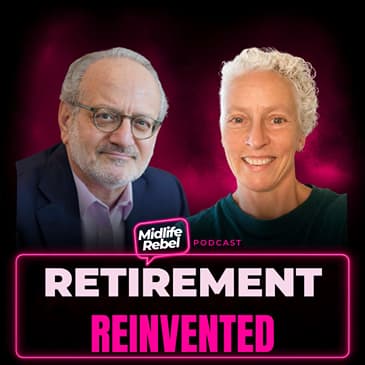
Retirement is supposed to be the reward at the end of decades of work. But when the diary clears and the job title disappears, it can leave us facing a much bigger question: Who am I without the role I’ve played for so long?
In this episode, I’m joined by retirement transition expert George Jerjian to explore what really happens when we step away from paid work, and why retirement can become one of the biggest identity changes of our lives.
George shares his own experience of reaching this point in 2016, including the 30-day silent retreat that gave him the space to look honestly at the life he had lived and consider what might come next. We talk about the strange in-between territory of retirement, when the old version of life has ended but the new one hasn’t quite taken shape, and why simply withdrawing from active life can leave people feeling lost, disconnected and without purpose.
We also explore the practical side of creating a meaningful next chapter. George takes us through his DARE method — Discover, Assimilate, Rewire and Expand — and how it can help us uncover who we are beyond our careers, responsibilities and old identities.
We talk about growth mindset, finding clues to what brings us alive through experiences of flow, the role fear can play in pointing us towards something meaningful, and why our physical and emotional wellbeing — including something as fundamental as sleep — can influence the decisions we make about what comes next.
Drawing on his research with people across the English-speaking world, George also shares what he has learned about the people who thrive after retirement and those who struggle to find their footing.
Whether retirement is still somewhere on the horizon, has recently arrived, or you’ve been there for years and find yourself wondering, “Is this it?”, this conversation is an invitation to see retirement differently — as an opportunity to discover what you want the next chapter of your life to be.
Visit our website to find out more about this week's guest.
All of our guests, including this one, are included in our Guest Directory so that you can find out more about them and the work that they do.
https://midliferebelpodcast.com/guest-directory
If you'd like to support the show you can buy me a coffee!
https://buymeacoffee.com/midliferebelpodcast
Good morning.
SPEAKER_02Good morning, Nadine. How are you?
SPEAKER_00I'm very well. How's it going?
SPEAKER_02Well, it's very early for me. 8 30 in the morning.
SPEAKER_008 30 in the morning. I'm such an early bird. Like, that sounds like a sleep mate major sleep in for me. I'm I'm a real morning person. I'm up at like 4 30, 5 o'clock.
SPEAKER_02So oh really?
SPEAKER_00Yeah.
SPEAKER_02So do you mind my asking what time do you sleep?
SPEAKER_00Oh well, I go to bed pretty early. Eight eight thirty, eight, eight thirty.
SPEAKER_02Oh my god.
SPEAKER_00Yeah.
SPEAKER_02That is okay. Uh yeah, well, you're obviously um going with the sun. Uh I get it. Yeah. You're going with the natural flow.
SPEAKER_00Yeah. Okay, that's I'm grateful for you to get up and and uh be surprising with me.
SPEAKER_02No, no, I get up at 7:30 normally, but I'm just not ready to um to chat, but I am today. I am today. But I'm just saying that's all. It's not because it was early, early.
SPEAKER_00Okay, yeah.
SPEAKER_02But it's um, but that said, um, I'm 71. I find that sleep, I find sleep is so important.
SPEAKER_00Right, because a lot of people when they uh get older say that they don't sleep as much.
SPEAKER_02They say that I find that weird because I find that actually um if you if I don't sleep enough, I get stressed. Sleep is a great um, sleep puts me in a space of um being calm and able to respond as opposed to react because I'm in a my body is um in equilibrium, if you like. I don't know. Sleep is kind of like a different kind of food for me.
SPEAKER_00Yeah, oh I agree. Well, that hence me going to bed uh, you know, after sundown. Um, I think that they say well, I've done a little bit of reading. There's a guy called Matthew Walker who um god, I think his book might be called Why We Sleep. Um, and he's done lots of studies on like the benefits of sleep. And he talks about REM sleep as a way of consolidating our experiences. That kind of coincides with what you're saying about it makes you feel less stressed. It's like we that's how we process what's been happening in the day.
SPEAKER_02Yeah, yeah. I've I've heard that before, I haven't sort of thought about it, but now that you say it, it makes complete sense because we do process things in sleep.
SPEAKER_00Yeah.
SPEAKER_02And um and sometimes you know we get the answers and sometimes we don't.
SPEAKER_00But we always feel better in the morning after a good night's sleep. And don't we always say, How did you sleep? Like we know the importance of yeah, no, no, yeah, absolutely.
SPEAKER_02Um, and if I've not had a good night's sleep, the next day is um crack a bit challenging.
SPEAKER_00Yeah, but anyway, um can I ask you? I've got a new microphone, and I've got um I had a a blue yeti microphone before, and it picked up loads of the external noise. And I think this is better, but I've got my fan on, and I wonder if you could tell me if you can hear any.
SPEAKER_02I cannot hear your fan. Oh, I love this, so good. These microphones are pretty good. I mean, my um mine's a road. Oh, yeah. One of your nation's products. Okay, and I love it. I love it totally. I had a blue Yeti. This is definitely better.
SPEAKER_00Oh, yeah. Well, this is a Q2U, Samson, and um it's pretty basic, but the I the I use Buzz Sprout as my podcast platform thing, and they recommended it. They were like, you know, it's it's just uh just kind of basic, but does all of the does all of the things and the sounds pretty good. So that's what I went with.
SPEAKER_02All right, Nine, I'm in your hands, take it away.
SPEAKER_00I've already hit record, I've already hit record. So um okay I yeah, I love just sort of easing into the conversation, and sometimes you know, you capture bits and pieces that are like the you know, the the goody bits, and and then they're not recorded. So
From Retirement Rebellion To Mindset Teachers
SPEAKER_00we are on. Well, I was doing a little bit of research, George, and the first thing I came across when I was doing my research was your your podcast. And I'm not sure do you have more than one podcast or not?
SPEAKER_02Um, I don't have a podcast, but I'm a guest on many retirement rebellion. Um, retirement rebellion was what I kicked off with.
SPEAKER_00Oh, well, that's what I came across in 2018. Oh well, I listened to Joe Despenser, the one about Joe Despenser. Oh, because I'm a fan.
SPEAKER_02I did six of those of the people that I had kind of studied with. Um, and Jojo Spencer was one of them. Bruce Slipton was another. Um, and and I and I kind of picked up six that I thought were kind of foundational for how I was able to change and adapt. So let's talk about Jojo Spencer. I would love to.
SPEAKER_00I would love to. Well, I so your podcast was that that six series podcast was is called the Retirement Rebellion. That's the first thing I came across when I you know searched your name and put went into the podcast. That was still available now. Well, it is, it's great, and I loved it. And I was like, Oh, yes, I'm so pleased that I came across that because um it really resonated for me. And I was just really curious about you know, you've you're talking about retirement and um you're a retirement transition expert. And you have obviously, as you said, studied some of these um well-known names, Joe Despenser, Bruce Lipton, um Eckhart Toll was mentioned as well.
SPEAKER_02Yes. Um James, James Allen, way back.
SPEAKER_00Yep, and Ken Robinson, Brene Brown.
SPEAKER_02Brene Brown, one of my hot favorites.
SPEAKER_00Okay, cool. So I don't know. Should we start there? Should we start with with your experience with Joe Dispenza and like how you have used his work in your personal growth um and your journey in like through retirement? Like, what's what's been happening?
SPEAKER_02Yeah, well, that's a great place to start. And what I like about this is that you're the first person that's actually delved into this. So it's um, you know, it's nice to have fresh uh conversations about new areas and topics. So I'll pick up on that. Um I went on a learning spree because I realized that um the roadway
The 2016 Crash And Liminal Space
SPEAKER_02had come to an end for me um back in uh 2016, and I had to find a new way. And there was no manual out there. There was no, there was no one to say, you know, oh, here's a manual, this is where you can kick off um and try and explore this area. Um, and so I had to do it all by myself, and um and I was treading on territory that was challenging everything I believed in. And that's really hard because you're fighting yourself, you're fighting the things that you thought were rock solid, and you built your whole life on it, and suddenly it's all it doesn't make sense anymore. And you're in this what is called liminal space of and it's a space of uncertainty, and we hate that. I hated it. But I had to become comfortable with the uncomfortable, and so when you have teachers um uh who are pushing the envelope, and a lot of my friends would think I'm balmy to have even touched that, you know. I'm talking about people my age, um, who are I think kind of traumatized, they can't move on. You know, their life has now come to sort of this last chapter, and they don't believe there is another chapter. You know, you're delusional to think that there is. And well, I know from the teachers that I've learned from that if you believe you can't, then you can't. Yeah, and if you believe you can, well, then you can. And so that's the kind of um uh mindset issues um that I learned about. And I deliberately went down this road, and I kicked off with Bob Proctor, the Canadian mindset coach, uh, who passed away. Uh in fact, he might my second book, Dare to Discover Your Purpose, which was based on his teachings and the teachings of people before him, uh people like um Andrew Carnegie, um Napoleon Hill, uh and and all these uh people who taught about mindset. And um and then I kicked off to these other people. But Bob Proctor was my first port of call because I wanted to learn about mindset.
SPEAKER_00Yeah. So what happened to you in 2016 when you said that you were a place where you didn't know who you were, what you were gonna do? Like what was what was going on for you there?
SPEAKER_02Everything in my life was crashing.
SPEAKER_00Okay.
SPEAKER_02Uh my work, um, my investments, my relationships, everything was crashing. And it was um it was a horrible place to be, and I had to get out, and I didn't know how to get out, I didn't know where to go. And thanks to my um beautiful younger daughter, Elizabeth, who was um in her early 20s, but very wise for her age, said to me, Dad, you need to get out. And I'm going, I can't believe I'm hearing this. This is such good news. What person to fight? And she said, You need to get out. You need to go, you need to go and well the way she said it, you need to go and get your shit together. And so I did. I went on something that I always wanted to do, but was uh either afraid of it or um thought that it wasn't something that
Thirty Days Of Silence And Breakthroughs
SPEAKER_02um I should do because you know we have a lot of the should, shoulda, coulda, you know, and all that stuff. And I always wanted to do a 30-day silent retreat.
SPEAKER_00Oh wow.
SPEAKER_02But I thought, you know, A, 30 days, are you kidding me? Um secondly, how much is this gonna cost? And where do I dig the time to do this? Right? There's all these questions. Um but when the situation is serious enough, you think, you know what, I'm gonna bite the bullet, I'm gonna do it. And it was one of the best decisions I'd made. Uh, going on a 30-day silent retreat, um, first of all, they wouldn't take me initially because they they'd like you to do um uh uh eight days or ten days first of silence before you jump in at the deep end. Um, I think it must be the same as scuba diving. Uh you you need to come up for oxygen, and if you do too much, you go brain dead or something. I I don't know what it was, but um I said that I can't do eight days because if I do eight days, that's all I'm ever going to do. And object is to do the full thing. And so they said, okay, but if you struggle after 10 days, we will ask you to leave. I said, Okay, I can sign up for that, and that's how I got in. Um, and the concept of uh of uh the spiritual retreat or 30 days of silence is um an Ignatian thing, it's uh uh Ignatius St. Ignatius, the head of the Jesuits, had created this, and it's called spiritual exercises, and um effectively you're cut off from all outside noise, so it takes you on an inner journey, and it's an inner journey that takes you through um it's a bit like going into Dante's Inferno. Um, it takes you into the sort of the darkest parts of your own life, and I think if you surrender to it, it's a lot easier, but I think people fight it because there's ego involved, there's um your own sense of self feeling being cracked open. Um, but what it is is in that silence, there's no newspapers, no TV, no emails, no phones. Um I mean, obviously in emergencies you can't make a phone, but the whole point is it's a self-insulating um thing. And I only you you only get 30 minutes with a spiritual director. The point being that um, and and and let me just put it out here: this isn't just for Catholics, it's there's all sorts of uh denominations that attend this because they see the value of going through this process. Um, and the only book that you technically have, or two books, is the Bible and the spiritual exercises, and so it takes you through a process, okay, of the the journey that Jesus went through, as it were, and you kind of go alongside it and allow yourself to open up, and you have somebody to talk to about what happens each day. So 15 minutes on what happened to you the day before, and 15 minutes on what you're gonna do today, and in the meantime, do you do a lot of meditation? Um, I also used to do two and a half hours of walking in the Welsh hills where there's not a single human, but millions of sheep. And in that silence, did I speak to certain sheep? Yes, I did.
SPEAKER_00Okay, so you did kind of break the bound.
SPEAKER_02Oh, I did. Oh, oh yes. Are you looking at me? You know, that kind of conversation. But you could you have to have fun with this as well. It's not you can't sort of make it all um uh super serious. And um, I had some wonderful insights. Um, where do I start with the insights? Um let me just share one, uh, which is well, before I get to the insights, one of the exercises is to do an audit on your life. And one of the ways you do an audit on your life is to choose the homes you'd lived in.
SPEAKER_00Okay.
SPEAKER_02And I'm a writer, so I write everything down. And I went back to the first home I remember and looked at the good things that happened to me there and the not so good things. And you do this for each home as you go through. And I got 12 lovely stories out of this exercise, which ended up being my book called Spirits of Gratitude: Crisis or Opportunities, because every crisis that happened to me in these homes, and some were mine and some were not, um opened me up to new opportunities that would not have come about without the preceding crisis, if that makes sense.
SPEAKER_00Yes.
SPEAKER_02And so, and we're never grateful when we're in a crisis for obvious reasons,
Retirement As Crisis And Identity Loss
SPEAKER_02right? But actually, they are we should be grateful for them in hindsight, because they open us up to new opportunities. And in a sense, that's what retirement is. It's a crisis, okay, in a true sense of the word, because crisis is a turning point.
SPEAKER_00Yeah.
SPEAKER_02And retirement is a turning point, but it's not a turning point in a linear sense. You know, like um you get married, um, that's a turning point. You have kids, that's a turning point. And you have manuals for each of these things, right? Your parents can tell you, your friends can tell you. Uh there are thousands of books on this stuff, but there's very few on retirement. And retirement isn't linear. You don't just sort of end your work one day and move into this next stage and it's all hunky-dory. Um, and it's not as though that it's only one aspect that's going to um change in your life. There's multiple transitions happening at the same time. Loss of work, loss of structure, loss of identity, loss of routine, loss of friendships. And then a new transition with your own partnership at home. You're now seven days with the person that who was only who you only saw X number of hours a day for decades, and now you have a real partner for life. How terrifying is that? For both parties. Um, and that's the point. And the changes are massive. There's um for men particularly, um, there's a tremendous loss of power. And that wreaks absolute havoc on their self-esteem and self-worth. And so, what do you do here? Sorry, I digress from your question.
SPEAKER_00I don't know what my question was anymore, but that's all right.
SPEAKER_02What happened in that um in that 30 days?
SPEAKER_00Yes, yes, yes.
SPEAKER_02So let me just just briefly talk about um if that's okay with that.
SPEAKER_00Yeah, keep going, yeah, for sure.
SPEAKER_02Um one of the things that happened uh in that thing was that I'm I'm I'm a really very persuasive person. And when I put my mind to something, I'm like, ooh, sharp, really sharp. I go right to the bone. Um and I I one of the days that I was there, I was sort of meditating, and I imagined I was slumped in the I I don't know why I was there, but I was there at the bottom of a swimming pool, with my back to the wall, my legs on the floor, um, and ostensibly breathing. I'd go explain that, I don't know. But I was there, and that's what happened. And all the people I'd hurt and the things I'd done. Okay, first of all, I was trying to put out, I haven't murdered anybody or anything, but just, you know, all my sort of um deeds that I'm not proud of, if you like, were rising up in bubbles. And normally I slice through them to justify. I'm very good at that. And I thought, nah, let it rise. I'm not fighting this. And it just all those, and at the end of that meditation, I felt incredibly light. It was like boulders were taken out of me. Um moving fast forward, by the third week, I had found myself walking, like as I said, two and a half hours a day, and I was just weeping as I was walking. Just effortlessly, just tears were rolling down. I couldn't believe that my tear ducts had that kind of liquid in there. It was just, you know, endlessly flowing, and there were tears of sadness. By the fourth week, I was still weeping. I know it sounds incredible, I still can't believe it. Um, but there were tears of joy. And I felt so light. I could literally fly. It's extraordinary. The nearest I've got to this sense, and you know, don't forget, by this time it's like fourth week in that silence. So I mean apart from the sheep. Is apart from the sheep, of course. Um But the weird thing was that the nearest I've achieved this sort of level of um going into an alternate state was doing mushrooms.
SPEAKER_00Okay.
SPEAKER_02Where you go into that state and you know, it's microdosing, obviously. You know, it's not for recreational purposes, but it's for trying to get to your higher self, if you like, in connection to you know what is it I want to do with my life, that kind of thing. Or reconfirming, am I in the right direction? Am I doing the right thing? Um, should I be looking elsewhere? And soin helps you with that kind of stuff, and it's much quicker. You can do it within a day. 30 days is a long time, but they're very different in the sense of you can go so much deeper on a 30-day. Whereas, you know, a one-day, yes, you can go deep, but it's it's um it's it's quick and dirty. It you're not gonna get the same essence and material that you get in a 30-day salon retreat. So, um, so yeah, that those were the sort of the what I discovered. And as I said, 12 stories ended up being spirits of gratitude, crises or opportunities, which was really my first book in this area, which was kind of my own journey of crossing over my rite of passage into retirement. And what do I do in this next chapter of my life?
SPEAKER_00I've just loved there's so many correlations um for what you've talked about, like that that crossing over, that initiation or rite of passage um that I have experienced as a woman in midlife. And I wonder whether, you know, it's another experience as well, because we have that hormonal shift that happens. But there are also those questions about who am I, you know, now that well, I mean, I know that men I know that men are, you know, parents as well and caregivers, and you know, so you know, who am I now when my children have left home? Who am I now because my job doesn't feel quite as fulfilling? You know, what's my purpose? Those questions all start to come up and have definitely been very prominent for me in this chapter of my life, which is a little earlier, but also um, you know, you were saying like each experience that you had in your homes or you know, crisis that you had that you had to overcome helped you learn for the next stage and it helped you your with your growth. So, like one can only assume that you know, my 40 to 50, and I'm now in my 50s, you know, that that rite of passage. Um, 100% is preparing me for the retirement or not.
SPEAKER_02Well, no, no, it I it is. I mean, uh no, these are not silos, right? It's a continuous flow. And so what you're getting is the pre-retirement uh you're getting the part one, getting the warm-up, you're getting the warm-up, absolutely. It is yours, is the warm-up, yeah. And in some ways, I think the earlier you catch on to this, the easier it is to navigate the next one. Yeah, it's people who've had it. I I don't like to use the word easy because it's nothing as easy in life. Um, people who haven't had battering or shocks in their lives, when they come to retirement, it's such a it's such a massive hit that a lot of people go under.
SPEAKER_00Technically. Do you think also there's the there are there are different selections of people like I know you said you don't like using the word easy, but there are also people that like to follow follow the crowd. So, you know, you do all of your life in a linear fashion, and and retirement's just another step in the process. And once you retire, game over, you know, getting ready to die kind of thing. That's a bit extreme, but but then it's not extreme, it's there's not extreme, you know, people like you on the other side of it that are like, hang on a minute, I'm not ready to finish this, I'm ready to do something new, so there's there's a bit of that as well. Do you reckon?
SPEAKER_02Yeah, no, there definitely I I think that um this is the thing. We spend the first part of our lives trying to belong, and in the process, we suppress our individual individuality because it gets in the way, and in the sense we betray ourselves to belong, and we all do that, even with our own families.
SPEAKER_00Yes, I know, and that's another thing that I'm exploring right now. But can you can you tell me your experience with that? Like, have you do you feel like you have uncovered through uh like we started talking about some of that personal development stuff? Do you do you feel like you have uncovered the truth of who you are? Or is there still layers?
SPEAKER_02Whoa, whoa, that is a heavy question.
SPEAKER_00Oof, oof, oof.
SPEAKER_02Ooh, have I I I am on my way to, I wouldn't dare to say that I have. Um I I think probably um I'd be able to answer that question on my deathbed, but before then, um, but I'm not who I was. Um, one of the things I discovered in my trying to understand about retirement is the the concept
Survey Findings On Health Money Purpose
SPEAKER_02that um, and again, I I got this from Carl Jung, and I've not heard other people mention this before, but I for me that really resonated. Uh, Carl Jung said, what was true in the morning of life becomes a lie in the evening. What was true in the morning of life, I'm paraphrasing, becomes a lie in the evening. And that what he meant by that is in the first part of life, it's about ambition. For men, particularly, ambition, accolades. Uh, for women, I think Brene Brown has kind of covered that bit. Um, it's about ambition, accolades, achievement. By the time you get to your 60s, it's like it's too much damn effort for too little reward. And so we go through a process. I think this is the rite of passage on we don't have a manual for it, and that's why people struggle. Um, the first part of life is about accumulation, the second part of life is about decumulation. And I walk my talk. I I had a house, I had family, I had lots of stuff, I had over a thousand books. Now I have a Kindle. I have decumulated. I literally um have two suitcases of clothes. I have got rid of everything except what is essential. Now, it doesn't mean that's where I'm gonna stop. I may start to accumulate again, but not in the same frenzied way as I did when I was younger. I don't need the clutter. I want to be able to move around easily. I don't need um I don't need possessions to weigh me down. Um I don't need extra costs that I need to then work to pay for, if that's making sense. Um and in a sense, you're you are preparing for your eventual demise on the planet, but in a way that gives you joy. Again, some of the things I've studied that brought that to me home to me was um and I'm kind of sort of jumping a little bit here, but um and I lost my thread.
SPEAKER_00Something that brought it home to me. You were talking about the like not having many possessions and the de cluttering. Decluttering, yeah.
SPEAKER_02Yeah. And I'm kind of I love what I do in helping people move through this transition. It makes me feel that, you know, I'm kind of like a guide or a teacher, something that I've never been before. Um, and it gives me great joy to see people make this transition successfully and to actually design their own life. I just, if you like, um help them to keep the scaffolding while they're kind of moving across, as it were. Um because one of the things I discovered in the process of my research into this was that um I asked over 20,000, 20 over 21,000 people uh in a survey and in the English-speaking world, which included Australia and New Zealand. Um 35,000 people came in on the first question. 20 just over 21,000 completed all nine questions. So it's a good database. It was done during COVID.
SPEAKER_00Okay.
SPEAKER_02Um and the survey was on Facebook for people aged between 55 and 75 in those five uh Anglo-Sphere countries. And um, having done the um the survey, um, the issues were 50% of the people thought health issues were the ones that were challenging, the most challenging in retirement. Um, 35% said uh outliving their savings was a major factor, and then the rest, 15% was per and having no purpose. Um when I gave them an opportunity, if they had a magic one, what would they change? Uh the 50% health was still 50%, but the others switched, having a new purpose, 36%. So people know when they when you give them agency, they know what they need to do. Um, the trouble is implementing it because it has a cost. And the cost is you need to look at your relationships, you need to look at areas of your life that are gonna destabilize.
SPEAKER_00Right. Yeah.
SPEAKER_02And above all, you need to look inside yourself, and that's a big ask. It's a big ask. But what I discovered is I I ticked all the boxes. I knew I'd done everything right from a marketing point of view, from asking people. But what I discovered was that there was something missing, and um, I came across a quote from Henry Ford, the founder of Ford Motor Company, who said, if I had asked people what they wanted, they would have said faster horses.
SPEAKER_01Yeah.
SPEAKER_02And that was my aha moment. I realized I'd asked people what they wanted, but they don't know what they don't know.
SPEAKER_01Yeah.
SPEAKER_02And I realized the first casualty in retirement is identity. Who am I now? Now, I think in your 50s, the identity, your identity is still quite strong, and you're not considering changing that. You're looking about fiddling with the bits and bobs at the edges to pivot a
Finding Flow And Facing Real Fears
SPEAKER_02little bit, but you're not looking for a major change. And in a sense, I think retirement is asking us now, as opposed to on our deathbeds, what is there that you've always wanted to do that you haven't done yet? And that's a really big ask. And for most people, it's like, oh, for God's sake, get that teenager out of here. You know, the teenager inside us that we are suppressed for years so that we could just get on. And it's about bringing, it's not about finding a new identity, it's about realizing that we have other identities that have not been used, and we need to question um and we need to be a bit of an archaeologist without destroying things, to get and dig and you know, probe and see what other aspects of myself which came naturally, which flowed, which we had to suppress. And we all have that story.
SPEAKER_00Yeah.
SPEAKER_02Male or female.
SPEAKER_00Yeah. How far back do you reckon that you need to go to like find that? Is it the essence?
SPEAKER_02I don't think it's a chronological issue. Um I think it's more of um like think of a time and activity that you did in the past that made you lose all sense of time. When you lose all sense of time, it means you are in that flow, you're in that joy, you're in that enthusiasm. And the word enthusiasm means in the spirit, so you're in that spirit of creativity, whatever it is that you do, that is you gotta listen to that. Don't sweep that under the carpet. You have to listen to that. Now, it may not be in the format that you might originally have thought, but you can recreate it into a new area or situation that would be wonderful. And and the thing is, is that this wouldn't be something that, oh, it'll be nice to do this, like whatever it might be, say gardening for argument's sake, right? But you could actually earn some money from it. Because the vast majority of people are going to outlive their savings, and you don't want to be thinking about going back to work when you're 85 and on one leg. You need to be doing that work now, and that will carry you mentally, physically, emotionally, spiritually, because you now have a purpose, and it's aligned to your more authentic identity.
SPEAKER_00Okay.
SPEAKER_02So that's kind of where you would be going with that. The other question I ask people is if they can't answer that question that I've just given you, is what are you most afraid of? Because what you love is right behind that. And I get that from um Joseph Campbell's quote. Okay. The cave you fear to enter holds the treasure you seek. Can you give you fear to sorry?
SPEAKER_00So yeah, I was just gonna say, can you give an example of that? Like when you say that the thing that you most fear is um the um the answers behind it. Can you get can you give an example of that?
SPEAKER_02Yeah.
SPEAKER_00Um, it means I kind of get what it means, but like, have you got an example of someone you know or your own experience?
SPEAKER_02Yeah, I mean, my own experience, and and I think for m millions of other people, it's if you do what you want, you might endanger um the relationships that you love and badly.
SPEAKER_00Okay, right, yeah.
SPEAKER_02And that is a it's a primal thing. It's like um, and if you don't follow, right? This isn't about having a fight and then moving away, right? That's childish. That's not what you want to be doing. What you want to be doing is talking about your feelings and what you need and want, um, and it's very likely not to be accepted because you your relationship up to this point is almost carved in stone, if if you for lack of another word, um, and you need to navigate this, and your partner may decide not to come along with you on this journey. Now, that could be very hard. And so you have a choice. Do you betray yourself and keep the relationship? Or do you let's use harsh words, or do you betray the relationship so that you don't betray yourself?
SPEAKER_00Wow.
SPEAKER_02Difficult questions, difficult challenges, you can't sweep it under the carpet. We all do because we don't want to face it. So those would be the sort of things. Um, and and it's always primarily to do with the people you love.
SPEAKER_00Okay.
SPEAKER_02And the the fact that the foundations will be rocked.
SPEAKER_00Okay.
SPEAKER_02But my belief is that if that relationship is rocky. Is no, well, if it's rocky, it's gonna, it's gonna break down completely. But if it's not rocky, if the uh you know if the love is there, then um you will remeet post the transition.
SPEAKER_00Yeah.
SPEAKER_02Um, and that's why I say don't break things.
SPEAKER_00Did that happen to you?
SPEAKER_02You need to navigate this.
SPEAKER_00Yeah.
SPEAKER_02You have to navigate it. So it's painful. Yeah. Whatever you do, it's painful.
SPEAKER_00Yeah.
SPEAKER_02But one is going to be one that's salvageable potentially, whereas the other one, you've broken it, you own it.
SPEAKER_00Yeah. And it is it because like if you're in that relationship and up until that point, you have been, I mean, I don't want to say pretending, but you've got layers of identity that you've created to fulfill other people's expectations. Is that, and then you're kind of saying, I don't want to do that anymore. This isn't who I really am.
SPEAKER_02Uh it's yes and no. Okay. Yes, because what you're saying is correct, but you're not necessarily doing it for the other person or for the relationship. You've been doing it just because that's what we do. Constructing it because you are creating this um construct of identity that makes you look at your best, but it's not necessarily you, right? But you know, because that's how you want to be seen in the world. Um, and it's about evolution, right? Your identity is now the old part of you isn't dead. There's another one. The old part of you you almost have to negotiate with, thank that part of you that brought you to where you are today. Without that person, without that identity, you would not be where you are today. And so I think it's it's trying to understand and and love yourself first.
SPEAKER_00Yeah.
SPEAKER_02Right? I mean, we we we hear the biblical quote, you know, love your neighbor as yourself, which isn't really workable because in the life that we lead today, most of us don't love ourselves. So the question is, how do you love your neighbor?
SPEAKER_00Yeah, right?
SPEAKER_02So you've got to flip that back. It's an equation. If one side doesn't work, the other one's not gonna work either. So you have to love yourself first, then you can love your neighbor.
SPEAKER_00Yeah. This um, I'd love to talk more about the the actual process that you do you you've written about, you've got the DARE method,
The DARE Method And Growth Mindset
SPEAKER_00and like how long this takes. It sounds like it's quite lengthy and deep. You've got to be like it sounds like you need to be pretty much all in and face some.
SPEAKER_02I think you do, but you don't need to uh worry about doing that on day one. Yeah, it's a process that um if you allow the process to take the time it needs to take, and it's different for everybody, um uh you'll get to where you're going to. See, once the intention is set, you start making the moves.
SPEAKER_00Yeah.
SPEAKER_02And uh you'll be you'll you may be inclined to drop the whole thing and go back to the old space, which is comfortable. But um, I think once the mind is opened, it's very difficult to um close it again. But the the Dare method is um again, um I think it comes back to Brene Brown. Um Daring Greatly was a book that really I I thoroughly enjoyed, and it was a very educational book for me. Um But it was just serendipity that my book is called Dare because my marketing girl, who's actually brilliant, took my four my eight steps or four steps and said, Um, we can call this the DARE method.
SPEAKER_00Of course.
SPEAKER_02And I just sort of you know fell off my chair.
SPEAKER_00Well, it fits perfectly, doesn't it? Because it's like DARE to retire differently, almost sort of.
SPEAKER_02Well, it is, but it's also an acronym for the steps. But but DARE is about courage, and courage is not a mental issue, it's a heart issue. Um, and so this transition can only be done um if you bring your heart along with the journey because your mind alone is not going to do it. Um, and so DARE is also an acronym for discover, assimilate, rewire, expand. In one sentence, discover what retirement is and what it's not. A is for assimilate um a new understanding of how our mind works, particularly the subconscious mind, and how that helps, how you help to move to the next step, which is about rewiring the neurons and synapses.
SPEAKER_00Which kind of takes us back to Joe Despenser a little, doesn't it?
SPEAKER_02A lot of that stuff, uh Joe Despenser, Bruce Litton, you know, they all talk about the same thing from different perspectives. But it is about changing the inner dialogue. Right? Uh uh moving from a fixed mindset to a growth mindset. So for example, um, and I think Carol Dweck in her book Mindset talks about this. She talks about um fixed mindset would say, I can't do this. A growth mind would say, I can't do this yet. Yeah, one word changes the pivot, allows you to see possibilities, whereas the other one is categoric, no possibilities, I can't do this.
SPEAKER_00So how if someone when does someone start this process? Because um it's not just as you said, like retirement is not just like one day, well, it can be, I suppose. One day you have a job, the next day you're retired, but this process is deep psychological um work, yeah, like as you said, rewiring, changing the way that you think, like, yes. When would someone come to you? Would they uh is it like, oh, they've done the retirement thing, and then they've realized that all of the things that you mentioned previously about identity and you know, changes in relationships and what you do with your time. Does that happen? And then they go, Oh shit, I need to do something about this, or is this like
When To Start And Course Options
SPEAKER_00prepare for retirement?
SPEAKER_02It's it's all three. There are pros and cons to each. Uh, you could prepare this like a year or even three years before, um, and you can sort of slowly come into the uh understanding, and by the time you you retire, you're you're already ready to to move across. Um there's advantages and disadvantages of doing that. Uh, the advantage is that you know you've got a you've got a nice sort of um uh runway to and you're preparing whilst you're still in your peak. Um to do it just after you retire um is probably would seem to be the best time to do that. Um, but you don't have any runway now.
SPEAKER_01Yeah.
SPEAKER_02And number two, you haven't experienced the pain of being in retirement.
SPEAKER_01Yeah.
SPEAKER_02All right, because there's advantages to that too. And then, of course, there are people who've been retired for a couple of years, and they are in a very different place. Lack of self-worth, I don't know who I am. Um, they're feeling all the pain and potentially feeling all the pain to the extent that I need to find a way out. So they are fully ready. They're like sort of, you know, uh low-hanging fruit ready to drop. Um, so there are pros and cons. It doesn't really matter. Um, I'm a big believer in you come to this when when you're ready. It happens when it happens. And mine is an eight-week course.
SPEAKER_00Okay.
SPEAKER_02It's a digital eight-week course, it's all pre-recorded material, uh, very inexpensive. Uh, I think it's 197 pounds, about $260. Eight-week course, and you get drip-fed each week, and you have an exercise each week, and by the end of it, you end up with a one-page plan of your own creation, your own design to start this work. Right? Yeah, um, the other one is a live one with me, 90 minutes each week. The same work, the same exercises, um, but I'm there to hold your hand, ask lots of questions, and also you learn a lot from the other people on the course.
SPEAKER_00Yes.
SPEAKER_02And occasionally I learn too, because there's so many different people, so many different experiences, and it's actually magical. Um, but that one is because it's live, it has me 90 minutes a week for eight weeks. That's um 1,997, just under 2,000 pounds. Okay, I think that's $2,600. Right. But those are the two courses available, and then I also have courses, the same ones, for HR departments in companies, and also for wealth managers and financial advisors.
SPEAKER_00Okay. So let's talk about this word retirement. Because I think what you're kind of, I know people need to be able to find you and know what you're
Why Retirement Exists And Who Benefits
SPEAKER_00doing, but the the actual word retirement you're is is null and void, isn't it?
SPEAKER_02Well, that's why drop retirement rebellion. Yeah, that's why drop retirement rebellion because it was moron. It was an oxymoron. And also at the end of the day, you know, I'm not running a large organization doing this. I'm a I'm I'm a one-man band. This is what I teach. And I'm kind of an activist in this area, yeah. And I'm a writer and speaker. Um, but retirement, um, and the best description of retirement is a withdrawal from active life. And uh Albert Einstein said, nothing in nature retires, it's either growing or dying. So if you've chosen retirement, you're right, yeah, it's God's waiting room.
SPEAKER_00Yes, yeah, it's depressing, isn't it?
SPEAKER_02Nice to have met you. See you on see you in the next on the next planet. But retirement is a very ugly word. Um, in fact, I think it was Ernest Hemingway who said retirement is the ugliest word in the English language. And um, I don't know if that contributed to his suicide or not, but um it kind of seems to rhyme a little bit. Uh, he must have come to the end and thought, I can't go through this shit. I don't know. Where does that go through people's minds?
SPEAKER_00Where did this idea of retirement ever come from? I feel like there's so many things, like where there's just the societal, you know, stories about, you know, this is what you do at this age, and you know, you get married, you have kids. I've talked about this a lot on the podcast because you know, as women, we go through all of these stories as well. Um, but retirement's just another part of the story, isn't it? It's like, oh, you need to start slowing down, or you you know, and and we're we're fed all of this stuff about like your health declines, and um, you know, you need to yeah, you need to slow down because your body's not going to be able to handle as much and so on and so forth.
SPEAKER_02Well, I studied this. Oh I studied, I did, and again, I I love the questions you come up with, Nadine, because you're asking questions that I don't get asked. Um the thing about retirement is I I kind of went back to study, you know, where this retirement malarkey came from. And um the earliest I could find, and I'm sure there were earlier ones, but the earliest I could find was Caesar Augustus.
SPEAKER_00Oh, Blimey, it's a long time ago then.
SPEAKER_02Yeah, it was. It was. And of course, you'll remember his uncle, Julius Caesar, was assassinated. And uh Augustus, who's called Octavian, was uh a more cerebral kind of kid, you know. He wasn't uh he he wasn't he he wasn't into muscle and into he it was just he was a bit nerdy. Okay, and um and he realized the value of having a strong army on your side, and so he his imperial Roman army didn't have pensions, and so when these generals reached a certain age, they were scared, and so they started plotting to make sure that they didn't die impoverished, so he devised this plan of you know, 25 years service, right? Yeah, you will get you will continue to get your annual salary for the rest of your life, right? So this isn't just for the top brass. The top brass got special dispensation that any new territories conquered by the Roman Empire, they would get those new domains, and the people that work the land would pay them a percentage to supplement their income. God, I love the good old days, don't you? And to have people working for you, giving you a percentage. I mean, that's brilliant. And so he secured all the top brass. What other emperor would do that for you? Why would you even need to consider treason and then potentially get killed for it? And then he also did the same, but to a lower extent, with all the rest of the uh military units. He um provided them with an annual income, but they needed to have served in uh 25 years and 12 military campaigns or something like that. They had kind of like categories. But the army never went hungry, is what I'm saying. Whether they reached uh uh when they reached the age of they unable to fight any longer, they were looked after. And that's the way he secured his own position, and he created a thing called aurorum militare, which is basically um military gold. And it got so big and so rich that the Roman Senate started borrowing against it. So for the following emperors, right? Only took two emperors' reigns for that to be depleted, a bit like our social security. The government borrows against it and depletes it. So that was the first one, and then afterwards, and I'll probably end with this one, is Bismarck came up with it. Uh FDR in in America came up with it. Um, we in Britain, Australia, and yeah, everywhere. Um, it all started happening. Um and Bismarck started it because he was afraid of the Marxists, because the Germans were falling in love with Marxism.
unknownOkay.
SPEAKER_02And of course, it was a way to um make the Germans feel secure so they wouldn't go off the reservation.
SPEAKER_00So they just kind of promised that don't worry, if you stop working, we'll carry on paying you, i.e., pension.
SPEAKER_02Yeah, and also in later life, the first pensions that started was actually with the railroads in America.
SPEAKER_00Okay.
SPEAKER_02And it was American Express in 1860, whatever it was, uh came up with the first personal private pension plan. And a lot of the railroad people, the reason they gave uh pension promises was to ensure the workers didn't go to other companies, they stayed with them. So it was the golden handcuffs, right? It was a way to hold people down, um, make them feel secure so they don't leave. Um, and in the 1930s, um, in Florida, golf clubs exploded um because companies needed to retire the older crew because they needed fresh blood. And the only way was to make them feel okay and secure and away from people who worked, so they didn't get any pangs of jealousy. Oh, I want to work, send them away.
SPEAKER_00So it's like they've just started to make room for new people, like the whole in it's like an industry, isn't it?
SPEAKER_02It is. I mean, today we have this problem that most of the people who are retiring um uh are being retired because there's not it's a system and they they can't retain these valuable people because the people coming from under them don't have the same capacity or um personality or work ethic. Um, and so a lot of these older people are being retired, and the company is losing a lot of their wealth with these people retiring. So and obviously there are activists trying to stop that flow, but it it's a challenge. Yeah.
SPEAKER_00So really, like if you if you didn't follow the the the system, I guess, of like you know, getting your golden handshake when you're 60, whatever it is, and retiring. What we need to change our mindset. It's not it's it's working potentially with more purpose or living with more purpose or serving with
Safety Stories And Choosing Adventure
SPEAKER_00more purpose. Would you say?
SPEAKER_02I I agree. I I think we have to um this is something that we all don't want to do. We we have been we have this inbuilt capacity to do what we're told.
SPEAKER_00Yes.
SPEAKER_02You know, our seven-year-old child within us wants to be told what to do.
SPEAKER_00Yeah.
SPEAKER_02Because we feel safe when we're told what to do. And when we go out of the reservation, we think, oh no, what's gonna happen to me? Am I safe? And the Hoppy Indians got it right when they said, We no one is coming to save us. We are the ones we've been waiting for.
SPEAKER_00I like that.
SPEAKER_02It is, it's so lovely when you realize that, oh my god, this isn't new. This has been going on for centuries, millennia. You know, the human spirit, we need to come out of the reservation and realize that life is no safer or no more dangerous outside the reservation than it is inside. The only difference is on the outside, you're gonna have adventures. So that's the one thing I can promise you. Now, um because you're not safe wherever you are. Safe from what is the other question. Safe from what? Illness? Illness can come to any one of us at any time. Yeah, you could be anywhere in the world, you can be right next to the uh Mayo Clinic, and they will not be able to save you. So, this idea of safety is what paralyzes us. This idea of safety, of being loved, of being um taken care of. What about flipping this over? What about loving and taking care of other people? How strong is that gonna make you feel? How good is that gonna make you feel? It's about flipping the script because there's no more or less love or no more or less safety in whatever it is that we do. It's just that notion that we've been fed and it's a lie we believe. That's the it comes back to the Carl Jung thing. What was true in the morning of life becomes a lie in the evening. How do you flip that? So what what you're doing now is true and authentic, not pleasing anybody else. First of all, you have to please yourself. What is it you love to do? I say all this, but I have to say this to myself every single day. Every day, yes, every single day. I have to repeat it.
SPEAKER_00Remind yourself, yeah.
SPEAKER_02Yes, because there's the part of me that wants to be safe and loved, and you know, in a good in that in that place, but that's not real. It's an illusion. This has been an interesting conversation.
SPEAKER_00Yeah, I like it. What about um so we're just we I'm conscious we're coming to the end of our
Client Transformations And New Chapters
SPEAKER_00hour, but I'd just love to know like what whether you have any particular examples of people that you've worked with um and how they might have evolved or transformed through this process, um, or your own experience, like with with um finding your own purpose and whether that's very different now to what you were doing when you did retire.
SPEAKER_02Yeah, um really good question. Um, I've evolved. I'm just speak myself first.
SPEAKER_00Yeah.
SPEAKER_02I've evolved. I'm not who I was. Um, I was a much more certain person uh about myself. Uh I was much more certain about my place in life, I was much more certain about a lot of things in life. I'm not that certain anymore, but I'm also okay with that most days. I qualify that because you know it is what it is. Um, but I'm uh I'm also doing very different work. I'm nurturing um a lot of things that I love to do, which I didn't before. I did it because it was working well with the construct of the person I had become. And I couldn't do some of the things I like because it didn't fit in with that construct. And so now I'm doing much more of the work I like to do, which I've talked about already. Um and um I'm more authentically me, and I am I'm okay with the uncertainty. I try to see it more as a sort of a I'm getting less security, more adventure. Whereas before it is more security, less adventure. It's kind of like the this the pendulum has swung. So that's me. Um and I love what I do.
SPEAKER_00I love that. That the and it's kind of reassuring to a degree to know that there is potentially more uncertainty, but it more it almost feels like more freedom as well.
SPEAKER_02Well, I think there's more life, more life, yeah. With certainty, it's um you're killing parts of yourself.
SPEAKER_00Yeah.
SPEAKER_02You know, we are we are free spirits inside, no matter how much we like to think we're not. I think everyone is a free spirit. But most people have forgotten that.
SPEAKER_01Yeah.
SPEAKER_02And so they work within, you know, we're a bit like donkeys on a on the pyramid on a on a sort of um uh uh uh excavation site where you know we've got blinkers on, we're told to move them, yeah, we move along. Oh now it's feeding time and then move along. Uh as opposed to sort of like taking the things off and just running away and thinking that I'm not a donkey anymore, I'm just magic. But anyway, coming back, clients. Um, I've had um numerous clients who uh I think all of them have transformed in one way or another, even those who thought they haven't. Um, because I I can see from that what they say and do that they've changed, even though they might not admit it to themselves. Um but a lot of them have changed, they've evolved. And Two, three years later, I I see, I hear of their exploits and stuff. And um there's one woman who was a nurse, and then she moved and became a business person with a another nurse, and they created a caring business where they would find nurses um they'd find nurses who would work privately, and they'd had place they'd place them.
SPEAKER_00Okay. Yeah.
SPEAKER_02And then they grew the business. And and then they reached the point where uh the my client was um tired. She wanted out, she wanted something new. Uh she was afraid that she would be disappointing her partner, her business partner, who has been a friend as well all these years, because she still wanted to stay on. But she had dreams, and she I got her to actually picture her dreams, to feel it, to visualize it. And she created this wonderful thing. I mean, even I wanted to move though myself. It was so good. Um she'd sort of created this um uh place by the by the sea, um, where it would be a sort of a therapy place, and she had pods. Oh, there'd be a mate place, and then she'd have pods, and the pods would be rented to other therapists with their clients, yeah. And then they could come and have something to eat or do a massage or do whatever. So there's a lot of um great ideas, but then she also wanted to do caravanning in Europe and visit her father. And um two years later, I spoke to her. Uh, she had sold her business, and her friend uh uh she and her friend were on very good terms, they sold for it for a good amount. They got a new contract and then solved it. Um, she did the caravanning through Europe in the meantime, and now she's on to this next stage.
SPEAKER_00Wow, that's so true.
SPEAKER_02So it it's it's not gonna happen overnight, but you need to take the steps to go towards your dream. But you need to know what your dream is, and and that takes time because people go, I don't have a dream, I don't know. I go, you don't know because I didn't either.
SPEAKER_00We suppress it, yeah, we push it down, we get told that it don't be silly to have such a dream, don't we?
SPEAKER_02Absolutely, yeah. You know, you can actually even hear the voices that told you that. Yeah, and what you need to do is not just bring the dream out, but I think you need to bring that part of your personality up to the forefront. So, for example, with me, after that 30-day silent retreat, I'd grown a beard. I felt like Moses coming down from the mountain. And I trimmed it obviously because I don't like sort of dirty long beards. But I I kept my beard for the last um 10 years, this 2016, um, was because when I came out of it, I thought I don't want to go back to the old George. Yeah, I want this new George, this gentler, softer George, to stay. And so I kept my beard. And I'm actually scared to, I'd like to be clean-shaven again, but it just bothers me that I might dangerously reverse.
SPEAKER_00You don't want to go back to old George, yeah.
SPEAKER_02So, yeah, another one was a woman who'd been depressed for three years. She was from Nashville, Tennessee. And um, she she did my course, the digital one, without me being around. And when she's when she finished it, she got in touch with me. And she said, Um, you changed my life. I go, Oh my god. I can't tell you how that feels. I cannot tell you the feeling. It makes your whole life, the work you do, so valuable. Yeah, it makes you reinforce any aspect of the work you're doing that you have doubts about. It reinforces it and makes you think, no, George, none of that negative talk anymore.
SPEAKER_00Keep going, George.
SPEAKER_02Keep going, keep going, don't listen to the doubters, just keep going.
SPEAKER_00Yeah.
SPEAKER_02She was depressed for three years because she was in the health care in the healthcare or health sort of business or whatever, and she reprogrammed herself to become a physical trainer, um, um, kind of like um a physical trainer coach or whatever. She took her license and everything else, and she's focused on helping elderly people. She's doing what kind of what I'm doing, but in her area, yeah, it's amazing. It was lovely, and she's kind of she moved um states, she's in Washington, no, Oregon, I think now. A whole new life.
SPEAKER_00So cool.
SPEAKER_02Yeah.
SPEAKER_00We're gonna um I we've come to the end of our conversation,
Where To Find George And Farewell
SPEAKER_00George. You've been so generous with your time. Thank you. I would um we're gonna share all of your details in the guest directory on the Midlife Rebel podcast website.
SPEAKER_02I was just gonna say actually, um, I didn't, I don't think I completed that form.
SPEAKER_00Oh, don't worry about that.
SPEAKER_02Okay, I I I will complete it afterwards.
SPEAKER_00I'll get you to complete it afterwards. So you will be on the website. Um and uh is there anywhere? All of your links will be there as well, but is there anywhere in particular you want to direct the listeners now if they're interested in finding out more about your work? Is there anything you've got coming up?
SPEAKER_02Uh the central place is my website, George Jurgian, as spelt on the um corner of bottom corner of the uh picture there. Yeah, GeorgeJurgian.com. That has everything.
SPEAKER_00Yeah.
SPEAKER_02My podcasts, um, the the lot, including all the social media handles and everything. Cool. So go there first.
SPEAKER_00Okay, great. Thank you so much for joining me. It's been a really great conversation. I really appreciate your time.
SPEAKER_02Likewise, Nadine. Thank you so much for this opportunity. Loved it.
SPEAKER_00You're welcome.
SPEAKER_02Loved your questions.