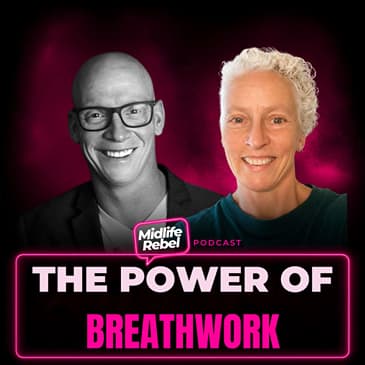
What does midlife actually feel like from the inside — especially for men?
In this episode of The Midlife Rebel Podcast, I'm joined by renowned breathwork pioneer Jon Paul Crimi for a wide-ranging conversation about ageing, identity, addiction, sobriety, and the work of turning towards ourselves rather than continually finding ways to escape.
We begin with midlife. The changes in our bodies, the strange new health routines we suddenly find ourselves adopting, and the deeper question of who we are when some of the things we've relied upon to define ourselves begin to change, and Jon Paul shares his perspective on navigating midlife as a man.
From there, we move into Jon Paul's own story. He speaks openly about his early struggles with drugs and alcohol, the path that eventually led him to sobriety, and what he's learned about the emotions and experiences that can sit underneath addiction. We also explore the grey areas — when life can look perfectly functional from the outside while something inside you knows it's time for change.
And then there's breathwork.
Jon Paul has spent years teaching conscious connected breathing, and we explore what can happen when we use the breath to move beyond the thinking mind and into the body. He explains why breathwork can feel uncomfortable at first, what may arise during a session, and how it can help us access emotions and experiences we may have spent years avoiding.
We also talk about nervous system regulation, intention, integration, finding space for practices like breathwork in ordinary life, and the importance of giving ourselves somewhere to put our attention other than the endless distractions competing for it.
This is a conversation about getting older, getting sober, knowing yourself more deeply, and discovering what can happen when you're willing to feel what's actually there. Because when nothing changes, nothing changes.
Because there’s a little bit of rebel in all of us.
Visit our website to find out more about this week's guest.
All of our guests, including this one, are included in our Guest Directory so that you can find out more about them and the work that they do.
https://midliferebelpodcast.com/guest-directory
If you'd like to support the show you can buy me a coffee!
https://buymeacoffee.com/midliferebelpodcast
Identity Beyond The Outside
SPEAKER_03Who am I if I'm not my outsides, right? People go through this if they lose their marriage or they lose their job, and if their whole identity is wrapped up in their career. But my identity, my self-worth was wrapped up in my looks, really shallow and embarrassing to say, but it's the truth that I you were already 25, right? Yeah, right. Exactly. So I went through that then. So I'm not going through the looks thing, but I am going through the health part of it where it's like I'm not as strong as I used to be. You know, I was a personal trainer for you know 20 years. So I don't have the strength that I have anymore. I don't have certain virality and the energy that I used to have. And so facing that has been very challenging.
Midlife Symptoms And Morning Routines
SPEAKER_01I'm ready to go whenever you are.
SPEAKER_03Do you have anything you want to establish?
SPEAKER_01Oh look, we've even both got jars for our drinks.
SPEAKER_03The jar is the way to go.
SPEAKER_01Oh my god, it's so hip and trendy.
SPEAKER_03My dad's I just like the size of it. Yeah. But also I'm finding like in the morning, I do uh aloe water because I have this GERD because I'm fucking midlife now. And I have GERD, which is a very old midlife thing, right? Okay, and so I have to do aloe water and it has the ounces on here. So I fill up the eight ounces of aloe water, right? And I drink that. Then I fill up my 16 ounces, it has that there of electrolytes is all the fucking thing for midlife, you know what I mean? Like it's all it's so exhausting. But I think this is gonna be fun. If you're gonna ask questions about midlife, it's which I think it's gonna be really fun because I have a lot of shit that we can joke that we can laugh about it.
SPEAKER_01Well, I think that we would should probably start there. I've already hit record because I like to kind of just flow in. Oh, fantastic. I'm gonna show you my jar because we my husband loves kimchi, probably for gut health, you know. But it's got these cute little things on it as well. Like a little it's got a peace symbol and a heart.
SPEAKER_03And what is that? Is it a cow? I don't know.
SPEAKER_01I think it might be a piece of broccoli.
SPEAKER_03Okay. I like it.
SPEAKER_01Yeah, I am actually really intrigued about um talk. I wasn't planning on this, but I think because we've you've mentioned it already, um, we should go there because I don't talk to very many men about their midlife journey. You know, it's very much uh women, what we're going through with menopause and you know, identity shifts and purpose with you know, and my and I've got my husband's just turned 50, I'm 52. And so, and I've kind of said to him the other day, do you like what's going on for you? And he's a bit, he's he's a bit, I don't know, we're a bit cagey about actually talking about those deep things that are going on in well he's English, isn't he?
SPEAKER_03English is he?
SPEAKER_01English Australian. Oh, okay. So maybe that's even worse. I don't know. Yeah, well, you know, because he's a bloke's bloke.
SPEAKER_03My father-in-law, who I never got to meet, was Australian, my my wife's father. So my wife grew up with him, this older Australian man, and a Japanese mother in Canada. So she's you know been going through perimenopause and all that stuff. And I woke up last night, I've been waking up hot in the middle of the night. I'm like, I think I'm going through menopause. Like menopause. Yeah, menopause. I'm going through menopause. And so um, yeah, it's been, you know, it's interesting that you say that. I I have had some weird challenges, I've had some memory issues. Um, I started taking creatine, right? And for memory. And I used to take creatine when I was a teenager to build my muscles. And I'm like, oh my God, this is like such a full circle thing that I was building it for my muscles when I was a teenager, and now I'm taking it because I can't remember shit anymore. Like it's so terrible, and it's not working, and I keep forgetting to take the creatine.
SPEAKER_01You have to set an alarm. That's the isn't that the thing? Like you have to set set timers.
SPEAKER_03Well, you need you need to build in routines. Yeah, yeah. Right? Routines in my in the morning. I get up and I have my coffee, then I have this, then I have this, then I do that. You know, you need these routines that are like your set routine, I find. And then once you have that, it becomes much easier.
SPEAKER_01Yes, definitely. And I would like to talk to you about that with the breath work, uh, like maybe not now. Let's continue this midlife thing. Sure. But yeah, that fitting it, like finding the right time, timing to do it and stuff, I think is really important. Um, part of the puzzle when it comes to to doing any kind of practice for your health. But what about like how old are you? Do you mind me asking?
SPEAKER_03No, not at all. I turned 54 yesterday.
SPEAKER_01Oh, happy birthday.
SPEAKER_03Thank you.
SPEAKER_01Okay, so you're kind of almost on the tail end of like the big, you know, 40 to 50 window, which feels like a massive, like when there's a lot going on. Well, that's been my personal experience.
SPEAKER_03You know, there's I'm a little different, I think, than some people.
Alopecia And The Early Identity Crash
SPEAKER_03So I have alopecia, which is hair loss, right? And that happened in my early mid-20s. Um, and I lost all my hair. And that's a whole long story that we could go into or not go into. But in that process was this something that I saw a therapist, and she told me, You're going through something men go through in later in life in their 50s and 60s, where they lose their hair and they lose their looks. So they, you're experiencing that now in your mid-20s. I'm like, yeah, in the prime of my life, where I'm like the best I'll ever look. That's when I lost all my hair and my eyebrows and everything. And so I kind of went through that looks, the the the aesthetic side of it in my 20s. And it forced me to go internal and find out like who am I? Like, if I'm not my looks, and I was, you know, how do I say this? Uh, I was really good looking. I was a model, I was a fitness model, I was an actor, you know, like my my whole world was based on my looks. So to have that stripped away was devastating. And then to go inside and go on a journey of like some spirituality and like, who am I if I'm not my outsides, right? People go through this if they lose their marriage or they lose their job, and if their whole identity is wrapped up in their career. But my identity, my self-worth was wrapped up in my looks, really shallow and embarrassing to say, but it's the truth that I were already 25, right? Yeah, right, exactly. So I went through that then. So I'm not going through the looks thing, but I am going through the health part of it where it's like I'm not as strong as I used to be. You know, I was a personal trainer for you know 20 years, so I don't have the strength that I have anymore. I don't have certain virality and the energy that I used to have. And so facing that has been very challenging.
SPEAKER_01And I wonder whether that's the thing that's gonna get my husband, because we're both personal trainers as well. Oh, wow. Yeah. Um and it, I mean, we just yeah, you just can't do as much as you used to do. But I think that part of that is I don't actually have the time to do as much as I used to do. So it's very hard to make that comparison, isn't it? Like when you're focused 100% on yourself, you don't have kids, you know, and you're you training as many times a week as you like, and yeah, um, and then it's like I can't. You can rest if you need more rest. Yeah, I walked for my cardio now.
Strength Loss And Learning Recovery
SPEAKER_03Yeah, I do Brazilian jujitsu, which is a martial art, right? And so I'm fighting with these people on the mat. And I used to be really strong and be able to savage people and use my athleticism and my strength, and now that's happening to me. And I'm like, I'm fighting guys, you know, half my age that are really strong, and I'm going, wow, I'm on the other side of this now, and it doesn't feel great, and like fighting getting injuries and all these kind of things, and you know, having to learn about longevity and recovery and how those things play in. I do cold plunge, I do sauna, I have a sensory deprivation tank in my house. I know it's really fun, and so I do all these things, you know, breath work, all the different things to like take care of myself. My self-care routine is insane. It's probably on par with someone like Madonna or Jennifer Lopez, some crazy celebrity who's like, oh, I have to, you know, moisturize, you know. But it for me, it's like rest and all these things. And um yeah, it's midlife is interesting. It's it's not what it's never what you think it's going to be.
SPEAKER_01No. And I feel like it just sort of you get carried along with what's whatever's happening in your life, don't you? But there's there it's the internal shift, and it sounds like that's something that happened to you early on. But I'm curious to know whether that is like there's a you know, we have those sort of death and rebirth cycles and and like whether that you're familiar with that experience because you had it when you were 25, but it's it's still probably how me it was a very much a death and a rebirth because the it coincided.
SPEAKER_03So the health issues coincided with extensive uh alcohol and drug use, and then I bottomed out from those things and got sober. And at the time, I was on all these drugs to keep my hair. So I was on prednisone, which is a catabolic steroid, right? Bodybuilders take anabolic, I was taking catabolic, which makes you fat and bloated, right? And I'm in Gold's gym in Venice, the Mecca of bodybuilding, right? And I'm taking fat steroids. Everyone around me is taking anabolic steroids, and I'm taking fat steroids. So there was that going on. And I was getting cortisone shots in my eyebrows and on my head to keep my hair. And so I got sober in a couple months, maybe three, four, five months into sobriety, I was like, I don't want to do this anymore because it was wrecking my health. I was getting an ulcer and all these problems. And the doctor said, Well, you're gonna lose your hair, like what's left of it? And I said, That's what it's supposed to be. That's what it's supposed to be. I can't keep taking this stuff. So I went off all that stuff and I lost all my hair. And I literally, I remember training a client and looking and going, Who's that weird-looking person? And then I moved and I went, Wait, that's me? That's me in the like I looked and I got, I didn't recognize myself, and then I judged myself, and then I realized it was me. And I went through this whole thing right there in the gym. My client's like, Are you okay down there? You know, they're on the treadmill walking, warming up. I'm like, I'm sorry, I'm just having a moment, you know. And I went through this whole shift, and also I got sober at that time. So I was like, you know, I don't know who I am without drugs and alcohol as my way of, you know, self-medicating when anything bad happens, when I can't deal with feelings. So there was this massive death and rebirth internally and externally. I look different, I feel different. I'm not the same guy inside. I'm having all these emotions, you know, it just felt like I was a balloon filled with feelings, and anybody could just pin pop it anytime they wanted because all the feelings had been stuffed down for 20 plus years, and now they're all coming out sideways, and I'm reacting and overreacting to every situation that I'm in. Um, until I, you know, developed the tools and learned and all these processes and tools to deal with the feelings and to deal with everything that was happening to me. Yeah. And so, in a way, it was such a great gift because it forced me to transform, right? It was the I'm you're now I'm in a cocoon and now I have to fight my way out of the cocoon if I want to become a butterfly, if I want to spread my wings and I want to fly. The butterfly has to push and fight and struggle to push the blood into its wings and and to break open the cocoon. If you cut the cocoon open for the butterfly, it won't be able to spread its wings and fly. It needs that struggle, it needs that strife.
SPEAKER_01And so that's what made me you've had uh what 20 odd years of lived experience, yeah, sobriety, I would which I want to talk to you
Choosing Discomfort To Keep Growing
SPEAKER_01about as well. 26 like 26, but the the lived ex lived experience of that transformation, how does that serve you now? Is it like just a constant reminder that you can do it? Um, that life's not so bad. Like if you can if you can push through all of that stuff, then yeah, you know, you can handle anything. How how does it serve you now and how does it play out in your life now?
SPEAKER_03There's always room to keep growing. And I and I and you get comfortable, and then you go, me, I go, okay, you know, where am I where do I need to grow next? You know, I did this thing, uh, I think it's been two years now, it's called the Hoffman process, which was quite incredible, where you know, you we inherited all these patterns from our parents, right? And you write them all down. You they you they have them all in there in the book before you even go. And um, you know, some of them you got from your mother, some of them you got from your father, some of you got from both. Some of the patterns you have you do in spite of them because they did that, you're never gonna do that, right? Yep, and so you do all this pre-work before you go, and then you go there and you do all this incredible work. And I had another transformation in there, and I had a shift in not only seeing my patterns, but going finding a level of love and compassion for my parents that wasn't there before I went.
SPEAKER_00Yeah.
SPEAKER_03You know, seeing them as children, yeah, and what they went through and having this deep, beautiful connection to them. And then I went home and I read them these letters and had this beautiful moment with them. And I'm so grateful I did that. You know, so there's there's always layers and levels that you can keep going through if you're willing to do the work. And the more you do that, the less like, you know, there's like not many things that can make me uncomfortable at this point. You know, I'm looking for the discomfort now. Like, where can I get uncomfortable? What's left? Right? Like, and so how what else is out there that's gonna make me grow? Because the more I do that, the more I grow, the better I feel, the better father I am, the better husband I am, the better son I am. And so, and also like I just want to be in joy and gratitude and love. Yeah, because it's real easy to have that transformation and then sit back. And if we're sitting back, not doing anything, then we start to backslide and it's very insidious, and we don't realize it. You can't go to the gym and then stop going to the gym and stay in shape.
SPEAKER_01Yeah. I was talking to my friend about this the other day, this discomfort thing, because we're kind of like we meet once a week online. She's in the UK, I'm in Australia, and um we talk, you know, we're talking about all of the midlife stuff, what's going on, you know, the challenges that we feel that we're facing. Um, a lot of it's sort of that sort of uh, you know, purpose, like the psychological shifts that we're experiencing. And then there are these moments of like peace where everything actually feels okay. And that I know I was like, and then I want more struggle. And I want the I realize I want the challenge, I need the challenge to grow, as you said, but it's really uncomfortable when you're doing it, so it's kind of a weird paradox, isn't it?
SPEAKER_03Yeah, it's it you think you want it and then you start to go do it, and you go, Oh shit, I didn't really want to do this. Yeah, when you're in it. Yeah, it's never unc it's never comfortable when it's in it, and that's the point, right? But you have to just force yourself to show up, you have to have smart feet and show up for the work and then push yourself through when you're there.
SPEAKER_01Yeah. And that kind of will lead into the the work that
Sobriety Tools And High Bottom Denial
SPEAKER_01you do. But I before we go there, I sure I'd still love to talk about sobriety and your experience with addiction. I stopped drinking four and a half years ago, and so many of the things that you just talked about, um, you know, who was I without alcohol? Like that has shown up for me. And I'm like 52. So for 45 years, well, you know, I didn't drink, I started drinking when I was a teenager. I didn't even realize why I was drinking, but it was it was when I stopped that I was like, oh shit. Uh like there's a whole bunch of things in there that I haven't been feeling for the last 30 plus years. So it's pretty full on. Um, what role did alcohol and drugs play into your life? And did you realize it at the time, or is it was it once you stopped that you kind of realized what why you were doing it?
SPEAKER_03I didn't realize it at the time because it was just a natural product of my environment. Yeah. Right? Like I'm in I grew up in Boston, south shore of Boston, 25 minutes south of the city, and you know, started drinking as a teenager with friends, you know, just to experiment. We saw the adults doing it, we wanted to try it. It was fun, you know, and we started having fun and doing crazy stuff, and that's just what we did, and that's what all my friends did. And then it started to get crazier and crazier, but none of us wanted to stop. And people started dying in car accidents and suicides and all kinds of other stuff. And I just in a way, it was the normal thing because it's what everyone around me, that at least the people I was hanging out with, was doing. So, not everyone around me. There were some other people who weren't doing it, but my group that I had got in, we were all doing it. And I didn't realize that it had become my tool for coping with grief, with you know, with anger, with you know, disappointment, with all the hard feelings. And if that's your tool to cope with the hard feelings, when hard feelings happen, when hard things, difficult challenges happen, and then you stop drinking, and then those things happen, and you're now you're an adult and you don't know how to deal with sadness or grief or disappointment in an adult way. Like, what the hell is that? And so, um, you know, and that's what happens. And I've seen I've worked with a lot of people, I've helped a lot of people, and I've seen grown men and women act like 13-year-old kids. Like they respond to a situation like a 13-year-old would respond because that's how they left off before.
SPEAKER_00That's where we stopped, right? Yeah, that's when we stopped.
SPEAKER_03And they say that they say that you know, that the age you start really drinking and doing drugs, you stop emotionally maturing in a lot of ways. And I didn't think that was true the first time I heard it, because I would I heard it in a DUI class after I was arrested for drinking and driving. And I was like, nah, that's not true. And then when I stopped drinking and using, I started go, I remembered that and I went, oh fuck, maybe that guy was right, you know. Um, because I feel like a 14-year-old or a 13-year-old in a lot of ways in some areas and and in relationships and dealing with relationships and all these different things. And so I had to grow up. I had to learn some tools. I had to learn how to handle different situations as an adult, and I had to get help. You know, one of the definitions of uh surrender is to join the winning side. And so I surrendered and I asked for help from people who had been down this road before me and and took their advice. You know, you it's like you can't think you know how to do it. I don't know why, you know, people used to come to me when I was a personal trainer, I'm gonna use this analogy because you'll get it, and go, you know, I don't know how to work out. And so, okay, so you know, you you grab the bicep curl, you grab the bar, and you do this. And you do this, and then um after months of doing this, we're gonna have biceps and it's gonna look great. But if you like, if you tell someone to do some exercise mentally and you tell them just do that for months and months and months, they're gonna go, that's crazy. I don't see any results. Well, yeah, because you it takes months. Sometimes it takes years, right? Your body's out of shape, or you've never done it. You don't know what you're doing. So you have to have the faith and the trust in the bicep curl. But I have a lot of people who like will come into you know recovery or 12 step or whatever, and then they'll leave and they'll go, Yeah, that didn't work for me. I go, Yeah, because you didn't do it. You know what you did? You went to the gym, you looked around, you watch people on the equipment, you watch people on the cardio, and then you went, Yeah, that didn't work for me. You didn't fucking lift any weights, you didn't do any cardio, you didn't eat properly. So you can't say it didn't work for you because you didn't do it. You didn't do the steps, you didn't get a sponsor and do the steps and then turn around and help other people. That's how it works.
SPEAKER_01Did you did you do that? Did you have 12 steps?
SPEAKER_02Yeah, yeah.
SPEAKER_01So you're a pretty you're in a pretty like 25, it just seems so young, doesn't it? Like you're in a pretty deep hole with alcohol. I was gonna kill myself.
SPEAKER_03I was gonna kill myself. So like when you get to that place where you're like, I'm gonna kill myself, you're desperate. And I had tried to quit on my own for a year and couldn't do it. I drink, I I would, I'm pretty strong-willed, I'm pretty powerful, I'm pretty smart. I couldn't do it. I get like I could do it for a couple months, and then I would be like, Yeah, I did it for a couple months, I'm good. And then I would drink again and it would be right back where I was before. So, you know, it's like when you see that. Sorry, I'm trying to fix my necklace because I see it's off here in the in the thing. And so when you do that and you go, like, shit, like this isn't, I I I don't want this in my life, but it keeps showing back up again. And so I finally reached out and asked for help. And it's funny because now I've been sober 26 years and I have all these great friends in recovery that are amazing, and I have these real relationships with them and real conversations and deep, meaningful friendships. And I didn't have that, they were more surface level before. And I think, you know, I occasionally I know somebody that will get sober off of a medication. They have some medications out there that can help. And I think, wow, yeah, great. You're sober off the medication. You're really missing out. You're really missing out because the the meetings and the things, there's such laughter and support and friendship and amazing things. Like that's one of the things you get. That's one of the gifts. That's one of the promises, one of the incredible things you get. People who are like you, who get your sense of humor, who have been down that road, you know, and then uh I say this a lot in recovery because a lot of people will get sober in recovery and use all get the tools and then leave. They'll start doing yoga or meditation or breath work or whatever. And they're like, I'm good with the you know, the 12-step stuff, right? And I'll go, well, they don't fucking talk about alcoholism and drug addiction in yoga when you're doing down dog. You're not hearing the language of recovery in yoga when you're in shivasana. You know, yoga is great, shivasana is great, but you need to hear the language of recovery and you need to help somebody else who struggled like you did, so you can remember that I never want to go back to that place. The turning around and giving it back to someone else is the most important part of all of it. Because you sit across from someone and you go, holy shit, I was there two years ago, five years ago, 20 years ago, and I never want to go back to that place again. And if you don't do that, you forget. And your brain, alcoholism, addiction is a disease that tells you you don't have a disease that tells you you don't have a problem. And so it goes, dude, you're fine. You've been sober 26 years, you could totally drink now and it wouldn't be a problem. And then you drink, and then your life is fucking decimated in a in six months or less. And I know because I've seen it over the 26 years, I've seen thousands of people do that. Like they go out and they think they could do it again, and then they die, or they ruin their lives, and sometimes they make it back and sometimes they don't. So I don't need to go do that experiment.
SPEAKER_01Do you still do you still meet with um people that I mean you said that you have friendships? Do you still coach others as well?
SPEAKER_03I don't, I used to have a business. I don't have the business. I do it, you know, in recovery in 12 step, but yes, I still sponsor guys, I still do step work. Yeah, it's the it's the it's like a soul-enriching, incredible thing when you take another human being through the 12 steps, and then their life is wrecked, and they get sober and they get their life back, or they get a new life, and you watch them flourish and grow, and you played a part in that. There's nothing better I'm gonna do. I do breath work and I love the breath work, and people have these incredible experiences. What's beautiful about the breath work is in one session, people can have a transformation, they can have an epiphany, they can shift and change and have these incredible experiences, and that will transform their life, especially if they stick with it. Um, so those two things together, it's just so rewarding. You know, the steps, the sobriety, that takes much longer time. The breath work is like instant gratification, instant transformation, which is what everybody wants now. They're like, I need it now, you know, I need it yesterday. Yeah. That does it, you know.
SPEAKER_01Do you do you put the two together? Do you have um uh what do you what do you call them?
SPEAKER_03You're the mentor or yeah, so I don't I have a lot of people in recovery come to my breath work, okay, but I don't combine the two because I want to keep it, I want to keep it clean and keep the boundaries, you know, because 12 step is for free and you know, for free.
SPEAKER_01Yeah, sure.
SPEAKER_03Right? And I charge for the breath work, and so I I keep them separate. Yeah, I was kind of curious about but I have I have sorry, no, no, I have invited tons of people that I've heard struggling. I'm like, why don't you come to my class? Here, I'll put, you know, like giving them, you know, comp them, whatever, like they're struggling. I I don't need the fucking money. Uh I I need to help people, you know.
SPEAKER_01Yeah. I was kind of wondering whether like when someone's experiencing addiction and they are um in the 12 steps program or any uh, you know, going trying to get sober, whether breath work itself can be used as a tool for change.
SPEAKER_03Absolutely. And now all the rehabs and the sober livings and the and the therapists that work in recovery are all using breath work. Okay. And if they're not, they're behind. Yeah. Like because it's so powerful because a lot of addiction and alcoholism is based in trauma and shame.
SPEAKER_01Yeah. Okay.
SPEAKER_03And the breath work is the best tool that I've ever found to clear or integrate or release or let go of or heal that trauma and shame. So breath work is the best tool that I've ever found, but you still need the language of recovery. You still need the accountability, you still need the meetings, you still need the 12-step, right? So it's like breath work's the best tool to use in recovery, but it's a tool. It's a tool like going to a meeting. I want to drink, I'm gonna go to a meeting. I want to drink, I'm gonna do some breath work. Yeah, right.
SPEAKER_01Well, it becomes part of your self-care protocol, doesn't it?
SPEAKER_03Yeah, part of your toolbox, right? Yeah, you've got a hammer, you've got a screwdriver, you've got a, you know, a staple gun, right? Like these are your tools, right? I've got a sponsor, I've got breath work, I've got, you know, a hammer, I've got a meeting, you know, like these are my toolbox for how I stay sober and how I feel good about myself and my life.
SPEAKER_01How much of just going back to addiction? I'm just curious because I've like I was addicted to drinking, but I feel like I was addicted. I don't know. I wasn't like I don't feel like I'd hit rock bottom. I wasn't trying to kill myself. I was probably what what do you call it, a high performing you know, drinker.
SPEAKER_03So high bottom, high bottom alcohol alcohol or high bottom drunk. There's a lot of different terms for it. Yeah, functioning, high functioning, yeah.
SPEAKER_01Yeah, so like I mean, it's difficult to say whether like whether I was an alcoholic or not, I didn't go through a program to stop drinking, but it was still quite a challenging experience. And now I've forgotten what the my thread is. Well, that's more insidious.
SPEAKER_03That's more insidious.
SPEAKER_01I think so.
SPEAKER_03Because when you so I've worked with a lot of high functioning, high bottoms, and I've worked with a lot of celebrities, right? Helping them get sober. And I'll here's what I'll tell you. So those people have the hardest time getting sober because they're still married and the business is fine, and that they've they've figured it out, right? If you lose your if you lose your marriage and you lose your job and you lose all your things, and it's you get arrested, and it's all it's pretty obvious, like you've got a fucking problem, mate, right? You know what I mean? Like you can't, it's undeniable, but there are people on their deathbed in the hospital with distended livers going, I don't have a problem. I'm fine. And like you're dying of alcoholism. You're in the hospital, you're dying of alcoholism. They're like, No, I'm not, I'm I'm fine. The denial can be so great that I've seen that. But so I it's really challenging with celebrities, for example, who people still want to hang out with them, they can still make movies. Uh, you know, they have plenty of money, they people still want to be with them romantically. You know, it's like it has to be an internal bottom.
SPEAKER_00Yeah.
SPEAKER_03Yeah. It has to be that internal conflict where it's like, I don't like the way this makes me feel. I don't like who I am when I do this. I don't like who I am the next day after doing this. I don't want to live this way anymore. I don't want to use this as a crutch to get through my day or to deal with my problems. Like, you can still recognize that. And I've worked with tons of people that can see that and recognize it and go, like, this is a crutch. And you know how you know that is when you stop doing it, you get really uncomfortable and you go, like, I really want to drink. You know, my wife doesn't have a drinking problem whatsoever, none. And you know, she got pregnant, didn't drink, right? Didn't have any alcohol. She can like leave it, take it or leave it with zero issue whatsoever. She could go a year and wouldn't even think about it. She wouldn't even think about having a drink. When I stopped drinking, that's all I could do was think about drinking. So that's a pretty good indicator. If you stop drinking, and all you want to like thinking, oh god, I'm I'm not gonna have a drink, but I'd really like to have a drink. This is a situation I really want to drink in. You know, like uh it would be great to have a drink with this dinner, with this fish, you know, whatever. Like non-alcoholics don't do that. Their brain doesn't obsess us over it.
SPEAKER_01Yeah. Yeah, it's quite a different thing, isn't it? I did have I did have a question about addiction right at the beginning of that part of our conversation, and it's it's gone, but well, maybe it'll come back. Yeah, it might come back. But um, let's get stuck into this breathwork thing.
unknownSure.
SPEAKER_01It's quite uh it's kind of grown in popularity, hasn't it? Breathwork in the last what? How
Breathwork Goes Mainstream Without Woo Woo
SPEAKER_01many years do you reckon?
SPEAKER_03I'd say the last 10 years. I started it 15 years ago. I started it back in 2011, 2012. Nobody I hadn't heard of it. I didn't know anything about it. When I Googled it, like hardly anything would come up in Google, like really weird shit that wasn't what I was doing wasn't coming up. And there was no Wim Hof, you uh Vogue magazine wasn't saying breath work is the new yoga. There was none of this. I was like, just this, I'm doing this weird fucking breathing thing, and it's changing me. And I it and I I was embarrassed, I didn't even want people to know. But people started noticing and they started going, like clients and friends are like, Are you medicated all of a sudden? Like, what do you mean? What's going on with you? And I'm like, what do you mean? They're like, Well, you're happy, you're present, you're like a completely different guy every day now. And I go, I'm doing this breathing thing. And they're like, Well, what wait, what? What do you mean you're doing a breathing thing? We're breathing right now, and I go, I know I'm I'm doing this weird breathing thing. You lay on the floor and you breathe intensely through your mouth for like 30 minutes, and then you have this massive cry and you let go of all this shit, and like traumas and feelings come up from when you're a kid, and they're like, What are you talking about? And I go, I don't know. I learned it from this guy, Matthew Perry bought me a session with this weird guy, and he he did a weird breathing thing, and then I found this other breathing technique, and I did that, and that's the one I'm doing, and it's doing all this shit to me. And I'm working with both these weird breathing guys that are fucking new agey and woo-woo and weird. And I don't know, it's just working. And they're like, show me. And so I go, all right. So I started showing clients, lay down, breathe this way, and taking them through. And they were like, that was incredible. And then this woman asked me to teach a class, and I was like, oh God, I've never taught a class, but okay, I'll try it. And so I thought, well, if I'm gonna do this, I'm not gonna do it in the way people are doing it that I don't like. I'm gonna do it in the way that I wish somebody would take a do a class. And so I changed the whole class format. Um, I changed the presentation at the beginning. I made it more scientific. I added in some humor, I changed all the little elements, made it more, you know, explained things better, told made a joke out of how it's gonna go, like how your brain's gonna go and fight you and all this shit. And so I brought in the science and I took all the woo-woo new ageiness out of it. And then I started using cool music instead of the woo-woo new agey music, right? I started doing fleet with Mac and the Who and uh, you know, all these kind of things, right? And then I coached like I would a trainer would. Nobody was saying anything during the breath work. I was like, come on, you've done harder shit than lay on the floor and breathe. Let's go, you know, because my brain, the breath work is hard for the first 10, 15 minutes, and your brain tells you to stop. I don't like it. It's weird because the thing that can happen, it's called transient hypofrontality. Part of the prefrontal cortex, or your brain can turn off in this incredible way. It's what I was looking for with drugs and alcohol to turn off my brain, right? It's what I thought meditation was supposed to do, but never did. So it does turn it off, but your brain doesn't want you to turn it off, so it fights you and you have to push through that. And it's, you know, you can get dizzy, feel weird, whatever. And you have to just be like, I'm doing this. And you have to keep doing the technique over and over and forcing yourself to breathe in this sort of unnatural way, and then your brain will turn off and you'll release this stuff out of your nervous system that's been living in you for years. And if I tell people that, they're like, come on, and I go, Yeah, don't believe me. Do it and tell me I'm wrong. Do it, let's do it. And they do it, and then they have this experience. I'm like, the more cynical, the more like doubtful you are, the bigger the experience, which is what I love. Yeah. Like you don't have to, it's not Reiki, you don't have to believe in it, you know. It's like, this is gonna fucking happen. If you read this way that I show you, you're gonna have this big experience or some experience. I and it's different for everybody, and it's different every time. So I don't know what it's gonna be for you. So, like, you could come to my class online on Sunday and have an incredible experience and then do the replay five days in a row because there's a replay and have a different experience, five different experiences from that. Same class. Literally, it's a recording, but you're having different experiences, and that's what was happening to me. I was clearing all this old stuff out, so I wasn't reacting all the time and overreacting, and people just noticed. And so I basically took this technique and said, I'm gonna do this in a totally different way. I was fortunate I had met Tony Robbins. Tony Robbins invited me to a seminar, it was life-changing, and I thought, I'm gonna do this more Tony Robbins-esque, you know, rather than a new agey woo-woo person. And I'm gonna bring in my own East Coast humor and edginess and like not be uh a spiritual guru and be like, you know, look, you think this is weird? I think this is weird too. Let's do it. Like, let's find out what's here, you know? So apparently that approach really worked for a lot of people because the original classes that I went to had like four people in them, and my classes took off and had like 150 people in them. Oh my god, and people people were begging to get in the door, and celebrities' assistants were calling to get the celebrities in the door. It was incredible. And then, you know, I was in uh, you know, Los Angeles Magazine and on Good Morning America, and all these things happened, and so it became this thing, and then it got to the point where like after COVID, I'd have 400 people in my classes, and last year I did a class online, yeah, yeah, in the room.
SPEAKER_01Holy dudes, yeah.
SPEAKER_03And last year I went to Switzerland and did a class for like, you know, a thousand people, which was incredible, and I did a class for Tony Robbins, which was a full circle moment, and I did a class for Tony Robbins online and in his life mastery event for like 3,500 people, which was incredible. Wow. So yeah, it works. It works online, it works in person, it works, but like anything, you have to show up and do the work for it to work.
SPEAKER_01Yes, you definitely do. Um so I'm gonna talk about I I actually did a sample of your one of your classes. You were generous enough to give me access to to one of your classes. So I've done that and I'd love to talk to you about that. I can I can kind of witness some of the you know myself and and uh the discomfort and you know putting it off and all of those things. So I'd love to hear your take on on my experience when we get to that. But I'd love to know a bit more about your your own experience. Like it almost sounds like you learned backwards, like you you started doing it for yourself, but you probably learned more and more about the benefits of it as you were teaching. Did you ever have any formal training? Or have you made did you kind of like I did? And you know, you know, all of that stuff about what's happening in the brain and what's happening to us physiologically, and so there wasn't so I did have training, but the trainings that were out there weren't what's happening in the brain.
SPEAKER_03The trainings that were out there were, you know, what's your intuition saying? What's your spirit animal? What's your you know, you know, it was all this kind of like, huh? And I was like, uh, and so when it came time, after a few years of doing sold-out classes and being very successful and sending people to these other teachers who were like the spirit animal teachers who are great people, but people would come back to me and be like, I want to learn from you, I want to learn your style, like because no one was doing it like me. And so I developed a training. And in the training, I started talking about transient hypofrontality. I brought in a health and science researcher from Harvard.
The Science Behind Circular Breathwork
SPEAKER_03Here's a great example. There's a thing that can happen during the class called technique where your hands cramp up like this, right? And I asked all these guru teachers who had been doing this type of breath work, circular breath work. So when we talk about breath work, breath work is an umbrella term, it's like saying fitness, right? I'm talking about circular breath work here because there's Wim Hof breath work and there's box breathing, and there's all these different kinds of breath work. And the one we're talking about that does this big transformation that causes all this stuff and can give you tetanny is circular breath work or conscious connected breathing. It's a very specific, intense type to release emotional trauma and all this stuff. So let's just get clear on that first. So I brought in this health and science researcher from Harvard because I had a theory, because I had been doing these sold-out classes, and I was seeing people in the room who were getting the tetany and other people who weren't getting the tetany, right? And I was also seeing contagion, which is someone would start crying and the people around them would start crying. It was like, it was wild. So I said, look at the people who are getting the tetany, it looks to me like they're breathing harder than everyone else, and they're pushing that exhale harder than everyone else. I think there's something there with the speed and the rate of the breathing. And also, they're not inhaling as much, they're exhaling more. And sure enough, I was right, because when you exhale more and you don't inhale and you speed it up too much, you're throwing off CO2. CO2 binds to oxygen and it absorbs in the muscle, right? But if you're throwing off too much CO2, then it can't bind to the oxygen and absorb in the muscle, and then you're getting cramps, you're getting tetany. Okay. So I was the first person that I know of to kind of discover this and make a video about it and put it on YouTube, right? So now there's tons of videos on YouTube because other people have come along and copied me. And so you can see mine dated before everyone else's. And I was the first guy to like start to dig into the science of this breath work. So I put that in my trainings. Like I said, I'm gonna do a training that has the science and some of the woo-woo a little bit and all the different elements, but really like knows like this is how you work with someone. This is what you do when someone comes in the door and you sit them down and you ask them these questions, and this is what you do when they're breathing, and this is slow it down, speed it up. So, really, the essentials and all the mechanics of the breath work and what happens to people and what you need to do as the facilitator to make a safe space for them, and how you keep the space safe and how you hold it and how you deal with all these different things. So, I made the most practical logical training out there that I know of. Um, and then I put it online. I have courses online, I have those trainings online, and you can do those trainings online. And I've certified over 3,000 people in the last 10. Years in my style of training. And you know, people all over the world are doing this training that I did and working with people successfully.
SPEAKER_01Why do you think breath work has become such a popular practice over the last 10 or so years? Like you're one of the OGs, right?
SPEAKER_03Yeah. So there's two reasons. One, everybody's struggling with anxiety, depression, grief, all these emotions that we're talking about, right? Breakup, all these things. And most people are medicating through it, right? They're like, you know, even like something in America, uh, 50 70% of people are on uh one prescription medication, and 50% are on two. Right? So there's all doesn't mean they're, you know, uh SSRIs or whatever, but there's a lot of prescription medication out there. Yeah. And everybody's struggling, and everybody's got these things. And everybody wants a quick fix. And there are no quick fixes out there other than medication and breath work. Breath work actually is a quick fix because I have seen it for the last 15 years. You can come in to a breathwork class with me and be struggling with anxiety, with grief, with depression, any of those emotions that we just talked about, and lay down and do the breath work and sit up and completely have changed that state. How does that happen? Well, there's a so this is, you know, this is tough to say, right? I think what it does is it creates an experience in some ways that is almost like a near-death experience. Oh, okay. Wow. Which I just started saying that, and I hesitate to say that because I don't want to scare people. But, you know, when you have something happen to you that's impactful, like a near-death experience, or you lose someone close to you, you stop giving a shit about all the little things that aren't important, and you excuse me, you start to look at what is important, right? You look at like, oh, the love that I have for this person, that's what really matters, right? Like I was worried about this bill or this thing or that problem or this person. Like, that doesn't fucking matter. It completely reorganizes what's important, what your priorities are. It resets that, it clears the decks. It's like you've got people can relate to this, I think. You've got all these little tabs open on your computer. Yes, right. And you've got the tab that's this tab for the argument with your sister, and you've got this tab over here that's a work problem, and you've got this tab over here. It's like you just closed out all the tabs, reset the hard drive, rebooted it, wiped it clean, and now you sit up and you're like, okay, let's focus on what really matters.
SPEAKER_01Does it last? Like one session, one and done, or like do those, you know, negative experiences, or that it you know how we were talking about how those that insidious nature of not doing the thing with alcohol. If you don't go to the meetings, if you don't do the work, then you can easily fall back into that.
SPEAKER_03It lasts the same way, it lasts the same way getting into shape lasts. In this way that you like, if you do a bunch of it for a while, you'll be in great shape. You'll clear out all the things, all the issues, you feel really strong, whatever, and then you can get away with like not doing it for a couple weeks. Okay. But you have to do it regularly, really. Not have to. I don't do it hardly as often as I used to do. Okay. I do I do it very, but in the beginning, I did it for a year and it changed every day. Yes. Wow. And it changed me, and then I backed off, and then I picked it up again, and then I backed off, and I picked it up again. And now I can lay down and do a session, and that could last me months if I wanted it to. But like all most of the issues I had are not there anymore. Yeah. Right? They don't exist. I can also lay down, I can breathe, you know, for a couple minutes and get to that place I need to get to. Right? Yeah, I can go to the gym and work out for 15, 20 minutes and get a great workout in. Yeah, I don't need to be there for two hours.
SPEAKER_01How important is setting an intention or being aware of um something that
Therapy Plus Breathwork And Integration
SPEAKER_01you're working on when you do a breath work session? So, you know, if you go to a therapist, you might be talking about particular things, um, you know, particular issues. Would it be important to have that kind of awareness before you go into a breathwork session so that you can set some intentions about what you want to release?
SPEAKER_03I always tell people to set intentions and I like them, but the breathwork's gonna do what it needs to do. Okay. Like you think you have a problem with you know, Joe, and the breathwork's like, uh, no, you have a problem with this thing that happened when you're eight years old. Yeah. You know, the Joe thing is like a just a reflection of that, or maybe has nothing to do with that at all, right? And so the breathwork's gonna work on the problem that from eight years old. Okay, so intention setting, we do it. I think it's important. I want to touch back on something you just said about a therapist. You know, I say on my website and all my stuff, like breath work is like 20 years of therapy without saying a word. I thought therapists were gonna get really pissed about that, but ironically, therapists send me more people than anyone. Oh, wow. Because all that stuff that comes up in the breath work, they feel like it comes up and then they're gonna go back to the they're like they've hit a wall with the client. Yeah, and the client's not making any changes, and a lot of that stuff that you're talking about, you're just reinforcing the neural link. Yes, like, oh, now I know why I'm fucked up, but I'm gonna keep doing the same thing, but now I know why I'm doing it, maybe, right? So this thing actually shifts it. People have come to me and be like, I thought I did all the work, I thought I did all the therapy, I thought I did the 12 step, I thought, like, yeah, you thought, you thought, you thought. It's in the language, it's up in your head. That's all up here. This is down here in the nervous system. This stuff is living in your nervous system. So when they lay down and do the breath work, they feel all these things coming up that they didn't realize that were there. You can't think your way out of the stuff that's living in your nervous system. You can't talk about the things in your nervous system and clear them out, but you can lay that out, do the breath work and start to integrate it and let it go. And forgive, you know, that younger version of you or that person or that thing and release it.
SPEAKER_01You know, it sounds a bit is it similar to doing psychedelics? Can it be similar to doing psychedelics in the outcomes?
SPEAKER_03Yes, yes, and there's a there's a uh a scientific paper out there right now. I just read it a month ago, that they did they compared it to psychedelics and the outcomes were better.
SPEAKER_01Oh, well, that's good.
SPEAKER_03Well, yeah, because think about it, psychedelics, you have to take the psychedelics, right? And then, you know, to get the outcomes. But this is you with psychedelics, the power is in the plant with breath work. The power is inside of you, and it's not as like you know, an experience in the jungle or whatever in a thing setting, you're like right here in your living room. I can lay down and do breath work and have this release this thing like I would in psychedelics and then go pick up my kids from school. Yeah, I can't take ayahuasca and go pick up my kids from school, no, right? So it's actually the outcomes are, I think, much better. And that's what this scientific paper is just proving. Now I'm sure I'm gonna have the whole psychedelic community coming at me and be like, how do you? I'm like, no, I'm not the scientist. Go look at the go look at the study.
SPEAKER_01Well, it's also like personal choice, isn't it? Some people might want to take some mushies rather than do breath work. So, like if they want to.
SPEAKER_03Sure, because they want they think it's an easier way. Like, I'm not gonna lay down and breathe because I want to just take something that's gonna that's gonna take me on that journey. Instead of me creating the journey and healing myself, I think I'm gonna take a mushy that's gonna heal me. You still have to do the work.
SPEAKER_01What about integration? So, like I've I've spoken to um a psilocybin journey person. I can't, god, my words are escaping me this morning. Um she uh guides people through psilocybin therapy, um, often for um addiction. And there is a process at the beginning where there's like you know, some counseling and you know, where you work together to figure out the intentions of the of the session and that sort of thing. Then there's the session itself, and then there's an integration period where they come back and they do, you know, they talk about what the experience was and um how they reintegrate into their lives having had this experience. I feel like that could be a missing link sometimes where you do follow a breathwork session and then you have this amazing experience, but it's like what what do what now?
SPEAKER_03Yeah, totally. I there that could happen. Um, and I think that's great. It why it's great to have a therapist to have that support. I think that's why therapists send their clients to me. They're gonna send them to me, I'm gonna crack them open, I'm gonna release all this stuff, and then they're gonna integrate them back, yeah. Which is fantastic. And I have, you know, a list of people where if someone emails me with something, it's like, hey, you know, uh, sounds like you need somebody to help you, you know, process that stuff. Here's a list of people, right? Um, but I'm gonna be honest, more breath work will help you integrate it. You know what I mean? Like literally just laying back down the next day or the day after that and breathing again. And like if that thing comes up again, it'll start to it'll start to work its way through.
SPEAKER_00Yeah.
SPEAKER_03Right? Because I know that because I did it myself. I spent a year doing it myself. And so when I first started doing breathwork online long before COVID, you know, the old school breathwork teachers, like, you can't do this online. I'm like, why not? They're like, well, because there's no one there. I'm like, yeah, I'm there. And they're like, well, what happens if, you know, they want to get in their car and drive home? What if they want to get in their car and drive? I'm like, well, they're at home, so they don't need to go anywhere. If they come to your class, then they have to drive. So what do you do then? You know what I mean? Like they had all these like ideas, and they there was all this resistance at me coming at me, and um, well, they're not thoroughly supported. I'm like, how are they not supported differently from leaving your class than leaving my class? What's the difference? Right. And so I got a bunch of pushback because I was the first guy to do this online, and then guess what happened? COVID happened, and everybody went online, and all those people that gave me a hard time, they went online, and I was like, hmm, wait, you're online now? Wait, suddenly it's okay? What's changed? Right?
SPEAKER_01There's definitely something to be said for doing a breath work session in person, like because, like you said,
Making Breathwork Fit Real Life
SPEAKER_01there's that um, what did you call it? Contagion. Yes, where you you know you feel the energy from the other people that are in the room with you, and it kind of can what I had my first group uh breath work experience was really in a group. Um yeah, so you you kind of you're you're you're carried with the energy of the group, aren't you? But yes, but also it's convenient to be able to do it at home.
SPEAKER_03Well, so here's the there's there's pros and cons of both. And this is what when I teach my trainings, I I tell I break them down, you know, to my students. Like, you know, for some people in per I do in person, I love in person, right? And it's incredible energy in the room, and I love it. Um, for some people, it they don't want to cry next to their whoever, their coworker, their wife, their spouse, who somebody, right? A stranger. So online at home, locked in their room, is they're gonna have a way better release. They're gonna feel way safer to let go, right? Um, other people are gonna that's gonna give them permission to cry, hearing the person next to them crying. That's gonna help them release, right? So it there's it depends on the person and the moment and the thing and what's going on. There's a lot of variables to it.
SPEAKER_00Yeah.
SPEAKER_01Well, let's go to my experience with doing one of your sessions. So there was some resistance. I kind of really wanted to do it. I've done some online breathwork sessions. Uh, Dan Brule, you've probably heard of, Anthony Abeneno. Yeah. Yeah. So I've done a couple, like I've done a couple of sessions of theirs.
SPEAKER_03I know Dan very well.
SPEAKER_01Oh, do you?
SPEAKER_03Yes.
SPEAKER_01He's he's got a collection of breathwork stuff, so that can get confusing. But but like the main thing that he loves is this the same stuff that you do, right? This um conscious connected breath. Um so I planned the time, I set myself up, but I've got two. Here's one of my first points of resistance. I've got two kids, we homeschool, so I'm at home with them a lot of the time. So finding the time to do this, I feel like I want to be quite private, even if I um shut myself away in a room and tell my kids or my family this is what I'm doing. It's always in the back of my mind someone might come in, you know, I might get, but I don't know if that's just an excuse.
SPEAKER_03Yeah, it is.
SPEAKER_00It is.
SPEAKER_01What time does it what time do the kids get up? Um, oh god, it depends. One of them's still in bed. It's quarter to eight now in the morning, and one of them's been up since before we got on this call. So like 6 a.m. I get up at five usually. But I'm there you go. Uh here's another thing.
SPEAKER_03There's your time.
SPEAKER_00Yeah.
SPEAKER_03Right there. Because I get up, I get up at four or five. Yeah. And I can roll out of bed and just do a session, even if it's a quick session or a long session, but they're not up yet. So I'm not worried about them. I'm not thinking about them. I've got the headphones on and I can totally go for it. That was actually the best time to do it. Okay. That's because your stomach's empty. You've been sleeping for seven hours, right? Eight hours, whatever. You've got an empty stomach. You get up, go pee first. You don't want to go pee in the middle of the breath work, right? Go pee, lay down, put your headphones on, lay down and do it. Boom. That's the best time.
SPEAKER_01That was another now.
SPEAKER_03You're gonna go into your day. Sorry. No, no, no. A different, a different mother. Yeah. A different uh the the best version of you is gonna show up.
SPEAKER_01That was another thing I was gonna ask you. Is there like a is there a beginner's version like that's not quite as long that can kind of get you into the practice of doing the breath? Yeah, because I feel like that for me is a point of resistance. I feel like I need to be more familiar with the experience, and I know there's that whole um thing that goes on in the front of the brain for the first 10 minutes. I did get past that, I got almost to the end. I didn't do the like the screaming out thing at the end. Yeah, that I was like, I'm too obviously still um have a control issue.
SPEAKER_03Well, let's talk about that because that's a phenomenon, okay? You're you're you're which are English, yeah. Yeah, okay.
SPEAKER_00So because I'm too polite.
SPEAKER_03It's a little bit, it's a little bit, but also also, this is just my experience over 15 years. Women don't like to yell. Okay, they don't like to scream, and men don't like to cry. Uh-huh. And so women need permission to scream, and men need permission to cry. And I found with in the in person in my private sessions that I used to do, I don't do them anymore, but in person, my private sessions in it in the classes, I have these two giant gongs and they are so loud. And when you wail on those, it really gives you permission because the gong drowns it out. And so I've seen women in the session, I'm like, yeah, and they're like, uh, and then I've seen it when I'm wailing on the gong and I'm like, yell, and they're like, oh, okay. And I have these women that come up to me after my class and they go, the breath work is great, but the gongs, the scream and the gongs for the minute and a half or two minutes is my favorite part of the class. Because when do you give yourself permission to do that? And that and it creates such this big momentous relief for them where they're just like, oh, there is some power and relief in that. And so I'll just say that you can put a pillow over your face and be like, that's what I do in the morning because I don't want to wake everybody up, right? And so I'll put a pillow over my face and scream into the pillow. And so there is something to look at there. Yeah. Just like your husband who's an Aussie is probably like, I'm not gonna cry, mate. You know, like I'm not and I'll have these guys who are like SWAT team leaders come in and they're like, mm-hmm. And then afterwards they'll come up to me and I can see they've been just bawling and they'll hug me and they'll go, That was incredible. You know, it was the most moving thing I've ever experienced. Thank you so much. I had this experience with my heart, and like they'll tell me all these things, and like this is like the toughest guy. This is a SWAT team captain, you know? Those guys need it the most because when do they give themselves permission to cry? Yeah.
SPEAKER_01So what about this? Short, can I do a shorter session than do you have do you have seven sessions?
SPEAKER_03Well, I don't do that, but I have a I have a I have a um I have a course. It's called the Five Day Emotional Detox. Okay. Okay. And with in that course, there's multiple length downloadable tracks, which is great because you can just download it, put it on your phone, and play it whenever you want. Like 15 minutes of breath work, 20 minutes of breath work, 25 minutes of breath work. I think kind of like 12, 15 is the minimum just to shut off your head, right? And what the way I'll just tell you what I used to do, because I would be like, I don't feel like doing it today. I don't want to do it. The resistance, right? And I go, John Paul, I'd have playlists on my phone, on my, you know, Spotify on my phone. And I go, three songs, John Paul. You can do anything for three songs. And then I hit the playlist. There's way more than three songs, but I hit the playlist and I'm like, I'm just gonna breathe for three songs. And by the time I get through to those three songs, either I'm good, I'm done for the day, and I'll lay there for a few minutes and integrate and pull in some gratitude and some love afterwards because that's important. Or I've broken through and I want to keep going. So I just trick my brain. Do you know who Mel Robbins is? Yes. She has this thing where she couldn't get out of bed and she'd go five, four, three, two, one. Yeah, it's just like that. It's like three songs, Nadine. Come on, Nadine, you can do anything for three songs. Pick three songs that motivate you, Nadine. And you like go, come on, Nadine, three songs. That's what you're just gonna breathe for three songs, and you roll out of bed, and you can just you don't even need my thing, but like you could do it for three songs.
SPEAKER_01Yeah. Okay, and if you want to keep going, keep going. Yeah. Great. Amazing. Yeah. Um, okay, is there anything like we've come pretty much we're close to the well, we're at the end of the hour. I just want to be just quickly scanning through my notes. None of it was written by AI. Um, but I'm just seeing oh yeah, look, I think it would be good. I'm really curious about um the process of healing and the importance of healing,
Unsubscribe From Scrolling And Reclaim Time
SPEAKER_01and there's a big resur like resurgence, maybe that's not the right word, um uprising of um people needing to heal.
SPEAKER_03Sure.
SPEAKER_01Do you see that as um a bigger like is there something bigger going on in your perspective with that? Or you know like our parents wouldn't be doing it, for example. But this generation, it's it feels like there's this huge push to yeah.
SPEAKER_03Yeah, I I think so. I I think there is a the younger generation sort of showing up, and the older generation showing up as well, going like, yeah, you know what? I need to I need to learn to take care of myself. I see both. I see I and I and I it's great. Uh I used to, it's funny because when people would say healing, I would be like, oh, I'd cringe because they feel like it's like this new agey woo-woo term. Yeah. But I've sort of made my peace with it, and now I can say it myself, and I do say it myself, you know, because I think there's a lot of misuse and abuse around that term healer. Right. Okay. Yeah. Right. And I think it's kind of like when I first, you know, heard God or whatever, it's like I think of uh think of the Catholic Church, right? And like all the things that have gone down there. No, thank you. Um, you know, and if you're out there and you're Catholic, fine, but like, you know, the the record still stands, um, unfortunately. Um, and but they don't own God, right? But I had an association with God in the Catholic. Yes, yes, yes, yeah. Just like I had an association with the term healer and like people who have been inappropriate over the years and done different things.
SPEAKER_00Yeah, yeah.
SPEAKER_03But healing, healing yourself is what really is important. I'm not a healer, I'm a person who shows people how to heal them. Yeah, I should I'm a person who shows how to how shows them how to heal themselves. I'm not healing you, you're doing it, you're doing the work. I'm pointing the light on the on the rocks, and you have to steer the ship around the rocks. I'm a lighthouse. Yeah, you know, and I require maintenance like a lighthouse. I require the maintenance too, right? Yeah, I'm not perfect. Yeah, there's a lot to take to keep it running. There needs to be someone in the lighthouse keeping it running.
SPEAKER_01You've got a background many years ago in acting and uh modeling. Do you ever think about like making a film about breath work? Like, does are you still inspired by the industry, like filmmaking industry, or are you done with that side of things? Both. It's both. You know what I mean?
SPEAKER_03It both can be true. Like I I I am still inspired and I'm done with it at the same time. Every once in a while I'll watch a show or you know, see something that like inspires me. I'm like, God, I would love to do this, and then and then I see something else, and I'm like, oh, so done with that. And so both are true, both are true. Um, you know, I it I it's rare that a show is really good and moving, you know, or does that, but when it does, it's still great.
SPEAKER_01Would you make a film?
SPEAKER_03Would you yes, I would. If the if it was right, if it felt right, and the people involved in it were right. I would love to, yes, of course. Especially if it's gonna help people. If if the if the driving force behind it and the motivator is like, we're gonna do this film and people are gonna see it, and it's gonna inspire them to take action in their life, and that action that they take is gonna change their life. Yeah, then I I want to do that. I a hundred percent want to do that. That's why I put it online. I was the first guy to put it online. Listen, everyone gave me hell when I put it online, but I was like, no, I have a vision, and I think, you know, because sometimes that vision is like people are pushing back against it and you believe in it and you see it before they do. And I would, and I have to say, feels good being right, but uh but like it doesn't feel good in the beginning when people are pushing back against it. Yeah, and I had this vision of like, I'm gonna help people in other countries and other parts of the world with this breath work. I'm gonna change people's lives in Europe and in South America and other countries, and I have. And then there's a company in Switzerland that did a course with me and they translate it into different languages. It's amazing, you know. Like I see that and I'm like, yeah, I'm changing people's lives all over the world, and I'm I'm a part of people's shift and healing journey. Like that, yeah, I want to do that. Of course. So would I make a movie or a documentary or a film? Of course, yes, love it. But I uh, you know, even though I know the film industry, it's just like it's I've been trying to figure it out and I haven't been able to.
SPEAKER_01One last question. Your jumper says unsubscribe. What does that mean? What does that mean to you?
SPEAKER_03You know, it's funny. My daughter had uh had one on that said unsubscribe, and I was like, I want an unsubscribe sweatshirt, jumper, whatever you call it, too. And I bought it and I love it. And I find myself literally every day unsubscribing to emails. And I'm like, who is this? How did they get my email? Why are they sending me this? You know, I have to unsubscribe. I'm constantly unsubscribing.
SPEAKER_02I love it.
SPEAKER_03Um yeah, we it's a choice, it's a choice that we make. You know, sometimes I want to subscribe and sometimes I want to unsubscribe.
SPEAKER_01Yeah, yeah. I think it yeah, it's got a uh it's almost got a like a strong social message, hasn't it? Like, don't follow the status quo. Unsubscribe. Yeah, yeah, do something different.
SPEAKER_03Yeah, I I I I agree with that. Like, I think there's a lot of beautiful things to be found online. We're here, yeah, right? We're doing this. This is amazing. This feels really good. I'm hoping people hear this, listen to this, watch this, and then come do some breath work and they heal from some trauma that they've been living with forever. That's why I'm here. Yeah, and I want to shut it all down and go be present with my kids in the in the wilderness.
SPEAKER_00Yeah.
SPEAKER_03Right? So there needs to be for me a balance. Because I know I've been down that thing where I'm like I'm scrolling mindlessly, and then I've wasted a ridiculous amount of time. And I went, well, that was a fucking waste. I should have been with my kid, or I should have been at the gym, or I should like anything more production. Yeah, I should have been doing some breath work or whatever, right? Making a meal with my wife in the kitchen and telling her how much I love her. Like, that's what I should have been doing. So you have to be aware of where you're putting your energy and your time. Yeah, because that stuff is really insidious and it's trained to um consume your brain just like drugs. You know, they they hire the people that create slot machines, yeah, right? And so to keep you scrolling, they know how to fire those centers in your brain like cocaine, like a slot machine. They know how to keep you scrolling, they know how to keep re-engaging you. Yeah, and you have to break that circuit if you want to get your life back. Unsubscribe. There it is.
SPEAKER_01Thank you so much for joining me. What a great conversation! Thank you for having me. I really appreciate your time.
SPEAKER_03Thank you so much.
SPEAKER_01Hey there, Rebel. Thank you for listening to this episode of the Midlife Rebel Podcast. If you'd like to support the show, you can buy me a coffee by going to Buy MeACoffee forward slash Midlife Rebel Podcast. Thanks for listening.